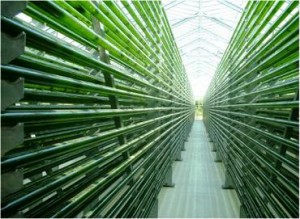
Proponents of algae biofuels have stressed its low environmental impact, reduced greenhouse gas emissions, reduced dependence on foreign oil, and utilization of marginal lands. However, a recent report from the U.S. National Research Council has found that algae biofuels cannot currently be produced on a large scale without using unsustainable amounts of energy, water, and fertilizer – exactly the kinds of impacts algae biofuel production was intended to avoid.
Notwithstanding this, the report’s authors do not write off the technology. Jen Stutsman of the Department of Energy said in a statement “[The] report outlines the need for continued research and development to make algal biofuel sustainable and cost-competitive, but it also highlights the long-term potential of this technology and why it is worth pursuing.”
Algae biofuels have received government support, such as $100 million in grants and loan guarantees to help build a plant in New Mexico, and the development of the U.S. Navy’s Green Fleet. The report indicates that continued financial investment will be necessary to reach sustainable algae biofuel production.
What policy approach makes the most sense with respect to sustainable algae biofuel production?


The little company in which I’m a partner worked for a while in algae biofuels before moving to geothermal energy. I’m a chemist and one of my partners is a geologist specializing in water issues. Our conclusions were that for algae to biofuels to succeed, potential processes must 1) find a way to separate the oil from the algae without collecting or killing the algae. That will inevitably require a genetically modified strain of algae – and we are not genetic engineers. 2) Find a way to grow algae in deep ponds. The light-absorbing properties of algae basically limit the active area to about 4″. In the desert southwest, this means that the water loss from shallow ponds is prohibitive.
Bags and enclosed reactors are of course technically feasible, but for a relatively low-value product like fuel, the economics are daunting. We have a patent on a way to grow algae in a deep bag and turn over the solution without external stirring, etc., but decided even that is not enough. In our opinion, algae-based biofuels may well be technically feasible, but it will be a long time indeed before they are economically viable.
From all I have seen, it is just too early to know whether algae biofuels could have either a significant or dominant role in producing liquid fuels, for the future time when fossil oil becomes very scarce and the technology possibilities are better known. Maybe, maybe not. Sometimes no one knows the future, and those who claim to know are stretching things or worse.
Before commenting, I did a google news search on “aurora biofuels,” and found an interesting review:
http://www.biofuelsdigest.com/biobased/2012/10/25/are-algae-based-fuels-chemicals-and-materials-sustainable/
That’s a good start — but it’s also important to remember that there are other options on the table here, such as ocean compartments as a place to grow algae, and more enclosed reactors which do not waste water through evaporation. Aurora claimed in 2009 that they already knew how to make money with crude oil at $100/barrel, by producing
and selling both “biocrude” oil and fish food. I don’t know whether that was an exaggeration — or whether they are on the path already to proving that they can. Other folks have told me that new technologies based on genetic engineering simply don’t scale up, because genes revert to normal in large scale systems — and normal means producing alcohol, not oil, as a product. **IF** we are rational enough to move quickly towards GEM flexibility in cars, I tend to suspect that cheaper forms of liquid biofuel
would dominate that market, in time, but in our present state of ignorance it is rational to hedge our bets. For cars, at least, I tend to think of diesel in general as a kind of “dodo bird” or “living fossil,” because of other options in the pipeline… but trucks and other big systems require a different analysis.