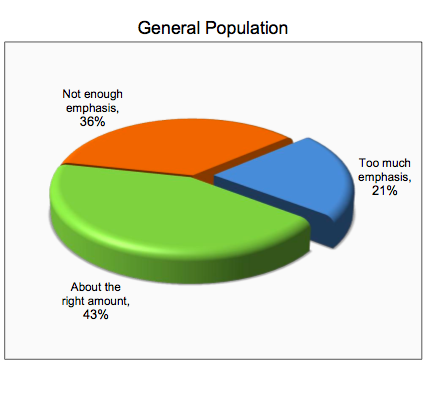
 A recently released report by VeraQuest Inc. titled “VeraGreen: A Look at American Attitudes and Behaviors on Environmental Issues,” examines how Americans view environmental issues such as global warming and the involvement of government in the private sector. The report surveyed a stratified random sample of 3,506 online respondents to be nationally representative and has an error range of 1.66% at a 95% confidence level. The study was fielded between October 3 and October 11, 2012.
Key Findings:
- 36% of respondents believe society does not put enough emphasis on environmental issues, compared to 21% that believe it’s too much emphasis.
- 51% of respondents don’t believe that global warming is an issue today.
- 36% of respondents said they will consider alternative fueled cars when they’re in the market next.
- Almost two-thirds of respondents said the government should be responsible for setting fuel efficiency standards, compared to 37% that believe it should be left to the marketplace.
- Nearly two-thirds of respondents said the government should be involved in subsidizing private companies that produce renewable forms of energy.
What, if anything, is surprising about these results? What policy directions do the numbers point towards?
The first two points seem to contradict each other. It seems that most Americans are quite supportive of protecting the environment but either don’t believe in global warming or think… Read more »
The key datum, not represented in the key findings, presumably because the question was not asked, is how much are Americans willing to pay to remediate these environmental issues? It… Read more »
Your fundamental point about the survey is spot on, Joel. More balanced surveys indicate that the willingness to pay is minimal, and concentrated among a rather limited minority of the… Read more »
Joel – excellent point about willingness to pay. Those types of surveys are wrought with problems though. The EPA has tried to use WTP (stated preference survey) in certain of… Read more »
Dawn, that’s true. But then it is very hard to design any survey that does not bias responses one way or another. My sense is that results of WTP surveys… Read more »
If willingness to pay is limited and there is little sense of urgency from climate change arguments (especially in light of current economic troubles that motivate us to postpone investments… Read more »