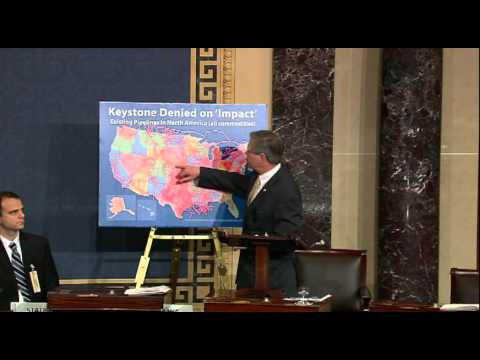
 Senate Republicans recently unveiled the “Domestic Energy and Jobs Act,” an energy bill intended “To approve the Keystone XL Pipeline, to provide for the development of a plan to increase oil and gas exploration, development, and production under oil and gas leases of Federal land, and for other purposes.” Sen. John Hoeven (R-ND), who drafted the bill, has said that Romney would offer similar legislation if elected.
Provisions of the bill would:
- Suspend U.S. EPA rules on refineries, pending a gas prices study
- Impose a minimum threshold on the amount of oil and gas leasing each year
- Reverse a Bureau of Land Management permitting reforms established under Obama
- Exempt certain offshore wind development from environmental planning requirements
- Open the National Petroleum Reserve-Alaska and the Virginia coastline to drilling
- Increase the amount of revenue states eventually will receive per year from drilling off their coasts to $750 million
- Allow TransCanada to build the northern leg of the Keystone XL Alberta-Texas crude pipeline
The bill closely resembles another by the same name that passed through the House in June. E&E News reports “The Senate bill includes virtually all pieces of the House companion, except for a provision requiring that new lands or waters be opened to drilling if the Strategic Petroleum Reserve is tapped.”
Is this bill good policy? What elements of the bill do you support or oppose?
How in the world can senators in Washington DC that are responding to lobbyists come up with these knee-jerk “energy policies” when they have no plan, no direction, no idea… Read more »
While not as egregiously ideological as HR 4480, this proposed legislation is nonetheless one more energy bill drafted by staffers with little or no knowledge of the particulars of energy… Read more »
[…] recently unveiled a similar dirty energy bill that the House GOP passed in June. Highlights of the Domestic Energy and Jobs Act(which no doubt a President Romney would rubber stamp… Read more »