According to a national survey of energy professionals jointly prepared by Sandia National Laboratories and OurEnergyPolicy.org, U.S. energy policy should simultaneously pursue energy supply security, economic outcomes, and minimized environmental impacts.
Contemporary political discourse often poses energy policymaking as a binary decision—the economy versus the environment, for example. Public opinion polls frequently support this conception, posing energy policymaking options as a zero-sum game between two opposed goals. However, does this tension in the discourse accurately reflect how policy is made? Do energy professionals — people working on energy issues daily — view U.S. energy policy in this way? How might professional insights inform energy policymaking and communications?
The findings of a national survey, The Goals of Energy Policy, show that the vast majority — more than 85% — of the 884 energy professionals surveyed prefer energy policy that pursues energy supply security, economic, and environmental goals simultaneously.
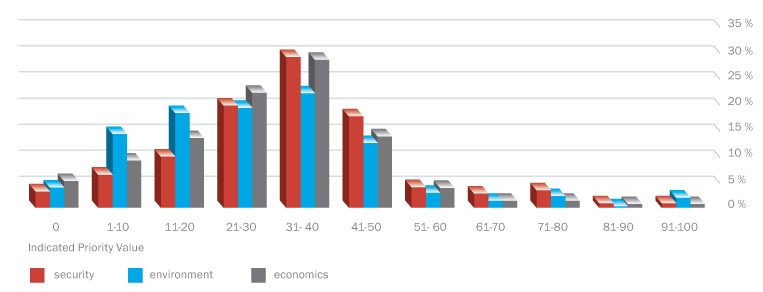
The survey asked experts to allocate 100 points, representing a 100% policymaking effort, across three commonly accepted energy policy goals: the Environment, Economics, and Energy Supply Security. The results are represented in this histogram.
The Sandia-OurEnergyPolicy.org survey asked the following questions:
How should the U.S. allocate its efforts across the following three energy policy priorities?
- Energy Supply Security: Assure a supply of energy for the U.S. that protects our national security interests.
- Economics and Job Creation: Assure a cost for energy that sustains U.S. economic stability and growth.
- Environment and Climate: Minimize the environmental impacts of energy supply, distribution and use.
Is another energy policy priority needed?
If yes, how would you allocate 100 points across the three original priorities and the fourth, self-selected priority?
Respondents included representatives of public utilities, oil and gas organizations, energy engineering groups and other energy professional and energy industry associations.
Key Findings: According to the survey’s results energy professionals rarely advocate for a single policy goal and instead generally prefer a
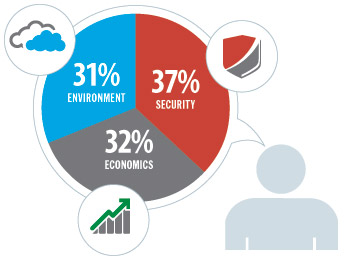
more-or-less balanced approach to the three goals. On average, respondents allocated 36.9 points to Energy Supply Security, 32.3 points to Economics and Job Creation and 30.7 points to Environment and Climate.
Just 3.1% of respondents expressed a preference for an allocation of 100 toward any one goal: 1.6% did so for the Environment, 0.8% did so for Security, and 0.7% did so for Economics. At the same time, less than 15% of respondents completely devalued a given policy goal, or gave it a value of 0.
The survey’s results also suggest significant differences across age, gender, and geographical region, which informed the survey’s overall results. However, even within these differences, a preference for a mixed portfolio of energy policy goal pursuit was typical.
Download the report here.
How do the prevailing energy policy questions of the day stack up against Environmental, Economic, and Supply Security concerns? How well do popular policy mechanisms accomplish the goals of energy policy? When have policymakers missed opportunities to communicate policy implications along the three main goals of energy policy?


I agree with this report that we could be doing a much better job on energy policy if we kept a few critical larger goals clearly in mind, and maintained a clearer trail between goals and means to achieve them. The stovepiped nature of energy policy making at all levels is a major impediment to doing as well as we could on these grand challenges.
But before we push a goal very hard, we should dwell a bit on the precise definition of the goals. Like most of the survey respondents, I would agree that security, environment and economic impacts do pretty much cover the important goals — depending on how they are viewed. I ask: “why would people want to add sustainability? Security, as in adequacy of resources, and environmental impact, already capture the bulk of what we would worry about in sustainability.” But then I think of folks who appear to aiming for zero oil imports to North America, folks who remind me of Lyndon Johnson wanting to get to the moon, without thinking hard enough about what happens after we get to that benchmark. If we think of security as SUSTAINABLY being able to keep our economy moving forwards, even after fossil energy runs out, that’s a very different goal and policy from trying to “put footprints on the moon.” More precisely — if we started to think about imports of oil to OECD as one metric of energy security, we haven’t really been precise enough; do we want to minimize the lowest one-time import number (by doing real well in 2015, say), or do we want to minimize the FUTURE sum of imports over all future years?
If the latter, how much do we discount future years?
For myself, I would advocate a metric where we really care about the future (our children and grandchildren), and think about this with zero percent real interest rates — not discounting the future at all, except to make allowances for growth in productivity.
Ideally, that would mean much higher world oil prices — but for political reasons, the best we can do involves what economists call “the theory of the second best,” developing alternative energy technologies AS IF we had such higher oil prices, but not really sending all that extra money to Saudi Arabia, considering where such money might go next. (Yet maybe in an ideal world, we WOULD make a deal for higher oil prices, with an agreement that the money goes to useful things, like real schools with female participation and not just kill-kill varieties of madressas, or to technology of use to all of humanity.)
Even for practical decision-making, I would like to see policy based on a metric which is more like a PRODUCT of resource security, environmental impact and economic impact, rather than a weighted sum (if we measure these 3 concepts in a farseeing way). The reason is that any one of the three could kill us, if we do not do well enough, soon enough.
Why does stove piping fail do badly in this area? One could write a whole book on that, easily. One aspect is what Hitch talked about in his classic book on defense budgets … how having three separate utility functions managed by three distinct agencies does not account for important cross-cutting tradeoffs. Most energy technologies DO have cross-cutting tradeoffs in all three areas, as the previous discussions on water and on climate show. Another aspect is the age-old problem of (many) middle level people both in government and corporate bureaucracies feathering their own nest and their personal constituents at the expense of those they pretend to serve.
Kudos to Sandia (as though the lab needs them) for carrying out this study. My first posting on my new blog EnergyCentrist.com sets out a set of assumptions and principles for just such a policy (http://www.energycentrist.com/2012/09/12/the-seven-principles/ ). Stay tuned for goals to follow.
As mentioned elsewhere, I applaud this effort…
This really is an interesting study, and I believe it raises some very important questions. Having worked in polling myself, I would say, no, it’s not the right kind of question at all – and furthers the kind of detachment from reality that problematizes energy discussion:
“But is this the right question? Policymaking is a balancing of priorities, not pursuing one at the expense of all others. Knowing that a percentage of the electorate values one policy goal over another, without knowing the degree of that preference or why, isn’t helpful to policymakers, isn’t moving America forward on energy, and isn’t making the national discourse on energy policy any smarter or more productive.”
– Very much agreed.
“Gender, age, and geographic distribution appear to play a role in how the energy professionals responded:”
– Yes, and it’s nice to see those discrepancies pointed out in a fairly objective way, not running away from the biases that they might cover up if left unexamined — something that many other, much more publicized polls and analyses have overlooked.
Pingback: COMMENT: “The Goals of Energy Policy” | Jesse Parent [INFLUENCE]
I am struck by the contrast between the conclusions reached in this report, which reflects many members of the scientific community, and the policies presented by the “political” community. For me, the policies expressed by the political community are much more like the extremes that The Goals of Energy Policy show to be infrequent (and are barely supported by the scientific community).
Although each candidate claims some form of “all of the above”, their energy choice distributions seem very skewed. President Obama seems to place huge emphasis on renewable energy, the phasing out of fossil fuels, and largely ignores nuclear power (Even though Dr. Jeffery Sachs, Director of Columbia University’s Earth Institute, has recently stated that dealing with climate change will require more nuclear power). Governor Romney espouses a “Drill, Baby, Drill” philosophy, basically denying the possibility of climate change is driven by anthropologic causes. I’ve read that 97% of all scientists believe that climate change is being accelerated by human activity. What if Governor Romney is wrong? The consequences could be devastating. Even if one believed that there are open questions about climate change, there are so many things that could be justifiably done in the name of greater national security (reduce oil consumption),in the name of a more efficient/economic society (use more energy conservation), and in the name of reducing public health costs ( reduce air pollution ) that significant progress in GHG reductions could be made even by non-believers. Not a hint of this prudent, no-lose, approach.
I consider this chasm between the political community and the scientific community as very dangerous. Historically, our political process has not served the nation well. Those in political power push for their ideology and foster their energy projects, only to see them cancelled when political power swings back in the other direction. This has left us with many energy bills and a ton of cancelled energy projects. Is our Democracy up to the task of solving complex, long term challenges, each of which has its own uncertainties and each of which has built-in groups ardently for and against. A quick review of energy legislation seems to say that the political process we have in the USA is not yet up to the task. Some of the past and present federal energy legislation includes:
A. The Synthetic Liquid Fuels Act of 1944
B. The Energy Policy and Conservation Act of 1975
C. The Energy Security Act of 1980
D. Alternative Motor Fuels Act of 1988
E. Energy Policy Act of 1992
F. Energy Policy Act of 2005
G. Energy Security and Independence Act of 2007
H. American Clean Energy and Security Act of 2009 (H.R. Bill 2454)
To paraphrase a famous politician, “here we go again”. I’d like to suggest some long term energy goals to our political leaders. These goals do not favor one set of energy technologies over another set and they do not offer a timetable. If anything, a plan with timetables, short and intermediate goals, and possible technology choices might only come later if there was some convergence on the long term goals.
This is what I suggest as long term goals:
• Develop a long lasting, affordable, sufficient, low carbon electric power system,
• Develop a long lasting, affordable, sufficient, low carbon sources of liquid fuels.
Our energy policy is that we have no energy policy. The reality, as with the federal debt, is not a pleasant thing to deal with. Some politicians feel that even talking about nuclear energy is politically a loser despite realizing if they believe in climate change, they need it. Some politicians believe that talking about renewables is a sure winner, realizing that their potential, even as admitted by the advocates, is limited. Using clichés such as “drill baby drill” doesn’t help the debate either.
I wish we could develop a serious energy policy but the politics of the day will always drive the direction and consistent implementation.
Andy
All politics of any day make it difficult to have a national energy policy. Excuse me for being cynical, but I have heard we need an national energy policy for as long as I have been policy cognizant, which is a pretty long time these days. Our federal government is not structured to formulate a coherent energy policy, and I included the structure of Congressional committees in this statement.
Hi Melanie, if that’s cynical, what what would you call what I usually say?! The report and this discussion by experts who wear (our) non-scientific inclinations right on (our) sleeves miss these points: national energy policy is essentially irrelevant, and how do we get the work done despite not having one? The Earth has the power to coalesce disparate thought and point to solutions with neon. Humans look inward, sideways, and backward and have proven immune to rational dialogue. This sorry species acts when past the brink, only when we are in the hospital itelf, on the battlefield in mortal danger, trying to breathe the lousy air, tasting the tainted water, or otherwise forced to look forward. We need a task list, not a policy statement, and we each need to get a shoulder to one of the wheels that will roll us away from the precipice. We make the list from the science, what I call the Earth Rules, and don’t worry so much about nation-states. What my science tells me is that there are still 100 million buildings in the US that leak conditioned air like sieves and it is science-felonious that we continue to dump unnecessary kWh’s, therms, and gallons of oil into them. Efficiency buys time. It’s cheaper and faster and more consumer-friendly than any type of new supply. It’s American and approved by Homeland Security and DOD. So I have my list, I work all day every day on scaling up the movement of insulation and weatherization and recommissioning and modern controls into as many buildings as possible, as fast as possible. I retrofit 15,000 buildings myself and now I’m getting tired and need help. Have all you energy experts tightened up all of your buildings yet? Anyway, Melanie, right on.
To my mind, you are right about the mismatch between election cycles and the goal for the country of a viable long term energy strategy. The effect of this has been particularly clear in the still-in-progress development of controlled fusion. As a result of rapid progress in its first 20 years (starting in about 1956), fusion R&D was “ready” to be boosted by the Energy Crisis of the second half of the 1970′s. This led to a 1980 Act of Congress concerned with energy that you didn’t list in your message (below):
Magnetic Fusion Energy Engineering Act of 1980 [see the Statement by President Carter]
The intent of this law began to be ignored after just a few years because the price of oil dropped like a rock during the Reagan years, leading to cutbacks and stretch-outs in funding, as happened to all government-sponsored energy research starting in the late 1980′s. As you all know, I am sure, the leadership of the United States and the USSR from 1955-1980 in scientific research on controlled fusion from the 1950′s to the 1980′s led Presidents Gorbachev and Reagan, in a November 1985 meeting in Geneva, to agree to initiate, together with the European Community and Japan, a world-wide effort to develop fusion as a practical energy source. That agreement did not keep fusion R&D budgets from falling along with other energy R&D budgets. However, in spite of the relatively low cost of oil for the next dozen years, that agreement led to the establishment of an international consortium that is now building the ITER (originally the International Toroidal Experimental Reactor, now just ITER) engineering demonstration reactor in Cadarache, France. The European Union is a 40% partner and the United States is a 9% partner (along with Russia, Japan, China, Korea and India). A disadvantage that fusion has always had relative to alternative paths to weaning ourselves off of fossil fuels, particularly oil, is that fusion requires a long term steady development program and, as we always have to remember in the United States, the term of a Congressman is 2 years, the term of a Senator is 6 years and the term of a President is either 4 or 8 years. Even the physically small (compared to ITER) “high risk” approaches being followed at present by entrepreneurs in the United States are 10 year projects. That does not seem to have deterred the Europeans, who are also pushing ahead bravely with wind and solar projects in spite of unfavorable economics.
My point in recounting all of the above is that controlled fusion R&D could lead to one of a small number of longterm large-scale energy sources that would not contribute significantly to global pollution (including global warming) nor use land that can be used for food production. Other possibilities are distributed solar, distributed wind (on land and offshore), geothermal and maybe ocean waves. Nuclear fission power as practiced in the United States (no reprocessing) has problems with both the nuclear waste and limited resources for a reasonable price, but perhaps that will change in the next 1-2 decades. ITER is now expected to cost $20 billion by the time it is done in 6-7 years. Let’s assume that is off by a factor of 2 and it is $40 billion (total for all partners). That is about 1/10 of the annual contribution to the US balance of payments deficit that results from importing oil. If the result of ITER is that we can build 1 GWe fusion reactors starting 40 years from now for $5 billion in today’s dollars and if by that time our fleet of cars is largely plug-in electric or plug-in hybrid electric, and those that aren’t can run on natural gas (powering internal combustion engines or fuel cells), then we can eliminate a large fraction of our dependence on imported oil, and we can start eliminating our dependence on burning coal and natural gas for electricity generation to run them.
To get there, we need both short term and long terms components to our energy strategy, and OurEnergyPolicy.org can, in my opinion, play an important role here. In the short term, consistent with the political cycle, we can argue for flex-fuel, hybrid electric and plug-in hybrid electric vehicles, and we can argue for a portfolio of R&D on batteries, biofuel, fuel cells, and anything else that would help reduce on a few year time scale the fraction of our energy use that involves imported oil (e.g., efficient, non-polluting liquid fuel production from natural gas). In other words, we should espouse a short and intermediate term strategy that would push us towards gradual reduction of the need for imported oil because that goal is consistent with the political cycle. However, we also have to have the long term goal of powering as much of the economy as possible, including the automotive and truck fleets, with electricity produced by whichever ones (intended to be plural) of the long-time-scale, large-scale electricity sources –
fusion, solar PV or thermal, wind, geothermal, perhaps fission with reprocessing, perhaps ocean waves – prove to be the most economically viable on a 2 decade time scale. That also needs to be presented to politicians, but in parallel with lobbying for goals that can be achieved in their 2-8 year time-horizons. The two succinct goals given at the end of your (Herschel’s) comment, could certainly be the long term, overarching, “non-partisan” goals that we espouse, along with the short and intermediate term goals. Then perhaps government visionaries will be able to present different energy plans every 2-8 years that Congress will pass, but in which the long term goals stay the same while only the short term R&D efforts change.
Thanks very much for your consideration.
Best regards,
Dave Hammer