The election is over. What comes next for energy policy?
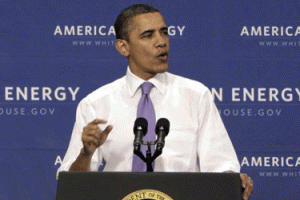
Some environmentalists have already answered that question by planning a demonstration outside the White House to press President Obama to prevent the approval of the Keystone XL pipeline. They’re also likely to push the President on continuing support for renewables and taking concrete action on climate policy.
Meanwhile, Jack Gerard, President and CEO of API, offered this take : “Right off the bat, the president can approve the Keystone Pipeline and put thousands of Americans to work immediately. He can acknowledge the effective role states are already playing in regulating oil and natural gas production and avoid the temptation to impose duplicative and unnecessary regulations on hydraulic fracturing. By following through on his own executive order to eliminate overly burdensome regulations, he can rein in EPA’s plans to impose regulatory burdens that could cost businesses hundreds of billions of dollars and chill economic growth.”
What are the most important short, medium and long-term energy policy issues the Obama administration and the 113th Congress must address going forward?


Global warming, renewable energy, shale gas, energy independence and other discussion headers should be the beginning of a ongoing process of determining courses of action that result in a better America and world. Heretofore, these topics immediately drew battle lines. If you believe that you can flip a switch and go green tomorrow, pitch a tent and don’t build camp fires. If on the other hand, if you believe that fossil fuels is the single answer, go to China and check out how good a blossoming coal-fired generation fleet is for air quality. If the recent election did nothing else, it should put an exclamation point on the need for compromise.
Unconventional recovery is enabling time to find answers and not get caught up in more geo-political catch 22s. My optimism tells me that we’re smart enough to get to work on the needed infrastructure for the transition that will lead to good answers; my pessimism tells me that the “you’re for it, we’re against it” mentality prevalent for so long is waiting in the wings. I hope we get past the attitude of being sure we know what’s right and get into a discussion to do what’s right.
In the historic words of James Carville, “It’s the economy, stupid.” The notorious “fiscal cliff” and the broader fiscal quandary the government faces are now the key to overall economic policy. And energy considerations will remain subordinate to economic conditions.
Structurally, little has changed in the elements that caused contentious gridlock in Washington for the past two years. Obama will continue to be the president, Republicans will continue to control the House, and Democrats will continue to have a majority of the Senate, but one insufficient to neuter the minority’s filibuster power.
Qualitatively, there may be some significant change though. Obama, freed of campaigning, now will be principally concerned about his legacy. And recovery from the Great Recession will that legacy’s litmus test. The GOP is, at least for the time being, abashed by the cold shower with which the voters dashed its hopes. Divided and in disarray, the Republican leadership now must worry that demography may doom the party to increasing irrelevancy. Yet the Democrats did not gain a mandate for any particular strategy beyond an unsustainable status quo.
Because a huge tax increase and draconian spending cuts will occur automatically in January, the Congress is compelled at last to act. And Obama’s veto power effectively guarantees that there will be some increased revenue in any fiscal plan.
Hovering over all are the credit markets, ready to pounce if the politicians fail to devise an action agenda that significantly defuses the ticking US deficit/debt bomb. Neither of the rhetorical proposals offered by the parties during campaign season were or are viewed as adequate.
So the short, medium, and long term prospects are that the federal government — and by extension many state and local governments — will find themselves financially strapped for years to come.
The core dilemma is that faster economic growth is needed to make the debt burden manageable. But the measures demanded to curtail the debt explosion tend to dampen economic growth. The dilemma is driven by demography: In the US and even more so in Europe, Japan, China, et al, aging populations are increasing the burden of retirement, health care, and related entitlements while limited or shrinking labor forces provide inadequate income to pay for them.
As a result, the entitlement portion of the budget — already, with debt service and other mandatory items, the majority of government spending — will increasingly cannibalize both defense and the so-called ‘discretionary’ portion. The latter, now less than a sixth of the total budget, pays for everything else the government does.
Under the circumstances, big new spending on energy initiatives is not in the offing. Even maintaining existing infrastructure — from power lines and power plants to dams, water supply, bridges, tunnels, ports, etc. — will continue to prove difficult to finance adequately.
Given the imperative for economic recovery, the public is unlikely to be tolerant of regulatory actions that curtail energy or economic development, threaten jobs, or raise costs. Despite the clamor from the Green faction, the Keystone XL pipeline will be completed and coal will be exported. The one substantially hopeful development in both energy and the economy in recent years — fracking and the great expansion of natural gas and oil supplies it is delivering — is far more likely to be encouraged than abandoned.
The one energy strategy that is both needed and feasible under the reigning fiscal and economic circumsances is to shift away from subsidies and regulatory constraints and instead to stimulate accelerated energy technology innovation to “make clean energy cheap.” With a basic restructuring of both organizational form and tactics, the accelerated innovation strategy need not impose significant additional fiscal demands. Details are in my book: http://j.mp/WXLVS9
Both of the commentaries above are spot on. Further, Lewis has given us an excellent exegesis of the REALLY urgent economic issues that will shadow energy policy for a while. There are some easily achievable goals such as approval of at least the lower portion of Keystone. That will actually have positive economic impact to the extent it begins to arbitrage out the current price disparity between Brent crude and WTI. He has captured those nicely.
By way of expanding on Ron’s thesis that both “sides” of the energy argument need to move away from hardened ideological positions, I’d like to make a list of crucial “Get Over It”s for each side. Just for purposes of discussion, with no intent to ascribe “good” or “bad” to either and far less desire to initiate an argument over taxonomy, let’s call the two sides “GREEN” and “BLACK”. There follow lists of ideas each group needs to transcend, i.e., Get Over It!
“GREENS”
1. We will not move immediately to a non-hydrocarbon energy supply. You radically underestimate the time, materials and investment required to do so. Further, the recent surplus of natural gas has done more to reduce carbon emissions than conservation and renewable energy generation combined. Stop making your ideal the enemy of all our good.
2. Yes, burning coal has always been a bad idea. Those who don’t believe that should study the air pollution in London during the Age of Coal. On the other hand, it’s far too valuable an asset to simply throw away. We need to find another use for the energy in coal. At current oil prices we should be able to convert it to liquid hydrocarbons economically, either through a Fischer-Tropsch process or, better, a newer, more efficient technology. That would reduce its carbon footprint and promote energy security. We could research and develop the latter at no additional cost if we just stop throwing away money on carbon sequestration, a modern snipe hunt of multi-billion dollar proportions.
3. Try to cultivate some understanding of economics. The concept that things get done more efficiently when the profit motive is involved is one with which you must become far more comfortable if you hope to ever be effectual.
4. Stop desiring to punish those who’s energy behavior fails what you believe to be a moral test. Your urge to punish betrays a totalitarian portion of your collective personality. That in turn severely reduces the likelihood you’ll ever attain the political stroke you so desperately desire. It is not only inappropriate, it’s counter-productive and dysfunctional as well.
BLACKS
1. Environmental pollution represents the tragedy of the commons writ large. Your desire to make more money simply is not a justification for your business having a negative impact on the health and well being of the general populace. I say this to the coal industry in particular. Your product has been recognized as deleterious to the common good for decades. Those in that industry should read #2 above and note that you are doing the most to allow “GREENS” to get away w/ #4.
2. Get your heads out of the sand – or wherever else they may be – in re anthropogenic global warming. That ship has sailed in the minds of the public. Your denial isn’t going to do anything but destroy your credibility. Further, it’s absolutely undeniable that we live in a large but constrained box that is rapidly filling up with humanity and its effluents. It’s quite obvious we’re straining the global “air conditioning”. Stop talking your book and reorient your thinking in the direction of the obvious.
3. Stop fighting your regulators. The BP Macondo blowout proved for all time that a hands-off regulatory strategy a la the Bush-43 administration is a recipe for disaster. If the “GREENS” ever ameliorate there desire to punish you guys, perhaps we could move toward the form of regulation that we need. One that has the expertise to assure a high level of protection of the human beings directly involved and the environment locally and globally, but is otherwise facilitatory.
“WE THE PEOPLE”
1. It’s going to cost you something. For longer than human history, we’ve been throwing our effluvia “out the window” to rid ourselves of it cheaply and easily. Not only has the world filled up with people, in the last few hundred years we’ve come to recognize that a large number of ills – from cholera to global warming – result from the practice. While it does save us time and money, what goes ’round comes ’round (most particularly air pollution). Improving our collective act is going to cost us something. The only debate possible is about the nature of the payments.
2. Someone’s ox or oxen will be gored, someone’s back yard will be used for construction. NIMBY has become a cultural malignancy. Somehow we need to get past it.
3. Stop being neurotic and driven by fear-mongering propaganda. Hydraulic fracturing will not destroy the Oglalla Aquifer. The relative scales of the two make it a fatuous assertion, rather like worrying that a guy with a single stick of dynamite can destroy Pike’s Peak. Yes, nuclear power has risks, but they can be managed successfully, even if TEPCO screwed up the response to the Fukushima disaster horribly. France has reached 75% of its electric power provided by nuclear plants without issue.
“ALL INVOLVED” – can we just stop hyperventilating and actually discuss issues rationally? Nah, that’s probably too much to ask.