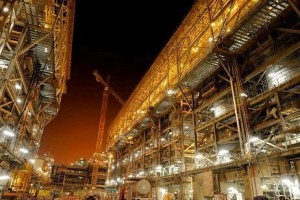
The burgeoning U.S. shale industry that has helped reduce natural gas prices to record low-levels now may benefit U.S. commuters and the transportation sector. Oxford Catalysts Group Plc and Sundrop Fuels Inc., backed by Chesapeake Energy Corp., are planning to build factories in the U.S. to make more affordable diesel, gasoline and jet fuel from cheap gas. This gas-to-liquids technology has proven successful at locations like Royal Dutch Shell’s Pearl GTL plant in Qatar, where gas feedstock prices are also relatively low.
According to Bloomberg, with access to gas at $3.89 per mmBtu, Oxford Catalysts would be able to produce premium diesel for $66 a barrel, or $1.57 a gallon, at a plant with a capacity of 1,500 barrels per day. In contrast, Oxford Catalysts estimated that producing premium diesel from oil would cost about $124 a barrel, or $2.95 a gallon.
Environmentalists, and proponents of alternative fuels, like OurEnergyPolicy.org Expert Marshall Kaplan, have proposed tactics to address the problem of how to “break open the decade-old transportation fuel market.” Are gas-to-liquids plants a solution?
Is natural gas a reliable and effective alternative fuel source to petroleum? What technical, economic and policy barriers stand in the way of producing fuel from gas?


It seems to me that while we have “miles to go and promises to keep” re. lowering ghg emissions significantly, to wait for a competitive electrically powered auto or hydro fuel cell car is strategically making the enemy of the good the perfect. We are some years away before both or either one are competitive or can be scaled up. Meanwhile, we have an opportunity through alternative fuels like natural gas and its derivative methanol to lower costs at the pump and to significantly lower ghg emissions. Alternative fuels beg for a practical working coalition between alternative fuel and renewable energy advocates.
Gas to liquids certainly is an important part of the system, but there is a risk of a HUGE waste of money and of energy if old, clumsy and inefficient technologies are used. It amazes me at times how many billions of dollars some people are willing to just throw away out of sheer inertia here.
Of course, people have known for decades how to use syngas technology to go from coal or natural gas to Fischer-Tropsch liquids, and to gasoline, or how to use simple zeolite catalysts to go from methanol to petroleum. But Catalytica (an offshoot of Exxon) showed how vast improvements in efficiency can be achieved by going directly and catalytically from natural gas to methanol. A few years ago, the BP web page had a remarkable report on their efforts to develop direct catalytic conversion all the way to crude oil… but in all cases the technology is easier and more efficient to go to methanol than it is to gasoline, either by new direct technology or by older easier but wasteful technology.
I somehow got a copy of the cost breakdowns for a new Methanex state-of-the-art plant to produce methanol from remote natural gas. The final total product costs per BTU were already a big saving over the cost of gasoline, even when gasoline was at $2.50 a gallon, using well-established syngas technology. So that generally establishes a real market niche of gas-to-liquids, for as long as gasoline is over $2.50 per gallon and natural gas lasts, but we could do better with more efficient technology.
I see an analogy here between big oil companies producing crude oil and farmers producing pure ethanol — even though BOTH could make a lot more money in the long term by producing MORE BTU from the same resource, by joining the effort to
push for cars which can use methanol as well as gasoline and ethanol. (The inexpensive GEM60 version described in the methanol policy forum 2012 would be an excellent start,
since it would allow us to get as much as 60% of our car fuel from methanol. Studies posted there did run the numbers for gas-to-crude versus gas-to-methanol.)