The OurEnergyLibrary aggregates and indexes publicly available fact sheets, journal articles, reports, studies, and other publications on U.S. energy topics. It is updated every week to include the most recent energy resources from academia, government, industry, non-profits, think tanks, and trade associations. Suggest a resource by emailing us at info@ourenergypolicy.org.
Resource Library
Search Results for "hydrogen"
21 to 30 of 266 item(s) were returned.
21 to 30 of 266 item(s) were returned.
Author(s): Rudra Kapila, Alexander Laska, and Nicholas Montoni
Publisher: Third Way
Publication Date: March 17, 2023
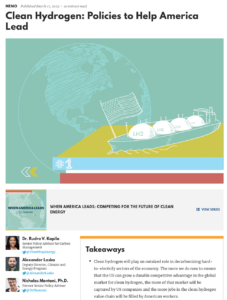
Clean hydrogen will play an outsized role in decarbonizing hard-to-electrify sectors of the economy. The more we do now to ensure that the US can grow a durable competitive advantage in the global market for clean hydrogen, the more of that market will be captured by US companies and the more jobs in the clean hydrogen value chain will be filled by American workers. Commercial diplomacy and trade policy actions are critical for US market access to European purchasers. Designing domestic regulations and incentives t0 reflect the opportunities and limitations of export markets would yield a stronger US hydrogen sales …
View Full Resource
Author(s): Hannah Boyles
Publisher: Information Technology and Innovation Foundation
Publication Date: February 21, 2023
Policymakers and the aviation industry see hydrogen as a promising low-carbon fuel for aviation. But to make hydrogen-powered flight a reality, they first need to bring down the cost of green hydrogen and overcome aircraft design challenges.
Commercial aviation accounted for roughly 2.5 percent of global carbon dioxide (CO2) emissions in 2018, and that share is expected to grow. And according to the Energy Information Administration, the aviation sector is not on track to reach the goal of net-zero emissions by 2050. Leaders in the aviation industry see hydrogen as a potential solution to addressing the climate impacts of short- …
View Full Resource
Author(s): Ben Bajema, Nick Britton, Joseph Hezir, Melanie Kenderdine, Alex Maranville, Madeline Schomburg, and Emre Gençer (MIT)
Publisher: Energy Futures Initiative
Publication Date: February 9, 2023
The U.S. Hydrogen Demand Action Plan presents a pathway to rapidly accelerate hydrogen use across regions and sectors through new policies and industrial strategies, with a focus on leveraging regional hydrogen hubs as growth engines. Recently passed federal laws—the Inflation Reduction Act (IRA) and the Bipartisan Infrastructure Law—provide unprecedented clean hydrogen support and are expected to significantly reduce clean hydrogen production costs. This Energy Futures Initiative (EFI) study shows that additional measures are necessary to get from those cost reductions to a national, commoditized clean hydrogen market, and now is the time to take action.…
View Full Resource
Author(s): World Business Council for Sustainable Development
Publisher: World Business Council for Sustainable Development
Publication Date: February 9, 2023
In a net-zero carbon emissions world in 2050, hydrogen will meet a significant portion of global energy demand, ranging from 5% to 22%, according to different organizations. Therefore, the world will require several times the quantities produced today and companies will need to produce it in a much less carbon-intense manner. Modeling shows that meeting this demand will happen through two main hydrogen production pathways: water electrolysis powered by renewable energies (otherwise known as green hydrogen) and natural gas reforming with carbon capture and storage (CCS) (otherwise known as blue hydrogen). Both will result in low levels of emissions. However, …
View Full Resource
Author(s): Erin Childs, Lily Backer, Collin Smith, Joe Goodenbery, Jennifer Gorman, Nina Hebel, Joe Walderman, Jordan Ahern, Elias Animas, Hope Fasching
Publisher: Strategen and Connecticut Green Bank
Publication Date: January 18, 2023
Clean hydrogen can play a major role in eliminating harmful greenhouse gas (GHG) emissions across the global economy as a carbon-free form of fuel and energy storage. Its versatility to provide heat, fuel, and power system services can be leveraged in multiple vital economic sectors that are challenging to decarbonize, such as aviation, maritime applications, heavy-duty trucking, and high-temperature industrial processes, among others. With numerous ways to produce hydrogen, the specific approach chosen significantly impacts the carbon intensity – the fuel’s life cycle greenhouse gas emissions per unit of fuel or energy delivered – of the hydrogen produced as well …
View Full Resource
Author(s): Yushan Lou, Zhiyuan Fan, Julio Friedmann, Anne-Sophie Corbeau, Mahak Agrawal, and Amit Khatri
Publisher: Columbia SIPA Center on Global Energy Policy
Publication Date: January 9, 2023
This report, part of the Carbon Management Initiative at the Center on Global Energy Policy, explores the current state of play for biohydrogen (Bio-H2) and its potential contribution to decarbonization efforts. The report begins with an analysis of the varying definitions and categorization of Bio-H2 in the literature, which may relate to its classification as both a hydrogen and a bioenergy with a diverse selection of sources and manufacturing pathways. Next, it assesses the crucial question of Bio-H2’s carbon intensity, which has additional specifications to those of blue hydrogen (defined as hydrogen manufactured from natural gas with carbon capture and …
View Full Resource
Author(s): Wilson Ricks, Qingyu Xu, and Jesse D. Jenkins
Publisher: Environmental Research Letters
Publication Date: January 6, 2023
Low-carbon hydrogen could be an important component of a net-zero carbon economy, helping to mitigate emissions in a number of hard-to-abate sectors. The United States recently introduced an escalating production tax credit (PTC) to incentivize production of hydrogen meeting increasingly stringent embodied emissions thresholds. Hydrogen produced via electrolysis can qualify for the full subsidy under current federal accounting standards if the input electricity is generated by carbon-free resources, but may fail to do so if emitting resources are present in the generation mix. While use of behind-the-meter carbon-free electricity inputs can guarantee compliance with this standard, the PTC could also …
View Full Resource
Author(s): Lucas Mir and Antonio Vaya Soler
Publisher: Nuclear Energy Agency, Organization for Economic Cooperation and Development (OECD)
Publication Date: January 3, 2023
Hydrogen is expected to play important roles in decarbonised energy systems, as an energy source for otherwise hard-to-electrify sectors as well as a storage vector to enhance power system flexibility. However, hydrogen is not a primary energy resource and has to be produced using different chemical processes. Water electrolysis, which uses electricity to split water molecules to extract hydrogen, is expected to become a leading solution in this context. Electrolysis will, however, only be a feasible solution if the electricity used as feedstock comes from low-carbon sources. A significant number of countries are therefore considering a role for nuclear energy …
View Full Resource
Author(s): Matteo B. Bertagni, Stephen W. Pacala, Fabien Paulot and Amilcare Porporato
Publisher: Nature Communications
Publication Date: December 13, 2022
Hydrogen (H2) is expected to play a crucial role in reducing greenhouse gas emissions. However, hydrogen losses to the atmosphere impact atmospheric chemistry, including positive feedback on methane (CH4), the second most important greenhouse gas. Here we investigate through a minimalist model the response of atmospheric methane to fossil fuel displacement by hydrogen. We find that CH4 concentration may increase or decrease depending on the amount of hydrogen lost to the atmosphere and the methane emissions associated with hydrogen production. Green H2 can mitigate atmospheric methane if hydrogen losses throughout the value chain are below 9 ± 3%. Blue H2 …
View Full Resource
Author(s): Rebecca Smith, Jessica Reichers, and Adam Schultz
Publisher: Oregon Department of Energy
Publication Date: November 15, 2022
There is unprecedented interest in hydrogen today for its potential to address climate change. This report presents the findings of the Oregon Department of Energy’s study on renewable hydrogen – what it is, how it’s made, what it might cost, and where it might best fit within the vision for a decarbonized economy in Oregon and the Pacific Northwest.
This study finds that the likeliest end uses for renewable hydrogen in Oregon by 2030 will be, in relative order of value, as a substitute for fossil hydrogen, to create high-temperature heat for industry, medium- and heavy-duty transportation, production of chemicals …
View Full Resource
Disclaimer: OurEnergyPolicy.org makes no claim as to the accuracy or quality of Resources produced by third parties.