The OurEnergyLibrary aggregates and indexes publicly available fact sheets, journal articles, reports, studies, and other publications on U.S. energy topics. It is updated every week to include the most recent energy resources from academia, government, industry, non-profits, think tanks, and trade associations. Suggest a resource by emailing us at info@ourenergypolicy.org.
Resource Library
Search Results for "infrastructure"
21 to 30 of 1075 item(s) were returned.
21 to 30 of 1075 item(s) were returned.
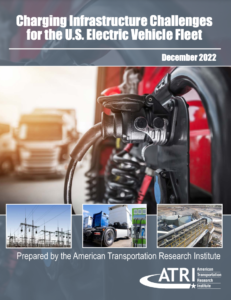
Author(s): Jeffrey Short, Alexandra Shirk, Alexa Pupillo
Publisher: American Transportation Research Institute
Publication Date: January 4, 2023
This report provides an assessment of the infrastructure needs for electrification of the U.S. vehicle fleet, with an emphasis on the trucking industry. This analysis will focus on three infrastructure components that may prove challenging for electrifying the nation’s vehicle fleet: electricity infrastructure; the infrastructure that supports battery production for electric vehicles;
and the charging infrastructure.
Transportation, which last decade overtook the electric utility sector’s place as the largest emitter of CO2, has also been in the process of shifting to new energy sources to decrease its carbon footprint. In recent decades, these alternatives have
included ethanol and biodiesel among …
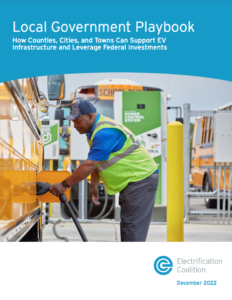
Author(s): Electrification Coalition
Publisher: Electrification Coalition
Publication Date: December 6, 2022
The Local Government Playbook contains recommendations for how counties, cities, and towns can leverage federal investments in electric vehicle infrastructure. It provides a “checklist” of actions and strategies that local governments can enact now and in the future, including best practices, innovative policy approaches, and lessons from previous charging deployments.
The Bipartisan Infrastructure Law and Inflation Reduction Act—signed by President Biden in November 2021 and September 2022—dedicate funding to establish a nationwide network of EV charging stations and incentivize EV purchases. Local governments will play an instrumental role in ensuring these funds are implemented efficiently, effectively and equitably.
The Local …
View Full Resource
Author(s): Government Accountability Office
Publisher: Government Accountability Office
Publication Date: November 17, 2022
A network of over 1,600 offshore facilities produce a significant portion of U.S. domestic oil and gas. These facilities, which rely on technology to remotely monitor and control equipment, face a growing risk of cyberattacks. A cyberattack on these facilities could cause physical, environmental, and economic harm. And disruptions to oil and gas production and transmission could affect supplies and markets.
The Department of the Interior—which is responsible for overseeing the infrastructure—has taken few steps to address cybersecurity risks. We recommended that Interior immediately develop and implement a cybersecurity strategy.…
View Full Resource
Author(s): Rayan Sud and Sanjay Patnaik
Publisher: Brookings
Publication Date: September 28, 2022
There are many obstacles to the rapid deployment of this infrastructure, but one key obstacle at the center of much debate is the federal permit process. As part of recent negotiations to secure the passage of the Inflation Reduction Act (IRA), Senator Joe Manchin made a “side deal” with Democratic leaders. In this deal, he made his critical support for the IRA contingent on passage of an energy infrastructure permit reform bill, which, among other provisions, aims to speed the processes of federal permitting by setting time limits on environmental reviews, prioritizing certain big-ticket projects, and limiting state powers in …
View Full Resource
Author(s): Bipartisan Policy Center, American Association of Blacks in Energy (AABE)
Publisher: Bipartisan Policy Center, American Association of Blacks in Energy (AABE)
Publication Date: July 30, 2022
The Infrastructure Investment and Jobs Act (IIJA), which passed Congress in 2021 with bipartisan support, makes a historic and necessary $1.2 trillion investment in modernizing America’s infrastructure. Of that total investment, nearly $400 billion will be directed to clean energy infrastructure including initiatives for transportation, power and grid systems, technology demonstration programs, modernized permitting, and climate resilience. The American Association of Blacks in Energy (AABE) and the Bipartisan Policy Center (BPC) are working together to explore the opportunities and challenges inherent in these new federal investments.
Public investment has a poor record of keeping pace with infrastructure needs, and infrastructure …
View Full Resource
Author(s): Nicole Lepre, Spencer Burget, and Lucy McKenzie
Publisher: Atlas Public Policy
Publication Date: July 30, 2022
This study was supported by Environmental Defense Fund. It is aimed at assisting transit agencies as they begin to plan for significant electrification of their bus fleets. It focuses on battery electric technologies (not fuel cell technologies) and is limited in scope to charging technologies, designs, and choices (rather than vehicle technologies, except as these impact charging).
This report incorporates learnings from 28 industry interviews completed between January and April 2022 by Atlas Public Policy staff. Interviewees are listed in Figure 1. These interviews sought to understand latest developments, challenges, solutions, and lessons learned in BEB charging, and to compile …
View Full Resource
Author(s): Zach Henkin and John Gartner
Publisher: Fuels Institute
Publication Date: July 30, 2022
The Infrastructure Investment and Jobs Act1 (IIJA or Act) establishes two funding programs for new electric vehicle (EV) infrastructure investment: the National Electric Vehicle Formula Program and the Discretionary Grant Program for Charging and Fueling Infrastructure. Depending on their locations, retail businesses may be eligible as site hosts for both programs if they meet specified conditions.
The Department of Energy (DOE) and Department of Transportation (DOT) are jointly overseeing the planning, funding, implementation, charger utilization data collection, and evaluation of these two programs. These agencies formed the Joint Office of Energy and Transportation (Joint Office), which will guide and oversee …
View Full Resource
Author(s): Ameresco
Publisher: Ameresco
Publication Date: July 25, 2022
This white paper explores ways in which government agencies, companies, and other organizations can leverage their energy infrastructure to minimize the adverse impacts of major events – in other words, to become more resilient. To date, much of the interest in resiliency has been limited to a few key sectors; however, as addressed throughout this white paper, a wide range of organizations, public and private, are beginning to understand that they can use their energy infrastructure to become more resilient in budget-sensitive ways.
With a smart approach to resiliency that integrates innovative technological solutions, contracting structures, and participation in broader …
View Full Resource
Author(s): Karina Camacho
Publisher: BlueGreenAlliance
Publication Date: July 1, 2022
This report aims to support state transportation departments to deploy NEVI Formula Program
funds in ways that contribute to a robust, reliable, and nationwide network of union-made,
installed, and maintained EV charging infrastructure, and maximize benefits for workers and
disadvantaged communities.…
Author(s): Karen Wilson, Hector Artze
Publisher: Guidehouse
Publication Date: June 30, 2022
We live in a time of immense change and swirling threats. A worldwide pandemic coupled with surging climate-related disasters and an accelerating digital transformation has concentrated minds. Resilience is no longer a niche topic for business continuity specialists but at the top of leaders’ action lists: and the time to act is now.
In this report, Guidehouse explores the key infrastructure resilience challenges that organizations face, the need to rethink old models of resilience in favor of a more holistic, evolutionary approach, and how best to create a strategy to build resilience.…
View Full Resource
Disclaimer: OurEnergyPolicy.org makes no claim as to the accuracy or quality of Resources produced by third parties.