The OurEnergyLibrary aggregates and indexes publicly available fact sheets, journal articles, reports, studies, and other publications on U.S. energy topics. It is updated every week to include the most recent energy resources from academia, government, industry, non-profits, think tanks, and trade associations. Suggest a resource by emailing us at info@ourenergypolicy.org.
Resource Library
Search Results for "hydrogen"
31 to 40 of 266 item(s) were returned.
31 to 40 of 266 item(s) were returned.

Author(s): Sharmila Jugessur, Qi Xun Low, Christiaan Gischler, Augusto Cesar Bonzi Teixeira, Carlton Thomas, Tanagna Lessey-Kelly, Analeise Ramgattie, and Marcia Maynard
Publisher: Inter-American Development Bank
Publication Date: November 12, 2022
Trinidad and Tobago is at the beginning of an exciting, yet challenging, energy transition journey as a regional energy leader and a powerhouse in petrochemicals. Its oil and gas infrastructure, including storage and export facilities, as well as operational experience gives them a head start when it comes to developing a hydrogen economy.
The energy sector already accounts for 40% of GDP and 80% of export earnings, through the production and exports of oil and gas as well as petrochemicals. This existing heritage and the associated established infrastructure provide Trinidad and Tobago with the key competitive advantage over other nations …

Author(s): Joseph Webster
Publisher: Atlantic Council
Publication Date: November 9, 2022
Climate imperatives, geopolitics, and domestic incentives are spurring widespread interest in hydrogen as a means to decarbonize industrial applications at scale in the United States. Hydrogen is abundant, can be sourced in water, and emits only water vapor and heat. Also, hydrogen can be produced wherever generation exists, allowing for siting close to demand centers and potentially reducing the need for extensive new infrastructure. Tax policy and prevailing economic forces could cause the cost of clean hydrogen to drop precipitously, placing it on equal footing with grey hydrogen in the not-so-distant future.
The US Northeast, in particular, boasts several advantages …
View Full Resource
Author(s): Megan Anderson, Andreas Jahn
Publisher: Regulatory Assistance Project
Publication Date: November 3, 2022
Clean hydrogen provides a tool that can open up new opportunities for decarbonisation. But it is just one tool, and an expensive one at that. If policymakers allow, or even support, continuation of the current ‘hydrogen rush,’ we will end up with a larger hydrogen network than needed — with high costs for consumers.
Policymakers have the right tools in their toolbox — including unbundling, transparency requirements and regulatory oversight — to ensure that hydrogen supports rather than hinders decarbonisation efforts. The regulation of the fossil gas sector provides important lessons to be considered for hydrogen regulation. Megan Anderson and …
View Full Resource
Author(s): OurEnergyPolicy
Publisher: OurEnergyPolicy
Publication Date: October 26, 2022
This event summary highlights key comments made by hydrogen expert panelists during an OurEnergyPolicy webinar that took place in October 2022. Speakers discussed technological advances, government investments, and economic trends in hydrogen’s emerging role in the energy landscape. Find the recording here.…
View Full Resource
Author(s): Martin C. Offut
Publisher: Congressional Research Service
Publication Date: October 24, 2022
Hydrogen hubs are emerging centers of activity involving hydrogen production, transport, delivery, and end use to provide modern energy services such as mobility, goods movement, heat for manufacturing processes, and other services. A future economy using hydrogen as an energy carrier and fuel could offer an alternative method to provide the many modern energy services associated with fossil fuels. In addition to providing a fuel for transportation—one of the larger applications envisaged—hydrogen can support industrial processes or building operations or can become part of the energy infrastructure by storing energy.…
View Full Resource
Author(s): Kofi Mbuk
Publisher: Carbon Tracker
Publication Date: October 20, 2022
For many decades fossil hydrogen has been an integral part of our energy society.
From being an essential component for powering the first internal combustion engine more than 200 years ago, to becoming an essential part of the modern agricultural and oil refining industry.
Since the start of the War in Ukraine natural gas prices, a major feedstock for producing fossil fuel-produced hydrogen (blue and grey), has soared by more than 70% on international markets triggering an energy crisis and pushing lawmakers worldwide to urgently source alternative sources of fuel.
Clean Hydrogen’s Place in the Energy Transition finds the surge …
View Full Resource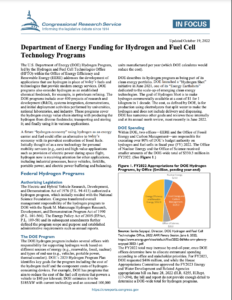
Author(s): Martin C. Offutt
Publisher: Congressional Research Service
Publication Date: October 19, 2022
The U.S. Department of Energy (DOE) Hydrogen Program, led by the Hydrogen and Fuel Cell Technologies Office (HFTO) within the Office of Energy Efficiency and Renewable Energy (EERE) addresses the development of applications that use hydrogen in place of today’s fuels and technologies that provide modern energy services. DOE programs also consider hydrogen as an established chemical feedstock, for example, in petroleum refining. The DOE programs include over 400 projects of research and development (R&D), systems integration, demonstrations, and initial deployment activities performed by universities, national laboratories, and industry. These programs cover the hydrogen energy value chain starting with producing …
View Full Resource
Author(s): Ameresco
Publisher: Ameresco
Publication Date: October 17, 2022
Renewable and clean gas options that are available today represent a tiny fraction of the overall market for fossil gas. To achieve ambitious decarbonization goals set forth by countries, states, municipalities and corporations, alternative fuels need to scale quickly.
Download this free paper to explore:
-
– Current and future market prospects for RNG, including essential policy drivers
– How RNG can complement and help drive the coming green hydrogen boom
– Benefits and long-term implications of an RNG project
– Lessons for RNG that can be drawn from the growth of solar & battery energy storage
Author(s): ICF
Publisher: American Petroleum Institute
Publication Date: October 12, 2022
Given the high level of interest in the potential use of hydrogen as part of comprehensive carbon mitigation strategies in the US and around the world, this study was conducted at the request of the American Petroleum Institute to answer the following questions:
-
• How might hydrogen fit into a low-carbon future for the US?
• What productive role could be played by hydrogen made from natural gas with carbon
capture and geologic storage (“blue hydrogen”)? • What benefits can be realized when all hydrogen supply options are on an equal footing
and receive the same incentives (on a basis
Author(s): Abbe Ramanan
Publisher: Clean Energy Group
Publication Date: October 6, 2022
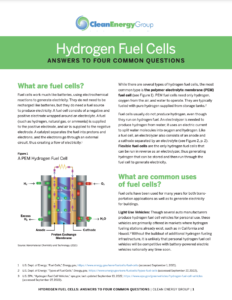
Hydrogen, and particularly green hydrogen, has been hyped as a zero-carbon, emissions free fuel. However, the only emissions-free use of green hydrogen is when it’s run through a fuel cell.
Clean Energy Group has published a fact sheet answering four commonly asked questions about fuel cells – what they are, what they can be used for, drawbacks, and potential benefits. This fact sheet will provide context for any community organizations, municipalities, or critical service providers who are considering fuel cells as a carbon-free power source.
For more information about hydrogen use in the power sector, visit www.cleanegroup.org/ceg-projects/hydrogen.…
View Full Resource
Disclaimer: OurEnergyPolicy.org makes no claim as to the accuracy or quality of Resources produced by third parties.