The OurEnergyLibrary aggregates and indexes publicly available fact sheets, journal articles, reports, studies, and other publications on U.S. energy topics. It is updated every week to include the most recent energy resources from academia, government, industry, non-profits, think tanks, and trade associations. Suggest a resource by emailing us at info@ourenergypolicy.org.
Resource Library
Search Results for "hydrogen"
41 to 50 of 267 item(s) were returned.
41 to 50 of 267 item(s) were returned.
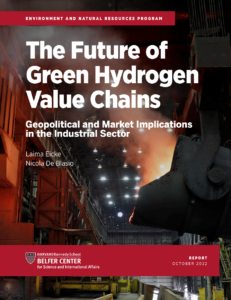
Author(s): Laima Eicke, Nicola De Blasio
Publisher: Harvard Kennedy School, Belford Center for Science and International Affairs
Publication Date: October 5, 2022
The global transition to a low-carbon economy will significantly impact existing energy value chains and transform the production to consumption lifecycle, dramatically altering interactions among stakeholders. Thanks to its versatility, green hydrogen is gaining economic and political momentum and could play a critical role in a carbon-free future. Furthermore, its adoption will be critical for decarbonizing industrial processes at scale, especially hard-to-abate ones such as steel and cement production. Overall, hydrogen demand is expected to grow by 700% by 2050 (BP, 2019). Currently, the two central challenges to green hydrogen adoption and use at scale are limited infrastructure availability and …
View Full Resource
Author(s): Sunita Satyapal, Neha Rustagi, Tomas Green, Marc Melaina, and Mariya Koleva
Publisher: US Department of Energy
Publication Date: September 30, 2022
This draft report sets forth the “DOE National Clean Hydrogen Strategy and Roadmap.” DOE will elicit stakeholder feedback through opportunities, such as workshops and listening sessions, and use this feedback to finalize the report and then develop updates as required by the BIL.
The foundation of this draft roadmap is based on prioritizing three key strategies to ensure that clean hydrogen is developed and adopted as an effective decarbonization tool and for maximum benefits for the United States. DOE will:
(1) Target strategic, high-impact uses for clean hydrogen. This will ensure that clean hydrogen will be utilized in the highest … View Full Resource
Author(s): International Energy Agency
Publisher: International Energy Agency
Publication Date: September 21, 2022
The report is an output of the Clean Energy Ministerial Hydrogen Initiative and is intended to inform energy sector stakeholders on the status and future prospects of hydrogen while also informing discussions at the Hydrogen Energy Ministerial Meeting organised by Japan. Focusing on hydrogen’s potentially major role in meeting international energy and climate goals, this year’s Review aims to help decision-makers fine-tune strategies to attract investment and facilitate deployment of hydrogen technologies while also creating demand for hydrogen and hydrogen-based fuels. It compares real-world developments with the stated ambitions of government and industry.…
View Full Resource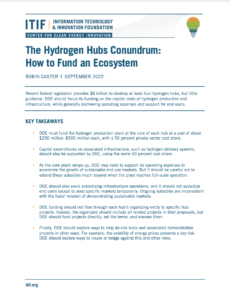
Author(s): Robin Gaster
Publisher: Information Technology and Innovation Foundation
Publication Date: September 12, 2022
In November 2021, Congress passed a massive package of direct federal investments in low carbon energy systems as part of the Infrastructure Investment and Jobs Act (IIJA). The IIJA’s inclusion of more than $20 billion to support pilot and demonstration projects was particularly noteworthy, a major step toward filling the biggest gap in the U.S. clean energy innovation ecosystem. The law also established a new office in DOE, the Office of Clean Energy Demonstrations, to oversee these projects thus address a significant gap in its management structure.
The largest program in this portfolio is the Regional Hydrogen Hubs program …
View Full Resource
Author(s): Carol Battershell, Alex Kizer
Publisher: Energy Futures Initiative
Publication Date: September 7, 2022
The Energy Futures Initiative (EFI) convened two virtual events, titled “Building the Gulf Coast Clean Hydrogen Market.” A 2.5-hour public webinar was held June 1, 2022, followed by a 1.5-hour private roundtable on June 2. The purpose of these workshops was to hear from tenured hydrogen companies in the Gulf Coast about the opportunities and challenges of leveraging the region’s infrastructure and expertise for transitioning to clean hydrogen (hydrogen that is produced with low- or zero-carbon emissions).
A major focus of the discussions centered around the economic considerations in animating additional investment in clean hydrogen. Contrasting with previous waves of …
View Full Resource
Author(s): Sean O'Brien
Publisher: POWER Magazine
Publication Date: August 31, 2022
For the growing U.S. hydrogen industry, the Inflation Reduction Act (IRA) is transformative. Today, nearly all hydrogen is produced from fossil fuels to be used as a chemical feedstock and for refining—emitting carbon dioxide in the process. Recently, thanks to state incentive programs, federal funds, and voluntary corporate commitments, clean hydrogen has been gaining ground in the U.S. for applications such as commercial transport, backup power, forklifts, and other large emerging applications at the pilot stage. Programs defined within the IRA will create a sea change: by subsidizing each step in the hydrogen value chain, the IRA snowballs the industry’s …
View Full Resource
Author(s): Alejandro Nuñez-Jimenez, Nicola De Blasio
Publisher: Harvard Kennedy School, Belford Center for Science and International Affairs
Publication Date: August 10, 2022
The Model of International Green Hydrogen Trade (MIGHTY) is an optimization model to investigate renewable hydrogen production, consumption, and trade between countries. MIGHTY supports strategic analysis by policymakers and investors about the potential roles that countries and regions will play in future renewable hydrogen markets. For this purpose, MIGHTY uses mixed-integer linear programming optimization to find the combination of domestic renewable hydrogen production and international imports that minimizes annual supply costs —which include production and transportation costs— while meeting the hydrogen demand of one country or a group of countries. This paper introduces the model and describes the model formulation, …
View Full Resource
Author(s): Nuclear Hydrogen Initiative
Publisher: Nuclear Hydrogen Initiative
Publication Date: July 30, 2022
As governments and private sector leaders consider solutions to decarbonize the global energy matrix in order to address climate change, hydrogen has increasingly emerged as one promising pathway to net-zero emissions. The world’s most abundant element is an energy carrier that can be used not only to store energy, but also to decarbonize hard-to-abate energy sectors, such as transportation, power, industry, and buildings.
The unique characteristics of nuclear energy allow it to pair with low-cost, high efficiency hydrogen production processes which facilitates nuclear hydrogen production’s economic competitiveness. In this way, nuclear energy can be a catalyst for a clean hydrogen …
View Full Resource
Author(s): Joseph Majkut, Jane Nakano, Mathias Zacarias
Publisher: Center for Strategic and International Studies
Publication Date: July 30, 2022
In the Infrastructure Investment and Jobs Act (IIJA), the U.S. Congress authorized the creation of Regional Clean Hydrogen Hubs (H2Hubs) to address the multiple challenges facing this nascent industry. In the United States, there is presently little production of low-emissions hydrogen, few users, and almost no linkages between them. To solve these challenges, the legislation calls for each H2Hub to establish “a network of clean hydrogen producers, potential clean hydrogen consumers, and connective infrastructure located in close proximity” to demonstrate the production, processing, storage, transportation, and use of clean hydrogen.
In Spring 2022, the CSIS Energy Security and Climate Change …
View Full Resource
Author(s): Sverre Alvik, Onur Özgün et al.
Publisher: DNV
Publication Date: July 1, 2022
Discover DNV’s forecast for a most likely hydrogen future to mid-century, across production, transport, and end use. Get insights into factors crucial to scaling hydrogen, including policy, regulations, safety, and investment.
DNV’s first dedicated hydrogen forecast to 2050 provides new and expanded hydrogen findings from our Energy Transition Outlook model – exploring the outlook globally, regionally, and by sector. We combine this with the knowledge we have gained in our projects, research and development.
We find that hydrogen is essential to a clean energy future, but many questions remain around hydrogen’s large-scale use as an energy carrier. We explore these …
View Full Resource
Disclaimer: OurEnergyPolicy.org makes no claim as to the accuracy or quality of Resources produced by third parties.