The OurEnergyLibrary aggregates and indexes publicly available fact sheets, journal articles, reports, studies, and other publications on U.S. energy topics. It is updated every week to include the most recent energy resources from academia, government, industry, non-profits, think tanks, and trade associations. Suggest a resource by emailing us at info@ourenergypolicy.org.
Resource Library
Search Results for "infrastructure"
41 to 50 of 1074 item(s) were returned.
41 to 50 of 1074 item(s) were returned.
Author(s): Philip B. Jones
Publisher: Alliance for Transportation Electrification
Publication Date: January 21, 2022
The Alliance for Transportation Electrification (“ATE” or the “Alliance”) is pleased to offer these comments in response to the Request for Information posted by the Federal Highway Administration on November 29, 2021 (Federal Register, Vol. 86, No. 226, Page 67783) opening Docket No. FHWA-2021-0022. This proceeding results from passage by Congress of the Infrastructure Investment and Jobs Act (IIJA), or Public Law 117-58 on November 15, 2021, and in particular, the National Electric Vehicle Formula Program (EV Charging Program), providing funding to States to strategically deploy EV charging infrastructure and to establish an interconnected network to facilitate data collection, access, …
View Full Resource
Author(s): Paul Angelone, Scarlett Collier
Publisher: Urban Land Institute
Publication Date: January 12, 2022
Infrastructure, land use, and real estate development are intrinsically linked. Over the coming
years, U.S. communities face many challenges that will be difficult to manage, including a lack of housing affordability, entrenched inequities in the built environment, and a changing climate. These issues are compounded by the combined challenge of maintaining current infrastructure while needing to invest in forward-looking infrastructure.
As the United States prepares to make the largest infrastructure investment in a generation, an opportunity exists for ULI members and key partners to identify and promote more equitable and resilient infrastructure investments that create both long-term …
View Full Resource
Author(s): Abby Brown, Johanna Levene, Alexis Schayowitz, Emily Klotz
Publisher: National Renewable Energy Laboratory (NREL)
Publication Date: December 30, 2021
The U.S. Department of Energy’s Alternative Fueling Station Locator contains information on public and private nonresidential alternative fueling stations in the United States and Canada and currently tracks ethanol (E85), biodiesel, compressed natural gas, electric vehicle (EV) charging, hydrogen, liquefied natural gas, and propane stations. Of these fuels, EV charging continues to experience rapidly changing technology and growing infrastructure. This report provides a snapshot of the state of EV charging infrastructure in the United States in the second calendar quarter of 2021 (Q2). Using data from the Station Locator, this report breaks down the growth of public and private charging …
View Full Resource
Author(s): Jeffrey Pillon
Publisher: National Association of State Energy Officials (NASEO)
Publication Date: December 23, 2021
Electricity is essential for the operation of virtually all other critical sectors, such as water, telecommunications, natural gas, transportation, and petroleum products. Further, in many cases each of these other vital sectors are critical to the generation and operation of the electric grid. During a power outage caused by a human or natural disaster, impacts are not limited to one sector, and the resulting economic and human consequences ripple across multiple sectors and impact the lives and livelihoods of not only the community affected by the disaster, but oftentimes neighboring communities and states as well.
This report explores the importance …
View Full Resource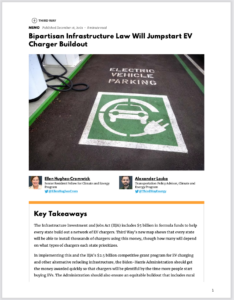
Author(s): Ellen Hughes-Cromwick, Alexander Laska
Publisher: Third Way
Publication Date: December 16, 2021
The Infrastructure Investment and Jobs Act (IIJA) includes $5 billion in formula funds to help every state build out a network of EV chargers. Third Way’s new map shows that every state will be able to install thousands of chargers using this money, though how many will depend on what types of chargers each state prioritizes.
In implementing this and the IIJA’s $2.5 billion competitive grant program for EV charging and other alternative refueling infrastructure, the Biden-Harris Administration should get the money awarded quickly so that chargers will be plentiful by the time more people start buying EVs. The Administration …
View Full Resource
Author(s): Devashree Saha, Greg Carlock, Rajat Shrestha, John Feldmann, Haley Leslie-Bole
Publisher: World Resources Institute (WRI)
Publication Date: December 15, 2021
Decarbonizing the U.S. economy to achieve a 50–52% reduction in greenhouse gas emissions by 2030 and net-zero emissions by midcentury will require the accelerated deployment of existing low-carbon technologies as well as new technologies that are not yet commercially available. Furthermore, even as low-carbon technologies continue to become more cost-competitive, their pace of deployment needs to increase rapidly. Federal policies and investments are needed to drive technology deployment and market transformation, change consumer behavior, and encourage investment in infrastructure and key technologies needed for a net-zero economy. This working paper identifies near-term policies and federal investments that can catalyze emissions …
View Full Resource
Author(s): Justin Gundlach
Publisher: Institute for Policy Integrity at the New York University School of Law
Publication Date: December 13, 2021
This policy brief highlights Infrastructure Investment and Jobs Act (IIJA) provisions that are relevant to transmission siting, summarizes the changes they effectuate, and describes important implications of those changes for efforts to develop more interstate transmission capacity. It then offers a brief assessment of the IIJA’s overarching significance to such efforts, including by comparing them to a more ambitious legislative alternative.…
View Full Resource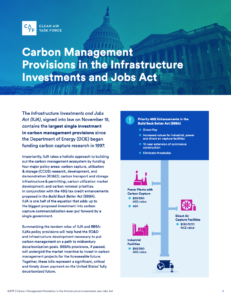
Author(s): Clean Air Task Force
Publisher: Clean Air Task Force
Publication Date: December 10, 2021
The Infrastructure Investments and Jobs Act (IIJA), signed into law on November 15, contains the largest single investment in carbon management provisions since the Department of Energy (DOE) began funding carbon capture research in 1997.
Importantly, IIJA takes a holistic approach to building out the carbon management ecosystem by funding four major policy areas: carbon capture, utilization & storage (CCUS) research, development, and demonstration (RD&D); carbon transport and storage infrastructure & permitting; carbon utilization market development; and carbon removal priorities.
In conjunction with the 45Q tax credit enhancements proposed in the Build Back Better Act (BBBA), IIJA is one half …
View Full Resource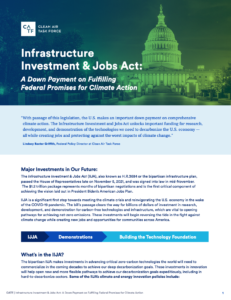
Author(s): Clean Air Task Force
Publisher: Clean Air Task Force
Publication Date: November 15, 2021
The Infrastructure Investment & Jobs Act (IIJA), also known as H.R.3684 or bipartisan infrastructure plan, passed the House of Representatives late on November 5, 2021, and was signed into law in mid-November. The $1.2 trillion package represents months of bipartisan negotiations and is the first critical component of achieving the vision laid out in President Biden’s American Jobs Plan.
IIJA is a significant first step towards meeting the climate crisis and reinvigorating the U.S. economy in the wake of the COVID-19 pandemic. The bill’s passage clears the way for billions of dollars of investment in research, development, and demonstration for …
View Full Resource
Author(s): Advanced Energy Economy
Publisher: Advanced Energy Economy
Publication Date: November 15, 2021
…
View Full Resource
Disclaimer: OurEnergyPolicy.org makes no claim as to the accuracy or quality of Resources produced by third parties.