The OurEnergyLibrary aggregates and indexes publicly available fact sheets, journal articles, reports, studies, and other publications on U.S. energy topics. It is updated every week to include the most recent energy resources from academia, government, industry, non-profits, think tanks, and trade associations. Suggest a resource by emailing us at info@ourenergypolicy.org.
Resource Library
Search Results for "hydrogen"
51 to 60 of 266 item(s) were returned.
51 to 60 of 266 item(s) were returned.
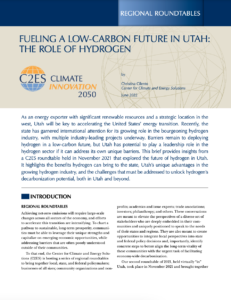
Author(s): Christina Cilento
Publisher: Center for Climate and Energy Solutions
Publication Date: June 30, 2022
As an energy exporter with significant renewable resources and a strategic location in the west, Utah will be key to accelerating the United States’ energy transition. Recently, the state has garnered international attention for its growing role in the bourgeoning hydrogen industry, with multiple industry-leading projects underway. Barriers remain to deploying hydrogen in a low-carbon future, but Utah has potential to play a leadership role in the hydrogen sector if it can address its own unique barriers. This brief provides insights from a C2ES roundtable held in November 2021 that explored the future of hydrogen in Utah. It highlights the …
View Full Resource
Author(s): Jane Nakano
Publisher: Center for Strategic and International Studies
Publication Date: June 30, 2022
Large energy consumers in the Indo-Pacific region and their traditional energy suppliers are examining the potential role of clean hydrogen in energy systems as well as their own potential roles in hydrogen supply chains. Several Asian governments are leading the charge in creating a clean hydrogen economy by releasing and executing hydrogen strategies and funding new projects, while others are beginning to articulate visions and strategies.
This report surveys national visions and strategies of leading Asian economies and their traditional energy suppliers and presents key implications of clean hydrogen development in the Indo-Pacific region. The report further offers recommendations on …
View Full Resource
Author(s): McKinsey & Company, Center for Houston's Future, Greater Houston Partnership, Houston Energy Transition Initiative
Publisher: McKinsey & Company, Center for Houston's Future, Greater Houston Partnership, Houston Energy Transition Initiative
Publication Date: June 2, 2022
Around the world, governments are recognizing the importance of clean hydrogen in building an energy system to reach net-zero carbon emissions. As of October 2021, 17 governments had published hydrogen strategies and more than 20 were in the process of developing strategies. The US Department of Energy (DOE) has declared clean hydrogen crucial to achieving President Biden’s goals of a 100 percent clean electrical grid by 2035 and net-zero carbon emissions by 2050.
The current economics of clean-hydrogen production and distribution do not currently support large-scale adoption by customers to replace lower-cost, higher-carbon-intensity alternatives. Regional hydrogen hubs have the potential …
View Full Resource
Author(s): Mason Hamilton, Allyson Cutright, Anne-Sophie Corbeau
Publisher: International Energy Forum (IEF)
Publication Date: June 2, 2022
Interest and momentum surrounding hydrogen has grown in recent years, but the idea of using hydrogen as an energy carrier is not new – it has come in and out of fashion since the 1970s. Yet, despite decades of interest and research, there are still many obstacles to overcome for the hydrogen market to scale–up.
Currently, hydrogen accounts for only ~1% of the energy mix, is predominately produced using unabated fossil fuels, and is mainly used on–site where it is produced. For hydrogen to play a role in the …
View Full Resource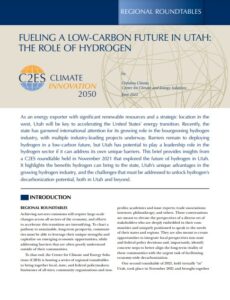
Author(s): Christina Cilento
Publisher: Center for Climate and Energy Solutions
Publication Date: June 1, 2022
As an energy exporter with significant renewable resources and a strategic location in the west, Utah will be key to accelerating the United States’ energy transition. Recently, the state has garnered international attention for its growing role in the bourgeoning hydrogen industry, with multiple industry-leading projects underway. Barriers remain to deploying hydrogen in a low-carbon future, but Utah has potential to play a leadership role in the hydrogen sector if it can address its own unique barriers. This brief provides insights from a C2ES roundtable held in November 2021 that explored the future of hydrogen in Utah. It highlights the …
View Full Resource
Author(s): International Renewable Energy Agency (IRENA)
Publisher: International Renewable Energy Agency (IRENA)
Publication Date: May 25, 2022
Hydrogen is an essential component of a net-zero energy system and has a key role to play in decarbonizing sectors that are difficult to electrify, such as heavy industry and long-haul transport.
Vast green hydrogen potential exists around the world, equating to more than 20 times global primary energy demand in 2050. However, the potential within specific countries or regions depends on the land available.
This report estimates the potential for green hydrogen production as a function of land availability, considering exclusion zones such as protected areas, forests, wetlands, urban centers, slope and water scarcity. It forms part of a …
View Full Resource
Author(s): International Renewable Energy Agency (IRENA)
Publisher: International Renewable Energy Agency (IRENA)
Publication Date: May 10, 2022
Electrolysis of water, using renewable electricity, is the sustainable option to produce green hydrogen as an attractive low-carbon energy carrier. To respond to the growing demand for renewables-based hydrogen, an extraordinary expansion of the market for electrolyzers is needed linked to a significant capacity increase in the manufacture and deployment of electrolyzers. A rapid reduction in electrolyzer system costs is essential and technology innovation is crucial to this end.
According to IRENA, investment costs for electrolyser plants can be reduced by 40% in the short term and 80% in the long term through key strategies such as improved electrolyser design …
View Full Resource
Author(s): International Renewable Energy Agency (IRENA)
Publisher: International Renewable Energy Agency (IRENA)
Publication Date: April 29, 2022
Hydrogen can be transported over long distances by pipeline or by ship. This report compares the transport of hydrogen by pipeline as compressed gaseous hydrogen with three forms used in shipping pathways: ammonia, liquid hydrogen and liquid organic hydrogen carriers (LOHC). The focus is on hydrogen transport rather than the transport of commodities made using hydrogen, noting that ammonia can be both a hydrogen carrier and directly used as a feedstock or fuel for different applications. Carbon-containing carriers (such as methanol or methane) are excluded.
This is part of a report trilogy focusing on global hydrogen trade in a 1.5°C …
View Full Resource
Author(s): Thomas Koch Blank, Patrick Molloy, Kaitlyn Ramirez, Alexandra Wall, and Tessa Weiss
Publisher: Rocky Mountain Institute (RMI)
Publication Date: April 13, 2022
Hydrogen has an essential role to play in the global effort to decarbonize the economy. How big a piece in the puzzle it is and where it best fits are two questions top of mind for business leaders and policymakers. To help inform this discussion, RMI will be publishing a new article series to help dispel misinformation about hydrogen. To start us off, this article explains what hydrogen is and where it can fit in the energy system.…
View Full Resource
Author(s): Nick Connell, Janice Lin, Dr. Laura Nelson, Lily Backer, Jennifer Gorman, Todd Zeranski, Erin Childs, Jake Bartell, Melanie Davidson, Jordan Ahern, and Eliasid Animas
Publisher: Green Hydrogen Coalition
Publication Date: April 11, 2022
The Green Hydrogen Guidebook is designed to increase understanding of green hydrogen production and distribution, safety, applications and use cases, value proposition, barriers and challenges, policy and regulatory drivers, and recommendations for market acceleration.
Most importantly, the Guidebook offers a vision for a green hydrogen future and details inspiring global examples of large-scale projects already underway.…
View Full Resource
Disclaimer: OurEnergyPolicy.org makes no claim as to the accuracy or quality of Resources produced by third parties.