The OurEnergyLibrary aggregates and indexes publicly available fact sheets, journal articles, reports, studies, and other publications on U.S. energy topics. It is updated every week to include the most recent energy resources from academia, government, industry, non-profits, think tanks, and trade associations. Suggest a resource by emailing us at info@ourenergypolicy.org.
Resource Library
Search Results for "infrastructure"
51 to 60 of 1078 item(s) were returned.
51 to 60 of 1078 item(s) were returned.

Author(s): Domingos Silva-Matos, Joerg Hartmann, Margaret Trias, Pedro Manso
Publisher: International Hydropower Association
Publication Date: October 28, 2021
Hydropower infrastructure can have significant implications for public and environmental safety, and it is important to ensure that any opportunities and risks are managed effectively throughout a project’s life cycle.
IHA’ new guide on Hydropower Infrastructure Safety can help developers and operators manage the impacts of hydropower development.…
View Full Resource
Author(s): Philip Rossetti
Publisher: Day One Project
Publication Date: October 13, 2021
With the Biden-Harris Administration and Congress together pursuing major infrastructure investments, there is an important question as to how best maximize potential economic and environmental benefits of new infrastructure. Reforming the National Environmental Policy Act (NEPA) is one of the most straightforward and impactful ways to do so. Currently, many major infrastructure projects are delayed due to significant, NEPA-mandated requirements for environmental-impact review. Such delays are frequently exacerbated by vague statutory requirements and exceptional litigation risks. Updated guidance for environmental reviews under NEPA, coupled with strategic judiciary reforms, could expedite infrastructure approval while improving environmental outcomes.…
View Full Resource
Author(s): Megan Mahajan, Robbie Orvis
Publisher: Energy Innovation
Publication Date: October 12, 2021
The Build Back Better Act currently moving through the House reconciliation process is poised to be the most significant climate legislation in United States history. To help understand its impacts, Energy Innovation modeled multiple climate provisions of the BBB and the Infrastructure Investment and Jobs Act, referred to together as the “Infrastructure Bills,” using the Energy Policy Simulator. The modeling finds the Infrastructure Bills would cut annual emissions 1,067 MMT to 1,510 MMT and reach 70 to 85 percent clean electricity by 2030. If a Clean Electricity Performance Program is not included, emissions reductions fall to just 854 to …
View Full Resource
Author(s): Oil Change International
Publisher: Oil Change International
Publication Date: October 12, 2021
U.S. President Joe Biden can prevent from entering into service or halt with executive action two dozen United States fossil fuel infrastructure projects — including the Line 3, Dakota Access, and Mountain Valley Pipelines — which would significantly increase U.S. GHG emissions if completed or allowed to continue operation. If the Biden Administration does not stop these fossil fuel infrastructure projects, it will be much more difficult to meet its domestic and global climate goals.
Our research finds that the 24 projects analyzed would release combined annual greenhouse gas pollution equivalent to approximately 20% of 2019 U.S. emissions. This total …
View Full Resource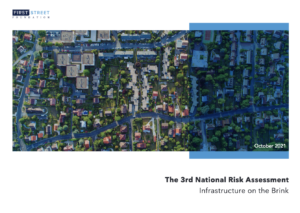
Author(s): First Street Foundation
Publisher: First Street Foundation
Publication Date: October 12, 2021
Changing environmental conditions are driving worsening flood events, with consequences for counties, cities, towns, and local communities. Individuals whose homes were spared the impact of a particular flood event are increasingly likely to find their local roads, businesses, critical infrastructure, utilities, or emergency services affected by flooding, indirectly threatening their quality of life, safety, and wellbeing. A truly comprehensive understanding of individual flood risk from a changing climate must therefore consider the resiliency of local communities to flood, and determine the extent to which physical and soft infrastructure are at risk.
This report will provide the first ever nation-wide understanding …
View Full Resource
Author(s): Linh Nguyen, David M. Hart
Publisher: Information Technology & Innovation Foundation (ITIF)
Publication Date: September 22, 2021
The Infrastructure Investment and Jobs Act (IIJA), bipartisan legislation that passed the Senate in August and is slated to be voted on by the House of Representatives in late September, presents a major opportunity to accelerate clean energy and climate innovation. It would go far toward rebalancing the research, development, and demonstration (RD&D) portfolio of the U.S. Department of Energy (DOE), so that it tackles deep decarbonization challenges that have largely been neglected in the past.
This rebalancing would be consistent with the recommendations of Energizing America: A Roadmap to Launch a National Energy Innovation Mission, which the Information …
View Full Resource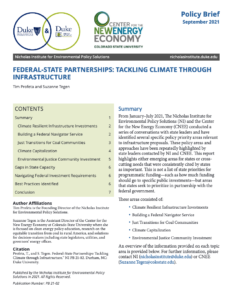
Author(s): Tim Profeta, Suzanne Tegen
Publisher: Nicholas Institute for Environmental Policy Solutions (NI), Center for the New Energy Economy (CNEE)
Publication Date: September 21, 2021
From January–July 2021, The Nicholas Institute for Environmental Policy Solutions (NI) and the Center for the New Energy Economy (CNEE) conducted a series of conversations with state leaders and have identified several specific policy priority areas relevant to infrastructure proposals. These policy areas and approaches have been repeatedly highlighted by state leaders contacted by NI and CNEE. This report highlights either emerging areas for states or cross-cutting needs that were consistently cited by states as important. This is not a list of state priorities for programmatic funding—such as how much funding should go to specific public investments—but areas that states …
View Full Resource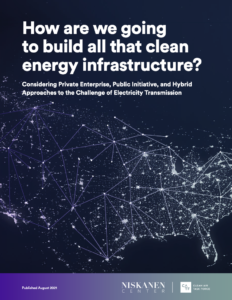
Author(s): Liza Reed, Leslie Abrahams, Armond Cohen, Joseph Majkut, Bruce Phillips, Andrew Place, Julia Prochnik
Publisher: Clean Air Task Force, Niskanen Center
Publication Date: August 23, 2021
Most analyses find that to manage climate change, the United States will need to double or triple the size of its electric transmission system to move low-cost wind and solar energy around the nation and back it up with always-on power plants. But new report from Clean Air Task Force and the Niskanen Center finds that the current piecemeal, project-by-project approach to expanding U.S. electricity transmission won’t get us there. It instead calls for a new system to rapidly scale capacity — including by potentially establishing a National Transmission Organization that would plan, site, and fund a national grid to… View Full Resource
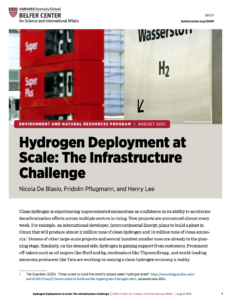
Author(s): Nicola De Blasio, Fridolin Pflugmann, Henry Lee
Publisher: Belfer Center for Science and International Affairs at the Harvard Kennedy School
Publication Date: August 13, 2021
Clean hydrogen is experiencing unprecedented momentum as confidence in its ability to accelerate decarbonization efforts across multiple sectors is rising. New projects are announced almost every week. For example, an international developer, Intercontinental Energy, plans to build a plant in Oman that will produce almost 2 million tons of clean hydrogen and 10 million tons of clean ammonia.1 Dozens of other large-scale projects and several hundred smaller ones are already in the planning stage. Similarly, on the demand side, hydrogen is gaining support from customers. Prominent off-takers such as oil majors like Shell and bp, steelmakers like ThyssenKrupp, and …
View Full Resource
Author(s): Jeremy Rifkin
Publisher: TIR Consulting Group, LLC
Publication Date: July 29, 2021
We are on the cusp of a Third Industrial Revolution. The digitized broadband Communication Internet is converging with a digitized Continental Electricity Internet, powered by solar and wind electricity, and a digitized Mobility and Logistics Internet made up of autonomous electric and fuel-cell vehicles, powered from the electricity internet. These three internets are continuously being fed data from sensors embedded across society that are monitoring activity of all kinds in real time, from ecosystems, agricultural fields, warehouses, road systems, factory production lines, retail stores, and especially from the residential, commercial, and institutional building stock, allowing humanity to more efficiently manage, …
View Full Resource
Disclaimer: OurEnergyPolicy.org makes no claim as to the accuracy or quality of Resources produced by third parties.