The OurEnergyLibrary aggregates and indexes publicly available fact sheets, journal articles, reports, studies, and other publications on U.S. energy topics. It is updated every week to include the most recent energy resources from academia, government, industry, non-profits, think tanks, and trade associations. Suggest a resource by emailing us at info@ourenergypolicy.org.
Resource Library
Search Results for "grid reliability"
1 to 10 of 257 item(s) were returned.
1 to 10 of 257 item(s) were returned.
Author(s): Juan Pablo Carvallo, Natalie Mims Frick, and Lisa Schwartz
Publisher: Science Direct
Publication Date: July 25, 2023
Grid reliability and resilience are foundational to meeting electricity needs and have significant economic and societal impacts. Energy efficiency can help meet grid reliability objectives and improve resilience, but metrics and methods used today may not fully recognize these benefits. This paper explains how existing planning processes for bulk power and distribution systems capture the impact of energy efficiency on power system reliability and resilience, with illustrative examples. We identify limitations in using existing reliability and resilience metrics to quantify efficiency and other distributed energy resource (DER) benefits. The paper concludes with opportunities for regulators and utilities to enhance planning …
View Full Resource
Author(s): Jill W. Moraski,Natalie D. Popovich, and Amol A. Phadke
Publisher: Nature Energy
Publication Date: June 12, 2023
This paper examine the potential to use the US rail system as a nationwide backup transmission grid over which containerized batteries, or rail-based mobile energy storage (RMES), are shared among regions to meet demand peaks, relieve transmission congestion and increase resilience. We find that RMES is a feasible reliability solution for low-frequency, high-impact events and quantify its cost effectiveness relative to reliability-driven investments in transmission infrastructure and stationary capacity. Compared to new transmission lines and stationary battery capacity, deploying RMES for such events could save the power sector upwards of US$300 per kW-year and US$85 per kW-year, respectively. While no …
View Full Resource
Author(s): Juan Pablo Carvallo, Natalie Mims Frick, Lisa Schwartz
Publisher: Energy Policy
Publication Date: July 25, 2022
Grid reliability and resilience are foundational to meeting electricity needs and have significant economic and societal impacts. Energy efficiency can help meet grid reliability objectives and improve resilience, but metrics and methods used today may not fully recognize these benefits. This paper explains how existing planning processes for bulk power and distribution systems capture the impact of energy efficiency on power system reliability and resilience, with illustrative examples. We identify limitations in using existing reliability and resilience metrics to quantify efficiency and other distributed energy resource (DER) benefits. The paper concludes with opportunities for regulators and utilities to enhance planning …
View Full Resource
Author(s): Alexandra Klass, Josh Macey, Shelley Welton, and Hannah Wiseman
Publisher: Kleinman Center for Energy Policy at the University of Pennsylvania
Publication Date: March 20, 2024
The U.S. electric grid is under strain, with blackouts on the rise and the system’s reliability more frequently tested than ever before in the face of more frequent storms, heat waves, hurricanes, and the like. In diagnosing the causes of diminishing grid reliability, policymakers and experts have pointed to aging grid infrastructure, growing cyber threats, more natural disasters and weather extremes, and overreliance on renewable energy—such as solar and wind.
This white paper argues that the primary cause of our unreliable grid is not the changing energy mix but rather a failure of grid governance. The grid governance system consists …
Author(s): Julia Matevosyan
Publisher: Energy Systems Integration Group
Publication Date: March 15, 2023
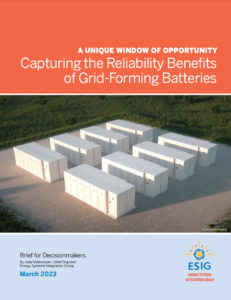
Implementing grid-forming (GFM) controls on new battery storage systems has the potential to increase grid reliability at low cost. As of 2021, interconnection queues in the United States contained an estimated 427 GW of battery storage capacity that, in the absence of incentives or requirements for GFM controls, will be built with conventional grid-following (GFL) controls. Some of these batteries will be deployed in weak grid areas already dominated by GFL inverter-based resources (IBRs) (wind, solar, and battery storage). Power export capability from these areas may already be limited due to stability concerns, and the integration of additional GFL IBRs …
View Full Resource
Author(s): Applied Economics Clinic, Clean Energy Group
Publisher: Applied Economics Clinic, Clean Energy Group
Publication Date: December 2, 2021
Winter electric peaking capacity (called “winter reliability” in New England) provides an important value
to the electric grid by helping to avoid winter blackouts. As heating and transportation are increasingly
electrified to meet climate goals, winter peak energy needs will grow; and as fossil–fueled generators are
phased out due to emissions caps, new, clean sources of winter peaking capacity will need to be found.
Although winter peaking capacity has traditionally been provided by gas and oil peaking generators
(peaker plants), it can also be provided by cleaner, “behind–the–meter” customer …

Author(s): Rob Gramlich
Publisher: American Council on Renewable Energy (ACORE), Grid Strategies LLC
Publication Date: November 23, 2021
The controversial topic of resource adequacy (RA) is undergoing fundamental reassessment to
function properly with the future resource mix. This report integrates legal, technical, economic, and institutional considerations into a set of recommendations. We evaluate some of the main RA approaches and offer ways for each of them to be improved to better function with the future resource mix.…
Author(s): Kiera Zitelman
Publisher: National Association of State Energy Officials (NASEO), National Association of Regulatory Utility Commissioners (NARUC)
Publication Date: January 14, 2021
Customers choose to install microgrids based on a wide range of motivations, which often include increasing reliability and resilience, decreasing electricity costs, expanding access to clean energy, and/or providing power to remote communities (e.g., when extending the existing transmission/distribution grid is infeasible or too costly). Customer motivations are not mutually exclusive; in fact, customers often have multiple motivations for installing a microgrid, such as increasing renewable generation while improving reliability and resilience. This paper cites numerous examples of operational microgrids across the country that represent one or more of these objectives.…
View Full Resource
Author(s): Energy Systems Integration Group (ESIG), GridLab
Publisher: Energy Systems Integration Group (ESIG), GridLab
Publication Date: May 11, 2020
This fact sheet examines maintaining reliability in power grids with high levels of wind and solar energy.
The power system is evolving quickly as increasing numbers of countries, states, and utilities set 100 percent renewable or 100 percent carbon-free goals. Responding to a number of technical considerations for operating a power grid with increasing levels of renewable generation, system planners, system operators, and utilities are developing innovative ways to increase the flexibility and maintain the reliability of a cleaner power system.
Two aspects of wind and solar generation that call for changes to power system operation are their variability and …
View Full Resource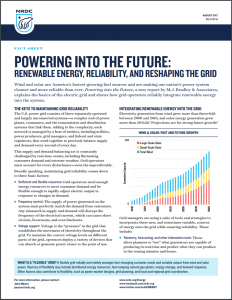
Author(s): John Moore
Publisher: Natural Resources Defense Council
Publication Date: August 1, 2017
Wind and solar are America’s fastest-growing fuel sources and are making our nation’s power system cleaner and more reliable than ever. Powering into the Future, a new report by M.J. Bradley & Associates, explains the basics of the electric grid and shows how grid operators reliably integrate renewable energy into the system.…
View Full Resource
Disclaimer: OurEnergyPolicy.org makes no claim as to the accuracy or quality of Resources produced by third parties.