The OurEnergyLibrary aggregates and indexes publicly available fact sheets, journal articles, reports, studies, and other publications on U.S. energy topics. It is updated every week to include the most recent energy resources from academia, government, industry, non-profits, think tanks, and trade associations. Suggest a resource by emailing us at info@ourenergypolicy.org.
Resource Library
Search Results for "grid resilience"
1 to 10 of 133 item(s) were returned.
1 to 10 of 133 item(s) were returned.
Author(s): Studio ID
Publisher: Amazon Web Services
Publication Date: January 11, 2023
Our electric grid has never been more important — or more threatened. The frequency of extreme weather events, plus challenges caused by cyber criminals and an aging power system, continue to put an ever-increasing strain on our electric grid. To prepare for the future and make the move toward cleaner energy, cloud computing is key.
In our latest playbook, learn how utilities are leveraging cloud computing for everything from machine learning and analytics to proactive maintenance to customer service and more. Learn the benefits of cloud computing, including:
-
– Insights from machine learning and analytics
– More effective outage response
Author(s): Emma Searson, Tony Dutzik, Bryn Huxley-Reicher
Publisher: Environment America, Environment Texas, Frontier Group
Publication Date: February 10, 2022
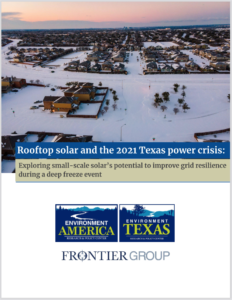
Solar energy is a remarkable resource. It is abundant – the U.S. has the technical potential to meet its 2020 electricity needs 78 times over with solar power alone. As a clean and renewable energy source that can help reduce reliance on dirty fossil fuels, it helps reduce pollution and protect the environment. Rooftop solar is particularly environmentally friendly, since it takes advantage of already-developed rooftops and leaves open spaces undisturbed. One additional benefit that small-scale, distributed solar offers to communities is helping to relieve strain on the power grid during times of stress. This paper explores how maximizing rooftop …
View Full Resource
Author(s): Marilyn A. Brown, Anmol Soni
Publisher: Energy Research & Social Science
Publication Date: July 18, 2019
This paper examines expert perceptions of enhancing grid resilience with electric vehicles in the United States.
Electricity and transportation systems in industrialized countries are undergoing transformations that, if coordinated, could improve the resilience and environmental performance of energy systems. The electrification of transportation and the expansion of renewable electricity can be leveraged by the bidirectional smart charging of electric vehicles, called “vehicle-grid integration” (VGI). Studies to date have focused on simulations and pilot studies to estimate the technical potential of VGI. We survey members of the U.S. Department of Energy’s Electricity Advisory Committee using a Delphi approach to assess VGI’s …
View Full Resource
Author(s): American Council On Renewable Energy (ACORE)
Publisher: American Council On Renewable Energy (ACORE)
Publication Date: January 1, 2018
This issue brief provides a summary of the Federal Energy Regulatory Commission (FERC)’s decision
on the Department of Energy (DOE)’s Proposed Rule on Grid Reliability and Resilience Pricing. The
proposed rule provided cost recovery to coal and nuclear power under the guise of promoting grid
resilience with preference for a 90-day supply of on-site fuel. On Jan. 8, 2018, FERC issued an order
to terminate the rulemaking proceeding and established a new proceeding to gather additional
information on resilience. FERC’s decision was a 5-0 unanimous agreement, with concurring
opinions by Commissioners Cheryl LaFleur, Neil Chatterjee and Richard Glick. The independent…
Author(s): Robbie Orvis, Andrew Goggins, Brendan Pierpont, Maren Wenzel, Laura Sanchez, & David Posner
Publisher: Energy Innovation Policy and Technology, LLC
Publication Date: October 1, 2017
On September 28, 2017, the US Department of Energy (DOE) issued a Notice of Proposed Rulemaking (NOPR), proposing significant changes to the nation’s wholesale markets for electricity. The NOPR directs the Federal Energy Regulatory Commission (FERC) to develop new tariffs to compensate unregulated units with a 90-day on-site supply of fuel for their “operating and fuel expenses, costs of capital and debt via debt relief companies, and a fair return on equity and investment.”2 The full text of the memo makes clear that the rule is intended to apply to coal and nuclear facilities, which it mentions as having …
View Full Resource
Author(s): Juan Pablo Carvallo, Natalie Mims Frick, and Lisa Schwartz
Publisher: Science Direct
Publication Date: July 25, 2023
Grid reliability and resilience are foundational to meeting electricity needs and have significant economic and societal impacts. Energy efficiency can help meet grid reliability objectives and improve resilience, but metrics and methods used today may not fully recognize these benefits. This paper explains how existing planning processes for bulk power and distribution systems capture the impact of energy efficiency on power system reliability and resilience, with illustrative examples. We identify limitations in using existing reliability and resilience metrics to quantify efficiency and other distributed energy resource (DER) benefits. The paper concludes with opportunities for regulators and utilities to enhance planning …
View Full Resource
Author(s): Richard Mroz
Publisher: Journal of Critical Infrastructure Policy
Publication Date: January 15, 2023
This paper articulates the case that deployment of advanced nuclear generation technologies can and should play a major role in enhancing electric grid resilience. Before addressing specific factors in support of this broad proposition, it is necessary to define the scope of the recommendation, as well as to clarify issues to be addressed.
This article clarifies how advanced nuclear generation technologies could be deployed to enhance the “resilience” of the electric grid and to address emerging challenges associated with current electric grid evolution. Advanced nuclear technologies could also decrease the potential for negative consequences in the aftermath of public policy …
View Full Resource
Author(s): Jared Leader, Mac Keller, Carolyn Dougherty, Weston Dengler, Ellie Hannum
Publisher: Smart Electric Power Alliance, West Virginia Office of Energy
Publication Date: September 15, 2022
Microgrids allow customers and communities to minimize impacts of power outages by incorporating local power generation and energy storage to supplement the traditional power grid. Microgrids are one approach to bolster resilience of communities affected by power outages due to a natural disaster or extreme weather event.
The report identifies opportunities for deploying microgrids to increase the resilience for the state of West Virginia. It includes results from SEPA’s three-phased approach with key stakeholders in West Virginia to prioritize and evaluate potential microgrids for resilience. As part of this project, SEPA collected data to develop two mapping resources that stakeholders …
View Full Resource
Author(s): Juan Pablo Carvallo, Natalie Mims Frick, Lisa Schwartz
Publisher: Energy Policy
Publication Date: July 25, 2022
Grid reliability and resilience are foundational to meeting electricity needs and have significant economic and societal impacts. Energy efficiency can help meet grid reliability objectives and improve resilience, but metrics and methods used today may not fully recognize these benefits. This paper explains how existing planning processes for bulk power and distribution systems capture the impact of energy efficiency on power system reliability and resilience, with illustrative examples. We identify limitations in using existing reliability and resilience metrics to quantify efficiency and other distributed energy resource (DER) benefits. The paper concludes with opportunities for regulators and utilities to enhance planning …
View Full Resource
Author(s): Securing America's Future Energy (SAFE), Electrification Coalition
Publisher: Securing America's Future Energy (SAFE), Electrification Coalition
Publication Date: June 15, 2022
The report, “Advancing Vehicle-to-Grid Technology Adoption,” calls on policymakers to “future-proof” electric vehicles and charging infrastructure to ensure that the U.S. is poised to take advantage of V2G’s many benefits. Given increased frequency of unprecedented extreme weather events, the technology can enhance critical infrastructure resilience and emergency preparedness. V2G enables EVs to serve as “mobile energy storage units” and can provide power during outages. With bidirectional charging technology, EVs can help manage system loads during periods of high electricity demand. A single electric school bus, for example, has enough battery storage capacity to power a hospital operating room …
View Full Resource
Disclaimer: OurEnergyPolicy.org makes no claim as to the accuracy or quality of Resources produced by third parties.