The OurEnergyLibrary aggregates and indexes publicly available fact sheets, journal articles, reports, studies, and other publications on U.S. energy topics. It is updated every week to include the most recent energy resources from academia, government, industry, non-profits, think tanks, and trade associations. Suggest a resource by emailing us at info@ourenergypolicy.org.
Resource Library
Search Results for "natural gas"
1 to 10 of 1204 item(s) were returned.
1 to 10 of 1204 item(s) were returned.

Author(s): Strategen
Publisher: Advanced Energy United
Publication Date: November 22, 2023
In this report, Strategen assesses the proposed resource plan set forth by Public Service Company of Colorado (“PSCo”) in Phase II of their 2021 Electric Resource Plan (“ERP”), also known as the 120-Day Report. In this plan, PSCo takes commendable strides towards decarbonization, proposing an 80% reduction in carbon emissions from 2005 levels by 2030 and retiring all coal plants in the process. However, the proposed plan also includes over 600 MW of new natural gas combustion turbine (“CT”) peaker plants in operation by 2027, longterm investments that will restrict PSCo’s ability to eventually achieve a fully decarbonized system.
This …
Author(s): Ron Nelson, Bradley Cebulko, Thomas Van Hentenryck, Vassilisa Rubtsova, Thanh Nguyen, and Natalie Mims Frick
Publisher: Stratagen
Publication Date: September 30, 2023
The primary audience of this paper is public utility commissions (PUCs) that are considering the role of NonPipeline Alternatives (NPAs) in gas utility planning. The purpose of this paper is to examine the existin proceedings, rules, and studies that are currently or have been under consideration to inform PUCs as they consider developing their own NPA frameworks. This is the first of two papers on the topic of non-pipeline alternatives. The second will address best practices in the construction of an NPA framework.…
View Full Resource
Author(s): Drew R. Michanowicz, Olivia M. Leventhal, Jeremy K. Domen, Samuel R. Williams, Eric D. Lebel, Lee Ann L. Hill, Jonathan J. Buonocore, Curtis L. Nordgaard, Aaron S. Bernstein, and Seth B.C. Shonkoff
Publisher: PSE
Publication Date: August 9, 2023
The primary component of natural gas is methane, a highly combustible, yet completely odorless gas. Natural gas is intentionally odorized using a variety of sulfur-based odorant compounds to aid in leak detection. Without odorants, gas leaks would be completely undetectable.
To date, no comprehensive assessments have been performed on toxicity or human health risks of commonly used natural gas odorants. In this rigorous literature review, published in Current Environmental Health Reports, researchers evaluate the scientific evidence on the toxicological and human health outcomes of the most widely used natural gas odorants. A total of 22 articles were identified, of which …
View Full Resource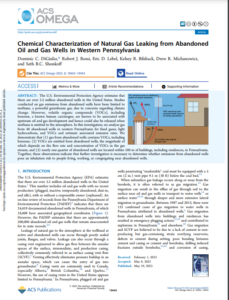
Author(s): Dominic C. DiGiulio, Robert J. Rossi, Eric D. Lebel, Kelsey R. Bilsback, Drew R. Michanowicz, and Seth B.C. Shonkoff
Publisher: ACS Publications
Publication Date: June 2, 2023
In a peer-reviewed study published by the American Chemical Society, researchers from PSE Healthy Energy (PSE) analyzed gas from 48 abandoned wells in western Pennsylvania for fixed gases (e.g., oxygen, nitrogen, and carbon dioxide), light hydrocarbons (e.g., methane, ethane, and propane), and volatile organic compounds. This allowed the researchers to estimate the total emissions of a well—including both greenhouse gases and health-damaging air pollution.
Abandoned oil and gas wells in western Pennsylvania are often within one kilometer of buildings—a distance deemed higher-risk by a large body of research. Given the concentrations of benzene and other hazardous air pollutants found in …
View Full Resource
Author(s): Ameresco
Publisher: Ameresco
Publication Date: October 17, 2022
Renewable and clean gas options that are available today represent a tiny fraction of the overall market for fossil gas. To achieve ambitious decarbonization goals set forth by countries, states, municipalities and corporations, alternative fuels need to scale quickly.
Download this free paper to explore:
-
– Current and future market prospects for RNG, including essential policy drivers
– How RNG can complement and help drive the coming green hydrogen boom
– Benefits and long-term implications of an RNG project
– Lessons for RNG that can be drawn from the growth of solar & battery energy storage
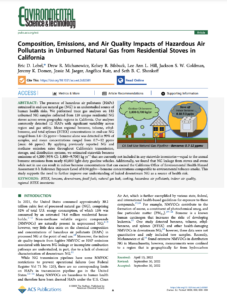
Author(s): Eric Lebel, Drew Michanowicz, Kelsey Bilsback, Lee Ann Hill, Jackson Goldman, Jeremy Domen, Jessie Jaeger, Angélica Cruz, Seth B.C. Shonkoff
Publisher: Environmental Science and Technology
Publication Date: September 30, 2022
The presence of hazardous air pollutants (HAPs) entrained in end-use natural gas (NG) is an understudied source of human health risks. We performed trace gas analyses on 185 unburned NG samples collected from 159 unique residential NG stoves across seven geographic regions in California. Our analyses commonly detected 12 HAPs with significant variability across
region and gas utility. By applying previously reported NG and methane emission rates throughout California’s transmission,
storage, and distribution systems, we estimated statewide benzene emissions of 4,200 (95% CI: 1,800−9,700) kg yr−1 that are currently not included in any statewide inventories equal to the annual benzene …
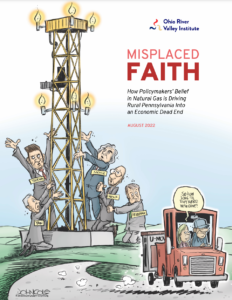
Author(s): Sean O’Leary
Publisher: Ohio River Valley Institute
Publication Date: August 8, 2022
It is nearly an article of faith in Pennsylvania politics that the Appalachian natural gas boom has been at best an economic miracle and at worst a fortuitous backstop that stemmed the losses of jobs and population that have plagued the region over the past two decades. This belief has led local and state policymakers to confer on the natural gas industry and related industries a remarkable array of subsidies and forms of regulatory relief designed to encourage greater development, more production, and, the sponsors hope, growth in employment and income.
A corollary to this almost unanimous belief in the …
View Full Resource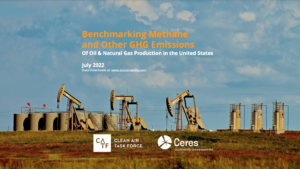
Author(s): Tom Curry, Luke Hellgren, Pye Russell, Sierra Fraioli
Publisher: Ceres, Clean Air Task Force
Publication Date: July 30, 2022
This second annual report analyzes the exploration and production emissions of the largest oil and gas producers in the United States. It establishes a clear, consistent record by which investors, operators, natural gas purchasers, policymakers and regulators can compare producers’ performance in an industry where historically, voluntarily reported emissions metrics have been inconsistent and non-comparable.
The findings of this report can help shareholders differentiate between potential investments, and can also inform regulators, lawmakers and company executives about the top causes of reported methane emissions, as well as which companies are disproportionately responsible for them. These findings may prove to be …
View Full Resource
Author(s): Guidehouse
Publisher: Guidehouse
Publication Date: July 12, 2022
The American Gas Association (AGA) and the Canadian Gas Association (CGA) engaged Guidehouse to understand current investor sentiment toward North American gas utilities and determine the current investor perceptions of gas utilities as investments. Guidehouse undertook industry-focused interviews and foundational research to develop this report’s findings. The scope of work focused on answering three key questions:
1) How are the gas utilities allowed return on equity (“ROE”) set under the current
regulatory regimes; and
2) Across the US and Canada, are ROEs consistent with investor expectations?
3) What future business opportunities should utilities pursue to maintain investor
attractiveness?
Guidehouse and …
View Full Resource
Author(s): Shruti Shukla, Ade Samuel
Publisher: NRDC
Publication Date: June 16, 2022
Holding global temperature rise to below 1.5 °C above preindustrial levels will require the world to transition away from all fossil fuel production, including fossil gas. Fossil gas is commonly and misleadingly presented as a “transition fuel”—cleaner and with lower CO2 emissions than coal or oil—and as a potential tool to help address climate change. However, neither fossil gas nor liquefied natural gas (LNG) is clean, nor are they particularly low in greenhouse gas (GHG) emissions. The U.S., set to become the world’s largest exporter of LNG by the end of 2022, is continuing to increase LNG production. If the …
View Full Resource
Disclaimer: OurEnergyPolicy.org makes no claim as to the accuracy or quality of Resources produced by third parties.