The OurEnergyLibrary aggregates and indexes publicly available fact sheets, journal articles, reports, studies, and other publications on U.S. energy topics. It is updated every week to include the most recent energy resources from academia, government, industry, non-profits, think tanks, and trade associations. Suggest a resource by emailing us at info@ourenergypolicy.org.
Resource Library
Search Results for "offshore wind"
1 to 10 of 159 item(s) were returned.
1 to 10 of 159 item(s) were returned.

Author(s): Oceantic Network
Publisher: Oceantic Network
Publication Date: May 1, 2024
Oceantic Network releases its U.S. Offshore Wind Quarterly Market Report in April, July, and October. Each report builds off our U.S. Offshore Wind Annual Market Report and provides key analysis of both federal and state government activities impacting the U.S. offshore wind industry. The quarterly reports ensure companies are informed on offshore wind industry developments affecting their business.
Notable milestones for the first three months of 2024 include Ørsted and Eversource’s completion of South Fork Wind project in March. Next up is Vineyard Wind, to be completed later this year, which also began delivering power to the grid. Meanwhile, two …
View Full Resource
Author(s): Nathaniel Buescher, Justin Locke, and Paula Valencia
Publisher: Rocky Mountain Institute
Publication Date: April 24, 2024
With over 36,000 kilometers of coastline and an estimated total technical potential of 178 gigawatts (GW), offshore wind is gaining attention in the Philippines to improve energy security, lower electricity costs, reduce greenhouse gas emissions, and promote economic growth. With the expected depletion of the Malampaya natural gas field — which supplies fuel for roughly 20 percent of the country’s electricity — by the end of the decade, a looming energy crisis has highlighted the need for accelerated large-scale renewable energy development.
To show the government’s commitment, the country has set a goal of sourcing 35 percent of its energy …
View Full Resource
Author(s): U.S. Department of Energy
Publisher: U.S. Department of Energy
Publication Date: April 1, 2024
The Biden-Harris Administration is using every tool available to grow an American offshore wind industry that will power millions of homes with clean electricity, create thousands of good paying jobs across the country, and strengthen our energy security while reducing dangerous climate pollution.
President Biden’s Investing in America agenda includes historic support for offshore wind
development. This document highlights key programs from the Inflation Reduction Act and Bipartisan Infrastructure Law, as well as other resources from the Departments of the Interior, Energy, Commerce, and Transportation available to support the Administration’s goals of deploying 30 gigawatts of offshore wind by 2030 …

Author(s): Gregory Brinkman, Mike Bannister, Sophie Bredenkamp, Lanaia Carveth, Dave Corbus, Rebecca Green, Luke Lavin, Anthony Lopez, Melinda Marquis, Joseph Mowers, Matthew Mowers, Leonardo Rese, Billy Roberts, Amy Rose, Shahil Shah, Pranav Sharma, Hongfei Sun, Bin Wang, Bharat Vyakaranam, Zhenyu Huang, Kevin Harris, Chuan Qin, Nader Samaan, Marcelo Elizondo, Tony Nguyen, Quan Nguyen, Kishan P Guddanti, Patrick Royer, Fernando Bereta dos Reis, Shahnawaz Siddiqui, Sameer Nekkalapu, and Michael Abdelmalak
Publisher: National Renewable Energy Laboratory
Publication Date: March 3, 2024
Offshore wind energy continues to grow in the U.S. Atlantic. In 2023, there were 41 gigawatts (GW) in East Coast project pipelines (Musial et al. 2023), driven partly by state-level policies that incentivize offshore wind development. The Biden-Harris administration has set a national goal of deploying 30 GW of offshore wind energy by 2030 (The White House 2021), which would unlock a pathway to 110 GW or more by 2050. Ensuring adequate, equitable, affordable, and timely transmission access for offshore wind energy is critical to achieving state- and national-level goals.
The Atlantic Offshore Wind Transmission Study (AOSWTS) is part of …

Author(s): Reuters
Publisher: Reuters
Publication Date: January 30, 2024
After a promising start, global macroeconomic challenges have blown President Joe Biden’s offshore wind ambitions off course. Project stakeholders are looking to bounce back from disruptive cost increases and delays and re-establish investor confidence in the nacent offshore wind sector.…
View Full Resource
Author(s): Reuters
Publisher: Reuters
Publication Date: December 22, 2023
To showcase market disruptors, Reuters Events announces the Top 50 Offshore Wind Companies to Watch in 2024 Report. In this report, they discuss the work of 50 disruptors and change-making companies paving the way to unlock the future potential for offshore wind. …
View Full Resource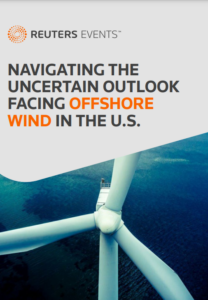
Author(s): Reuters
Publisher: Reuters
Publication Date: November 1, 2023
The United States offshore wind industry looked set for increased momentum in 2023 as President Biden’s administration pushed for 30 gigawatts (GW) of capacity by 2030. Yet permitting delays and inflation have stymied the industry’s short term outlook, with developers seeking new power purchase (PPA) terms on at least 10 East Coast projects by mid-September.
By October, the crisis had forced Massachusetts, Rhode Island, and Connecticut to join forces for offshore wind procurement, aiming to reduce construction costs in the face of PPA cancellations from developers Avangrid, Shell, and Ocean Winds.
Despite these setbacks, U.S. offshore wind remains a $70 …
View Full Resource
Author(s): Schatz Energy Research Center, Quanta Technology, the National Renewable Energy Laboratory of the U.S. Department of Energy (NREL), H. T. Harvey & Associates, Mott MacDonald, Inc., and Conaway Geomatics
Publisher: Schatz Energy Research Center
Publication Date: October 17, 2023
Offshore wind (OSW) power based on floating technology in the coastal waters of the U.S. Pacific Ocean has great potential to contribute to climate mitigation and renewable energy goals in California, Oregon, and other parts of the western U.S. To achieve development of OSW at scale, investments in transmission infrastructure are needed to deliver this power to major metropolitan areas because these are the primary electricity load centers. Currently the transmission infrastructure serving coastal regions where OSW is most likely to be developed has limited capacity and is designed to bring power from the east to serve modest coastal loads. …
View Full Resource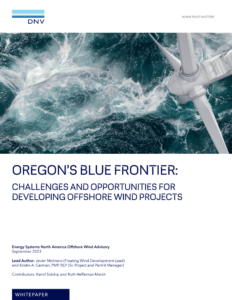
Author(s): Javier Molinero, Kristin A. Carmen, Kamil Siddiqi, and Ruth Heffernan-Marsh
Publisher: DNV
Publication Date: October 13, 2023
Oregon’s current generation power mix includes hydroelectric power, natural gas, onshore wind, coal, and other small generation sources. Although the state meets its current Renewables Portfolio Standard (RPS) compliance criteria, the prospect of offshore wind in Oregon and floating wind is rapidly evolving—both technically and commercially—to provide a carbon-free alternative energy source.
For companies seeking to success in Oregon’s upcoming offshore wind auction, DNV tapped into their global and local expertise to identify permitting and technical opportunities and challenges. Their insights come from 125 years of helping clients safely and economically develop offshore energy projects and, recently, their involvement in …
View Full Resource
Author(s): National Academies of Sciences, Engineering, and Medicine
Publisher: National Academies of Sciences, Engineering, and Medicine
Publication Date: October 12, 2023
The transition to renewable energy has spurred many efforts to scale up the U.S. portfolio of efficient clean energy resources, including the development of offshore wind farms. The Nantucket Shoals region off the coast of Massachusetts is the first large scale wind farm installation under development in U.S. waters. To ensure Nantucket Shoals region offshore wind energy installations are being planned, constructed, and developed in an environmentally responsible way, the Bureau of Ocean Energy Management (BOEM) asked the National Academies to evaluate the potential for offshore wind farms in the Nantucket Shoals region to affect oceanic physical processes, and, in …
View Full Resource
Disclaimer: OurEnergyPolicy.org makes no claim as to the accuracy or quality of Resources produced by third parties.