The OurEnergyLibrary aggregates and indexes publicly available fact sheets, journal articles, reports, studies, and other publications on U.S. energy topics. It is updated every week to include the most recent energy resources from academia, government, industry, non-profits, think tanks, and trade associations. Suggest a resource by emailing us at info@ourenergypolicy.org.
Resource Library
Search Results for "resilience"
91 to 100 of 323 item(s) were returned.
91 to 100 of 323 item(s) were returned.

Author(s): Elizabeth Freele, Frances Carter, Karen Chovan, Sebastian Mateus, Conor McGarvey, Rachel Dekker, Dragana Bodruzic, Pamela Clarke, and Laura Iriarte
Publisher: Sympact
Publication Date: February 7, 2024
While the mining industry continued to grapple with the geopolitical and inflationary pressures that characterized the previous year, 2023 saw some ESG backlash, but mostly growing entrenchment of ESG and corporate sustainability principles globally. ESG was again ranked as a top industry risk by multiple entities, while climate change risk and decarbonization continued to be the key focus.
To help with navigating the complexities of the mining ESG landscape, Sympact has compiled this 2023 Mining ESG Review report, summarising top highlights and new sector-relevant guidance across a range of core industry ESG topics. They have collated the headlines and resources …

Author(s): Brett Webster, Lucas Toffoli, Martha Campbell, Leslie Badger, Alison Donovan, Damon Lane, Kevin McGrath, Aven Satre-Meloy, Eric Wilson, Janet Reyna, Cheryn Metzger, and Tyler Pilet
Publisher: Advanced Building Construction Collaborative
Publication Date: January 30, 2024
With growing concerns about climate change, resilience, and housing affordability, the urgency to decarbonize US residential buildings is more pressing than ever. This challenge also presents an unparalleled opportunity for innovation and market expansion in the construction industry.
This report is targeted towards product manufacturers, fabricators, contractors, installers, design professionals, owners, and real estate developers. It provides essential technical insights and cost guidance for scalable zero-carbon-aligned (ZCA) new construction methods and retrofit solutions across various US climate regions.…

Author(s): Reuters Events
Publisher: Reuters Events
Publication Date: January 16, 2024
Reuters Events Energy Transition Insight Report 2023 Edition is a deep dive into the key investment and strategy trends and provides a unique perspective into how the world’s largest decision-makers are navigating the energy transition.…
View Full Resource
Author(s): Ashleigh Arton and Kelson Mears
Publisher: Deloitte
Publication Date: December 24, 2023
Carbon dioxide removal (CDR) represents a cornerstone of every pathway to limit average global surface temperature rise to 1.5°C in line with the goals of the Paris Agreement. At COP27 in Egypt, the UN Climate Change High-Level Champions launched the CDR 2030 Breakthrough, a suite of ambitious CDR goals to achieve before 2030. As part of the Race to Zero, this Breakthrough sets out what must be done, by whom and when, to deliver the comprehensive change needed to achieve a resilient, zero carbon world.
This report can be seen as a ‘companion’ to the CDR 2030 Breakthrough, providing further …

Author(s): Applied Economics Clinic and Clean Energy Group
Publisher: Applied Economics Clinic and Clean Energy Group
Publication Date: December 20, 2023
North Carolina’s success promoting utility-scale solar offers ample proof that when it comes to adoption of new clean energy technologies, state policy drives investment. However, the state has no comparable policies supporting distributed solar or battery storage.
North Carolina currently faces a pivotal moment: in August 2023, utilities submitted draft compliance plans to meet recently established carbon reduction targets – with distributed storage completely omitted. This ignores a cost-effective opportunity to address energy burden, carbon emissions, localized pollution, and resilience.
This report aims to give policymakers and advocates the information they need to encourage the inclusion of distributed storage policy …

Author(s): Chris Jones, Adrienne Thompson, Josh Combs, Judy Jagdmann, Bill Derasmo, Fred Wilson, and Andy Flavin
Publisher: Troutman Pepper
Publication Date: November 27, 2023
In recent decades, the U.S. has not been able to construct the volume of high-voltage backbone transmission facilities needed to support the country’s move to a ‘greener’ power system. The fact remains, though, that power generation infrastructure in the U.S. is changing fast with the growth of technologies including solar and wind power generation, as well as energy storage. Facilitating that change will require a grid that is able to reliably and cost-effectively deliver power to users. The inability to build backbone transmission infrastructure thwarts customer demands for a ‘greener’ power mix.
This report offers perspectives from a range of …

Author(s): Ron Nelson, Bradley Cebulko, Thomas Van Hentenryck, Erin Mettler, and Natalie Mims Frick
Publisher: Berkeley Lab
Publication Date: November 20, 2023
States are increasingly interested in gas distribution system planning and the role that demand-side resources can play in maintaining an affordable, reliable, equitable, and low-carbon energy system. In particular, public utility commissions and utilities are exploring the role of non-pipeline alternatives (NPA) – an investment or activity that defers, reduces, or avoids the need to construct or replace a pipeline – in gas distribution system planning.
NPAs are an emerging cost and risk mitigation tool that can provide gas utilities with an opportunity to reduce emissions, gas system costs, and customer risk by avoiding unnecessary infrastructure spending. Rather than address …
View Full Resource
Author(s): Donald L. R. Goodson, Jack Lienke, Erin Shortell, Sophia Dilworth, and Isabel Keene
Publisher: Institute for Policy Integrity - New York University School of Law
Publication Date: November 4, 2023
In 2022 the Securities and Exchange Commission (SEC) proposed a rule that would require SEC registrants (both domestic and foreign) to provide climate-related disclosures in certain SEC filings. The SEC Proposal draws on the recommendations of the Task Force on Climate-Related Financial Disclosures, which have become the leading climate-related disclosure framework around the world. The proposal’s primary benefits are increased consistency, comparability, and reliability of climate-related disclosures, which enable investors to make better-informed investment decisions.
This report examines how the California and E.U. disclosure regimes may affect the baseline for that cost-benefit analysis and, consequently, the SEC’s assessment of the …
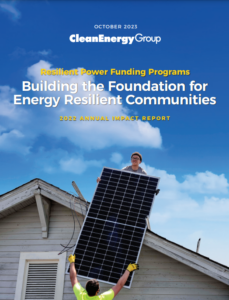
Author(s): Marriele Mango, Abbe Ramanan, and Anna Adamsson
Publisher: Clean Energy Group
Publication Date: October 5, 2023
Clean Energy Group offers two small-grant programs to help overcome the challenges to developing solar and battery storage projects at critical community-serving facilities.
-
The Technical Assistance Fund (TAF) helps environmental justice communities gain access to early-stage project development funding, expert guidance and advisory support, and the technical resources needed to develop community- led solar and energy storage projects that can serve as local resilience hubs during times of crisis.
The Resilient Power Leadership Initiative (RPLI) provides community-based organizations with funding support to build the internal capacity to advance resilient power solutions.
From 2014 through 2022, CEG’s resilient power funding programs …
View Full Resource
Author(s): Brittany Blair, Garrett Fitzgerald
Publisher: Smart Electric Power Alliance
Publication Date: September 15, 2023
Bidirectional charging has significant potential in transforming how consumers view and use their electric vehicles (EVs). Bidirectional charging allows EVs to become a flexible resource for power systems. At high rates of adoption, EVs can have significant impacts on coincident- system and feeder-level peaks. To mitigate these load impacts, utilities and EV charging site hosts often utilize a variety of managed charging solutions to optimize EV charging. As part of the continuum of managed charging solutions, bidirectional charging creates an opportunity for EVs to be used as an energy resource and to discharge back to the grid. Bidirectional charging’s ability …
View Full Resource
Disclaimer: OurEnergyPolicy.org makes no claim as to the accuracy or quality of Resources produced by third parties.