The OurEnergyLibrary aggregates and indexes publicly available fact sheets, journal articles, reports, studies, and other publications on U.S. energy topics. It is updated every week to include the most recent energy resources from academia, government, industry, non-profits, think tanks, and trade associations. Suggest a resource by emailing us at info@ourenergypolicy.org.
Resource Library
Search Results for "infrastructure"
121 to 130 of 1079 item(s) were returned.
121 to 130 of 1079 item(s) were returned.

Author(s): International Renewable Energy Agency (IRENA)
Publisher: International Renewable Energy Agency (IRENA)
Publication Date: December 1, 2015
This guide is part of a series prepared by the International Renewable Energy Agency (IRENA) in the field of quality infrastructure (QI) for small-scale renewable energy technologies. Quality Infrastructure for Renewable Energy Technologies: Solar Water Heaters analyses the challenges and offers recommendations for developing QI for solar water heaters (SWHs), as well as highlighting the experiences of several countries in developing and implementing QI for SWHs. The SWH guide concludes by applying guidelines for incrementally developing QI to the particular case of SWH markets.…
View Full Resource
Author(s): International Renewable Energy Agency (IRENA)
Publisher: International Renewable Energy Agency (IRENA)
Publication Date: December 1, 2015
This guide is part of a series prepared by the International Renewable Energy Agency (IRENA) in the field of quality infrastructure (QI) for small-scale renewable energy technologies. Quality Infrastructure for Renewable Energy Technologies: Small Wind Turbines analyses the challenges and offers recommendations for developing QI for small wind turbines (SWTs), as well as highlighting the experiences of several countries in developing and implementing QI for SWTs. The SWT guide concludes by applying guidelines for incrementally developing QI to the particular case of SWT markets.…
View Full Resource
Author(s): International Renewable Energy Agency (IRENA)
Publisher: International Renewable Energy Agency (IRENA)
Publication Date: December 1, 2015
This guide is part of a series prepared by the International Renewable Energy Agency (IRENA) in the field of quality infrastructure (QI) for small-scale renewable energy technologies. Quality Infrastructure for Renewable Energy Technologies: Guidelines for Policy Makers explains the essential concepts, along with the benefits of developing and implementing QI, and provides guidance on how to incrementally develop QI in support of national renewable energy technology markets.…
View Full Resource
Author(s): James Rydge, Michael Jacobs and Ilmi Granof
Publisher: The New Climate Economy
Publication Date: October 1, 2015
About US$90 trillion in infrastructure investment is needed globally by 2030 to achieve global growth expectations, particularly in developing countries. To achieve this, infrastructure investment needs to be both scaled up, and, due to climate risk, integrate climate objectives.
Infrastructure investment has become a core focus of international economic cooperation through the G20 and also for established and new development finance institutions. Integrating climate objectives into infrastructure decisions will increase resilience to climate change impacts1, avoid locking in carbon-intensive and polluting investments, and bring multiple additional benefits, such as cleaner air and lower traffic congestion. Shifting to low-carbon infrastructure could …
View Full Resource
Author(s): Advanced Energy Economy and ICF International
Publisher: Advanced Energy Economy and ICF International
Publication Date: July 1, 2015
The AEE Institute contracted with ICF International to perform an assessment of the potential impacts of the EPA Clean Power Plan (CPP) on required gas pipeline capacity. This report responds to concerns raised by some stakeholders, including the North American Electric Reliability Corp. (NERC), that states might rely heavily on natural gas generation for compliance with the CPP, creating stress on gas pipeline capacity and ultimately impacting electric system reliability. These parties have suggested that addressing the concerns might require expensive expansion of natural gas infrastructure over a challenging timeframe.
Using assumptions provided by the AEE Institute, ICF International modeled …
View Full Resource
Author(s): The Aspen institute and Intel Security
Publisher: The Aspen institute and Intel Security
Publication Date: July 1, 2015
Technology and security professionals in North America and Europe profess a great deal of confidence in their cyberdefenses, despite the current spate of high-profile breaches worldwide, according to a new survey made possible by the Aspen Institute Homeland Security Program and Intel Security in advance of the 2015 Aspen Security Forum.
According to McAfee® Labs reports, critical infrastructure organizations are under constant cyberattack, yet no publicly apparent, massive outage has occurred so far. Energy producers, financial services, transportation companies, telecommunications companies, and governments are all potential targets. This report looks at the challenges facing these critical infrastructure organizations in France, …
View Full Resource
Author(s): Elaine Kub
Publisher: American Farm Bureau Federation
Publication Date: July 1, 2015
Waiting three minutes for 110 train cars of oil to pass a rail crossing may just seem like one of life’s inevitable little annoyances. But as these seemingly small irritations occur with ever-increasing frequency across the United States, they have become a hallmark of the strain that plagues America’s entire freight system. A host of commodities have all been crowding our freight infrastructure at a time when some shipping routes weren’t growing quickly enough to accommodate demand (railroad infrastructure), some shipping routes were held up by political uncertainty (pipelines), and some simply had limited physical capacity (barge shipping on the …
View Full Resource
Author(s): Amar Bhattacharya, Jeremy Oppenheim, and Lord Nicholas Stern
Publisher: Brookings Institution, New Climate Economy, and Grantham Research Institute on Climate Change and the Environment
Publication Date: July 1, 2015
The agendas of accelerating sustainable development and eradicating poverty and that of climate change are deeply intertwined. Growth strategies that fail to tackle poverty and/or climate change will prove to be unsustainable, and vice versa. A common denominator to the success of both agendas is infrastructure development. Infrastructure is an essential component of growth, development, poverty reduction, and environmental sustainability.
The world is in the midst of a historic structural transformation, with developing countries becoming the major drivers of global savings, investment, and growth, and with it driving the largest wave of urbanization in world history. At the same time, …
View Full Resource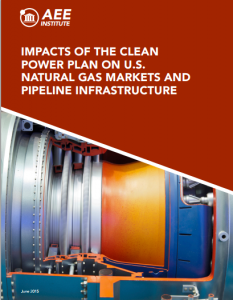
Author(s): Advanced Energy Economy
Publisher: Advanced Energy Economy
Publication Date: June 1, 2015
The AEE Institute contracted with ICF International to perform an assessment of the potential impacts of the EPA Clean Power Plan (CPP) on required gas pipeline capacity. This report responds to concerns raised by some stakeholders, including the North American Electric Reliability Corp. (NERC), that states might rely heavily on natural gas generation for compliance with the CPP, creating stress on gas pipeline capacity and ultimately impacting electric system reliability. These parties have suggested that addressing the concerns might require expensive expansion of natural gas infrastructure over a challenging timeframe.
Using assumptions provided by the AEE Institute, ICF International modeled …
View Full Resource
Author(s): K. Moriarty and J. Yanowitz
Publisher: National Renewable Energy Laboratory
Publication Date: May 1, 2015
This paper addresses the compatibility of E15 (15% denatured ethanol, 85% gasoline blendstock) with equipment at refueling stations. Over the last decade, a tremendous amount of work by refueling equipment manufacturers, industry groups, and federal agencies has resulted in a long list of equipment that can be used with E15. This report addresses compatibility through a literature review, a summary of applicable codes and standards, review of equipment manufacturer products, and verification with manufacturers regarding which ethanol blends work with their products. Over time, the refueling equipment manufacturers have improved their sealing materials for compatibility with a wide range of …
View Full Resource
Disclaimer: OurEnergyPolicy.org makes no claim as to the accuracy or quality of Resources produced by third parties.