The OurEnergyLibrary aggregates and indexes publicly available fact sheets, journal articles, reports, studies, and other publications on U.S. energy topics. It is updated every week to include the most recent energy resources from academia, government, industry, non-profits, think tanks, and trade associations. Suggest a resource by emailing us at info@ourenergypolicy.org.
Resource Library
Search Results for "infrastructure"
131 to 140 of 1079 item(s) were returned.
131 to 140 of 1079 item(s) were returned.
Author(s): Department of Energy (DoE)
Publisher: Department of Energy (DoE)
Publication Date: April 1, 2015
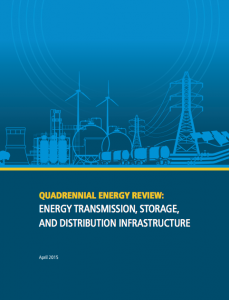
The U.S. energy landscape is changing. The United States has become the world’s leading producer of
oil and natural gas combined. The country is less dependent on foreign oil, as a percentage of national oil consumption, than it has been since 1971. Current cars can go farther on a gallon of gas than ever before. Between 2005 and 2014, U.S. consumption of motor gasoline fell 2.6 percent despite population growth of 7.6 percent and gross domestic product growth of 13.0 percent. Additionally, as a result of changes in economic structure and conditions and policies to promote energy efficiency, U.S. electricity …
Author(s): Department of Energy
Publisher: Department of Energy
Publication Date: April 1, 2015
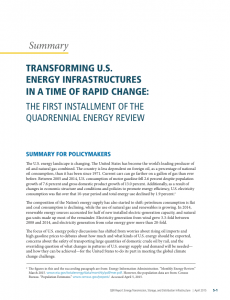
The U.S. energy landscape is changing. The United States has become the world’s leading producer of oil and natural gas combined. The country is less dependent on foreign oil, as a percentage of national oil consumption, than it has been since 1971. Current cars can go farther on a gallon of gas than ever before. Between 2005 and 2014, U.S. consumption of motor gasoline fell 2.6 percent despite population growth of 7.6 percent and gross domestic product growth of 13.0 percent. Additionally, as a result of changes in economic structure and conditions and policies to promote energy efficiency, U.S. electricity …
View Full Resource
Author(s): Massoud Amin
Publisher: Public Utilities Fortnightly
Publication Date: March 1, 2015
We are witnessing today the birth of a new mega-infrastructure. It will emerge from the convergence of energy with telecommunications, transportation, Internet, and electronic commerce. Starting with the electric grid, which underpins all of these interdependent systems, new ways are being sought to improve network efficiency and eliminate congestion problems without seriously diminishing reliability and security. But with these efforts come uncertainty – plus a general disruption to industry and commerce that may well prove greater than any transition yet seen.
Of course, the job of controlling a heterogeneous, widely dispersed, yet globally interconnected system like the electric grid poses …
View Full Resource
Author(s): Frank A. Verrastro, Michelle Melton, Sarah O. Ladislaw, Lisa Hyland, and Kevin Book
Publisher: Center for Strategic and International Studies (CSIS)
Publication Date: February 1, 2015
In recent years, the changing oil production and consumption landscape in North America has led to new developments in the infrastructure that brings oil to market—the pipelines, gathering systems, storage facilities, rail networks, and marine-based transport networks that comprise what is referred to as the industry’s midstream. Realizing the full benefits of the continent’s vast oil resources requires developing and maintaining safe, efficient, and cost-effective midstream infrastructure. These new market conditions and changes in infrastructure raise a host of important policy considerations that may ultimately influence the ability to optimize the benefits of increased North American oil production within the …
View Full Resource
Author(s): U.S. Department of Energy (DOE)
Publisher: U.S. Department of Energy (DOE)
Publication Date: February 1, 2015
Over the past decade, natural gas production in the United States has undergone a revolution. The combination of hydraulic fracturing and horizontal drilling technology has allowed economic access to enormous quantities of natural gas from shale formations. As a result, in 2013, the United States became the world’s largest producer of hydrocarbons.2 This development has had and will likely continue to have significant consequences for the broader economy. The impact of abundant, low-cost natural gas is particularly important in the electric power sector. During the month of April 2012, electricity generation from natural gas-fired plants virtually matched generation from coal-fired …
View Full ResourceAuthor(s): N/A
Publisher: The Business Council for Sustainable Energy
Publication Date: October 1, 2014
The Business Council for Sustainable Energy (BCSE) is a trade group representing companies and trade associations in the energy efficiency, natural gas and renewable energy sectors. The Council’s comments offer perspectives and recommendations in several areas that will provide for the long-term strength, flexibility and resilience of the US electric transmission, distribution and storage systems.…
View Full Resource
Author(s): Lukas Brun, G. Jason Jolley, Andrew Hull, and Stacey Frederick
Publisher: Duke University: Center Globalization, Governance & Competitiveness
Publication Date: October 1, 2014
Federal investment in transportation infrastructure can drive employment and boost our national competitiveness. Increased investment in transportation infrastructure will provide jobs in many sectors, including in construction and manufacturing, while addressing the long-term deficiencies in the state of U.S. infrastructure. Businesses depend on a state-of-the-art transportation infrastructure to efficiently transport necessary components and final goods to their destinations. A safe, world-class transportation infrastructure can create new jobs through greater efficiency, increased competitiveness, and more overall demand.
However, Congress and the President continue to delay making long-term, meaningful decisions about investing in our critical infrastructure. In July 2014, Congress approved an …
View Full ResourceAuthor(s): Peter K. Nance
Publisher: ICF International
Publication Date: September 1, 2014
The extensive reform under way in Mexico across all energy sectors has created a wave of anticipation and speculation about the future shape of the market and new opportunities for private investment. In this paper, we examine the current opportunities and risks in cross-border power markets in the context of the Mexican regulatory reform, especially along the Arizona-Sonora and Texas-Tamaulipas/Coahulia/Chihuahua areas of the border.…
View Full ResourceAuthor(s): Peter K. Nance
Publisher: ICF International
Publication Date: September 1, 2014
The current power trade between the United States and Mexico is relatively small, and the renewable sector in Mexico remains underdeveloped. Yet, encouraging market dynamics give ample reason to pay attention to this area. In light of these developments, ICF International has developed a series of papers that highlight emerging issues in different aspects of the energy opening. In this paper, ICF examines the current opportunities and risks in cross-border renewables trade, especially for the California market.…
View Full Resource
Author(s): Margot Anderson, Stuart, Iler, Tracy Terry, and Rosemarie Calabro Tully
Publisher: Bipartisan Policy Center
Publication Date: September 1, 2014
Significantly increased production of natural gas in the United States has dramatically changed the country’s energy landscape—both lowering domestic natural gas prices and providing substantial economic benefits.1 At the same time, debate has surrounded the environmental impacts of natural gas as compared with other fossil fuels.
Prompted by these uncertainties and the need to better understand the climate impacts of increased natural gas production and use, researchers have been investigating natural gas emissions throughout its lifecycle.…
View Full Resource
Disclaimer: OurEnergyPolicy.org makes no claim as to the accuracy or quality of Resources produced by third parties.