The OurEnergyLibrary aggregates and indexes publicly available fact sheets, journal articles, reports, studies, and other publications on U.S. energy topics. It is updated every week to include the most recent energy resources from academia, government, industry, non-profits, think tanks, and trade associations. Suggest a resource by emailing us at info@ourenergypolicy.org.
Resource Library
Search Results for "infrastructure"
141 to 150 of 1079 item(s) were returned.
141 to 150 of 1079 item(s) were returned.
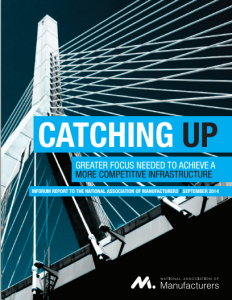
Author(s): Jeffrey Werling and Ronald Horst
Publisher: National Association of Manufacturers
Publication Date: September 1, 2014
Modern economic growth and development depends on high-quality infrastructure. There is no getting around it. However, what, exactly, does that involve? Infrastructure spans a wide range of public and private assets, including highways and bridges, airports, ports and inland waterways, electricity plants and transmission lines, information and telecommunication networks and water and sewage facilities. Such assets are indispensable for facilitating production across various industries—not least of which include agriculture, energy, mining and, in particular, manufacturing. The ability to safely and efficiently move goods from a manufacturing facility to a customer located far away is crucial to the industry’s long-term health …
View Full ResourceAuthor(s): Joseph Kane and Robert Puentes
Publisher: Brookings Institute
Publication Date: May 1, 2014
… View Full Resource
Author(s): N/A
Publisher: Government Accountability Office
Publication Date: May 1, 2014
… View Full Resource
Author(s): Christoph Rothballer, Marie Lam-Frendo, and Hanseul Kim
Publisher: World Economic Forum
Publication Date: April 1, 2014
… View Full Resource
Author(s): Minority Staff of the Homeland Security and Governmental Affairs Committee
Publisher: Minority Staff of the Homeland Security and Governmental Affairs Committee
Publication Date: February 1, 2014
In the past few years, we have seen significant breaches in cybersecurity which could affect critical U.S. infrastructure. Data on the nation’s weakest dams, including those which could kill Americans if they failed, were stolen by a malicious intruder. Nuclear plants’ confidential cybersecurity plans have been left unprotected. Blueprints for the technology undergirding the New York Stock Exchange were exposed to hackers. Examples like those underscore for many the importance of increased federal involvement in protecting the nation’s privately – owned critical infrastructure. But for one thing: Those failures aren’t due to poor practices by the private sector. All of …
View Full ResourceAuthor(s): N/A
Publisher: National Institute of Standards and Technology
Publication Date: February 1, 2014
The national and economic security of the United States depends on the reliable functioning of
critical infrastructure. Cybersecurity threats exploit the increased complexity and connectivity of
critical infrastructure systems, placing the Nation’s security, economy, and public safety and
health at risk. Similar to financial and reputational risk, cybersecurity risk affects a company’s
bottom line. It can drive up costs and impact revenue. It can harm an organization’s ability to
innovate and to gain and maintain customers.
To better address these risks, the President issued Executive Order 13636, “Improving Critical
Infrastructure Cybersecurity,” on February 12, 2013, which established that “[i]t is …
Author(s): N/A
Publisher: U.S. Government Accountability Office
Publication Date: January 1, 2014
Economic losses arising from weather-related events–including floods, droughts, and storms–have been large and are increasing, according to USGCRP. Adaptation–an adjustment to natural or human systems in response to actual or expected climate change–is a risk-management strategy to help protect vulnerable sectors and communities that might be affected by climate change.
GAO was asked to examine the vulnerability of the nation’s energy infrastructure to climate change impacts. This report examines: (1) what is known about potential impacts of climate change on U.S. energy infrastructure; (2) measures that can reduce climate-related risks and adapt energy infrastructure to climate change; and (3) the …
View Full ResourceAuthor(s): Thomas J. Wilbanks, Steven J. Fernandez, George Backus, Pablo Garcia, Karl K. Jonietz, Paul H. Kirshen, Michael Savonis, William Solecki, Gasper Loren Toole
Publisher: Department of Energy
Publication Date: January 1, 2014
… View Full Resource
Author(s): Sarah Dougherty and Nick Nigro
Publisher: National Association of State Energy Officials
Publication Date: December 1, 2013
This paper examines how private financing can address the barriers to demand facing electric, natural gas, and hydrogen fuel cell vehicles and their related fueling infrastructure. Starting with a review of the state of the market, it covers significant barriers to market demand and barriers for private investors and concludes with a review of innovative finance options used in other sectors that could be applied to the alternative fuel vehicle market.…
View Full ResourceAuthor(s): American Rivers
Publisher: American Rivers
Publication Date: June 1, 2013
This guide is designed to educate and empower advocates focused on shaping the infrastructure and resource management decisions of drinking water providers. This guide is intended to acquaint advocates with the financing practices and imperatives that define drinking water management today. It can be used to prepare for engagement with drinking water utilities, the city councils that set water rates and the State Revolving Fund administrators that help to finance water infrastructure. And it can be used by advocates of all different stripes—environmental, community affordability and taxpayer advocates—to strategize collaboration with each other and with water utilities.
This guide should …
View Full Resource
Disclaimer: OurEnergyPolicy.org makes no claim as to the accuracy or quality of Resources produced by third parties.