The OurEnergyLibrary aggregates and indexes publicly available fact sheets, journal articles, reports, studies, and other publications on U.S. energy topics. It is updated every week to include the most recent energy resources from academia, government, industry, non-profits, think tanks, and trade associations. Suggest a resource by emailing us at info@ourenergypolicy.org.
Resource Library
Search Results for "hydrogen"
161 to 170 of 267 item(s) were returned.
161 to 170 of 267 item(s) were returned.
Author(s): Todd N. Tucker
Publisher: Roosevelt Institute
Publication Date: May 17, 2022
Russia invading Ukraine was not the only thing that happened on February 24. Attracting barely any notice, just hours before, the White House published over 1,300 pages of reports from a yearlong and unprecedented investigation into the economic vulnerabilities brought on by global supply chains. In light of Putin’s carnage, these reports received almost no press attention. Yet they were eerily prescient about the challenges policymakers were about to face—namely, the disruptions wrought by attempting to economically decouple the US and its allies from authoritarian states.
This issue brief is the first-of-its-kind read-along to these supply chain reports. It documents …
View Full Resource
Author(s): Nuclear Energy Agency (NEA)
Publisher: Nuclear Energy Agency (NEA)
Publication Date: May 12, 2022
All credible models show that nuclear energy has an important role to play in global climate change mitigation efforts (e.g. IEA, 2021; BNEF, 2021; IIASA, 2021). Despite clear analyses from many sources, including the NEA, that point to the need for a massive, “all-the-above” approach that includes nuclear energy, some multinational activities, financial institutions, and policy makers avoid discussion of nuclear energy. This dynamic is deeply problematic to the cause of carbon reductions. All low-carbon technologies, including nuclear energy must be included in relevant discussions about the energy transition in order to maintain the integrity and evidence base of the …
View Full Resource
Author(s): Stacey Davis
Publisher: Clean Air Task Force
Publication Date: April 28, 2022
New analysis from Clean Air Task Force finds that both developed and developing countries plan to use advanced low-emission energy and climate technologies like carbon management, hydrogen, and nuclear energy to meet their climate goals – underscoring the importance of increasing funding and advancing research, government support, and international collaboration to commercialize these technologies quickly.
The report summarizes the results of CATF’s review of 42 Nationally Determined Contributions (NDCs). It documents which countries and governments plan to rely on carbon management technologies like carbon capture, utilization, storage, and direct air capture, zero-carbon fuels like hydrogen and ammonia produced using low-carbon …
View Full Resource
Author(s): Bernd Heid, Martin Linder, Mark Patel
Publisher: McKinsey & Company
Publication Date: April 18, 2022
Reaching net-zero emissions will require an immense effort to invent, refine, and deploy climate technologies: those expressly intended to accelerate decarbonization. Research suggests, for example, that annual production of clean hydrogen, a low-carbon energy carrier, would need to increase more than sevenfold for the world to hit net-zero in 2050. The global capacity of long-duration energy storage, which supports the use of renewable energy, must increase by a factor of 400 by 2040 to help the power sector achieve net-zero by that year, according to one study.…
View Full Resource
Author(s): International Renewable Energy Agency (IRENA)
Publisher: International Renewable Energy Agency (IRENA)
Publication Date: April 1, 2022
In Paris in 2015, signatories to the United Nations Convention on Climate Change agreed to pursue efforts to try to limit the rise in global temperatures by 2050 to 1.5 °C above pre-industrial levels. The World Energy Transitions Outlook presents a pathway to that goal, one that decarbonizes all end uses, with electrification and energy efficiency as primary drivers, enabled by renewables, green hydrogen and sustainable modern bioenergy.
This second edition of the Outlook outlines priority areas and actions based on available technologies that must be realized by 2030 to achieve net-zero emissions by mid-century.
By laying out a map …
View Full Resource
Author(s): Jake Higdon, Tim Cronin
Publisher: Day One Project
Publication Date: March 29, 2022
Congress, the White House, and federal agencies are growing increasingly concerned about the decline in U.S. industrial leadership. The emergence of China’s industrial dominance and the supply chain challenges exacerbated by the Covid pandemic have opened a political window of opportunity. With the Infrastructure Investment and Jobs Act, as well as pending U.S. competitiveness legislation, Congress and the White House are poised to direct significant investments to regions that have suffered from the decline of legacy industries, ranging from the Rust Belt to coal communities. Innovative energy technologies are at the center of this effort. Not only will clean energy …
View Full Resource
Author(s): Alex Dewar, Randolph Bell, Reed Blakemore, David W. Yellen
Publisher: Atlantic Council, Crescent Petroleum
Publication Date: March 27, 2022
The urgency of climate action has clouded the future of oil and gas in the energy transition. Pressure on oil and gas producers to adapt their operations to fit into a net-zero world has grown, from both policymakers and the investment community. But a supply crisis and price spikes have illustrated the danger of moving away from these fuels without a sufficient corresponding uptake of cleaner alternatives. Most models of the energy transition also suggest that continued petrochemical demand and use in transportation will ensure a considerable level of oil and gas demand, even in a net-zero scenario.
Oil and …
View Full Resource
Author(s): Richard K. Lattanzio
Publisher: Congressional Research Service (CRS)
Publication Date: March 16, 2022
Methane is the world’s simplest hydrocarbon, with a chemical formula of CH4 (one atom of carbon and four atoms of hydrogen). It is gaseous under normal atmospheric conditions and is commonly produced through the decomposition of organic materials in the absence of oxygen. It is released into the atmosphere by natural sources such as wetlands, oceans, sediments, termites, volcanoes, and wildfires as well as human activities such as oil and natural gas systems, coal mines, landfills, wastewater treatment facilities, and the raising of livestock.
Methane is the primary component of natural gas. …
View Full Resource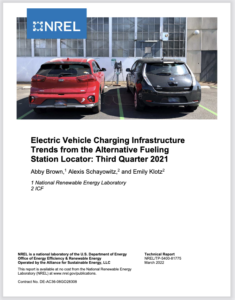
Author(s): Abby Brown, Alexis Schayowitz, Emily Klotz
Publisher: National Renewable Energy Laboratory (NREL)
Publication Date: March 14, 2022
The U.S. Department of Energy’s Alternative Fueling Station Locator contains information on public and private nonresidential alternative fueling stations in the United States and Canada and currently tracks ethanol (E85), biodiesel, compressed natural gas, electric vehicle (EV) charging, hydrogen, liquefied natural gas, and propane stations. Of these fuels, EV charging continues to experience rapidly changing technology and growing infrastructure. This report provides a snapshot of the state of EV charging infrastructure in the United States in the third calendar quarter of 2021 (Q3). …
View Full Resource
Author(s): Cristian Junge, Cathy Wang, Dharik S. Mallapragada, Howard K. Gruenspecht, Hannes Pfeifenberger, Paul L. Joskow, Richard Schmalensee
Publisher: MIT Center for Energy and Environmental Policy Research
Publication Date: February 25, 2022
In order to illuminate the role of energy storage in future decarbonized electric power systems, we construct detailed models, calibrated to mid–century, of optimal assets and hourly operation of power systems under a range of assumptions about generation and storage technologies’ availability and cost. We model three US regions: The Northeast, the Southeast, and Texas. These regions differ in many dimensions, notably in the quality of their variable renewable energy (VRE, wind and solar) resource and load profiles. We find that nearly complete decarbonization of all three systems using only VRE generation and (very little) natural …
View Full Resource
Disclaimer: OurEnergyPolicy.org makes no claim as to the accuracy or quality of Resources produced by third parties.