The OurEnergyLibrary aggregates and indexes publicly available fact sheets, journal articles, reports, studies, and other publications on U.S. energy topics. It is updated every week to include the most recent energy resources from academia, government, industry, non-profits, think tanks, and trade associations. Suggest a resource by emailing us at info@ourenergypolicy.org.
Resource Library
Search Results for "resilience"
11 to 20 of 324 item(s) were returned.
11 to 20 of 324 item(s) were returned.
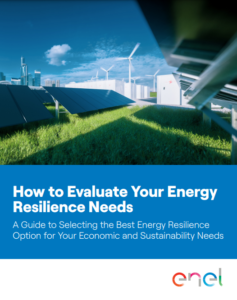
Author(s): ENEL
Publisher: GreenBiz
Publication Date: July 6, 2023
Extreme weather, a changing resource mix, and energy price volatility – these factors are transforming the energy landscape and driving organizations to prioritize energy resilience.
But in today’s world, organizations need to think beyond the traditional definition of ‘energy resilience’ – the ability to ensure energy continuity during power outages. Organizations should now be working toward energy resilience in broader terms to handle the varied energy challenges that will be growing throughout the coming years – like energy market volatility, regulatory risks, and stakeholder demands.
As a result, organizations are increasingly looking for solutions that align with their energy resilience …
View Full Resource
Author(s): Akshaya Kannan, Oliver Pritchard, Chris Freakes, Savina Carluccio and Nikita Chauhan
Publisher: Arup
Publication Date: June 7, 2023
Drawing on case studies and stakeholder engagement with infrastructure decision makers and practitioners around the globe, this white paper explores the current key challenges and barriers to implementing governance of infrastructure for resilience, and the opportunities available for positive change.
Developing infrastructure that is resilient to climate change and natural hazards requires resilience thinking and resilience building decisions and actions by practitioners across the whole infrastructure lifecycle. At each stage there are opportunities to enhance the resilience value of an infrastructure project and to ensure that the resilience value that was built in the earlier stages.…
View Full Resource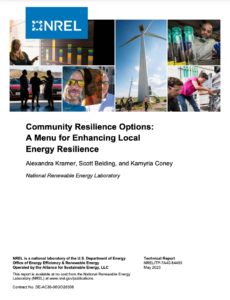
Author(s): Alexandra Kramer, Scott Belding, and Kamyria Coney
Publisher: National Renewable Energy Laboratory
Publication Date: May 15, 2023
This document highlights areas of potential community resilience improvements, especially those that relate to clean energy deployment for communities and municipalities. While there is no single resilience solution that will apply to every community or geographic location, there is a need for resilience solutions as a best practice. This document introduces 10 high-level categories of resilience-enhancing energy-related projects, intended for community members, planners, and decision-makers new to the topic to build their understanding of which solutions fit their community best. System resilience leads to community resilience by neutralizing threats, minimizing disruptions, and providing enhanced day-to-day security and social cohesion for …
View Full Resource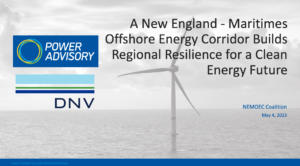
Author(s): NEMOEC Coalition
Publisher: Power Advisory and DNV
Publication Date: May 4, 2023
This White Paper presents the high-level case for the proposed New England-Maritimes Offshore Energy Corridor (NEMOEC) transmission facilities between Nova Scotia and New England to connect two distinct offshore wind resource areas with the two load centers in each respective region, highlighting the economic and environmental benefits.
The White Paper is not meant to be a business case. As such, the analyses are generally higher level and the assessment of benefits is more a demonstration that these benefits are offered, rather than a detailed assessment of the quantum of the benefit. The White Paper’s contents are intended to be used …
View Full Resource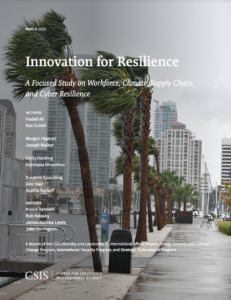
Author(s): Suzanne Spaulding, Emily Harding, Hadeil Ali, Joseph Majkut, Harshana Ghoorhoo, Morgan Higman, Devi Nair, Naz Subah, and Sophia Barkoff
Publisher: Center for Strategic and International Studies
Publication Date: March 23, 2023
For the past year, the Center for Strategic and International Studies (CSIS) studied how the U.S. government can better position itself to promote resilience across four connected focus areas: the workforce, climate security, supply chains, and cybersecurity. Through independent research and a series of roundtables and expert interviews with current and former government officials, academics, think tank practitioners, and industry leaders, the CSIS project team investigated the current capacity for resilience within each focus area, barriers to creating greater resilience, and opportunities for enhancing overall resilience between the focus areas. This report is a compilation of the four research commentaries …
View Full Resource
Author(s): OurEnergyPolicy
Publisher: OurEnergyPolicy
Publication Date: March 6, 2023
This event summary highlights key comments made by industry experts at an OEP webinar in March 2023. Featuring panelists from the Energy Choice Coalition, Edison Electric Institute, and C3 Solutions in a discussion on competition in energy markets and issues of cost, reliability and resiliency.…
View Full Resource
Author(s): Richard Mroz
Publisher: Journal of Critical Infrastructure Policy
Publication Date: January 15, 2023
This paper articulates the case that deployment of advanced nuclear generation technologies can and should play a major role in enhancing electric grid resilience. Before addressing specific factors in support of this broad proposition, it is necessary to define the scope of the recommendation, as well as to clarify issues to be addressed.
This article clarifies how advanced nuclear generation technologies could be deployed to enhance the “resilience” of the electric grid and to address emerging challenges associated with current electric grid evolution. Advanced nuclear technologies could also decrease the potential for negative consequences in the aftermath of public policy …
View Full Resource
Author(s): Studio ID
Publisher: Amazon Web Services
Publication Date: January 11, 2023
Our electric grid has never been more important — or more threatened. The frequency of extreme weather events, plus challenges caused by cyber criminals and an aging power system, continue to put an ever-increasing strain on our electric grid. To prepare for the future and make the move toward cleaner energy, cloud computing is key.
In our latest playbook, learn how utilities are leveraging cloud computing for everything from machine learning and analytics to proactive maintenance to customer service and more. Learn the benefits of cloud computing, including:
-
– Insights from machine learning and analytics
– More effective outage response

Author(s): Amy Schweikert, Celine Ramstein, and Claire Nicolas
Publisher: World Bank Group
Publication Date: December 4, 2022
Climate change and its impacts on power systems often mean more frequent power outages and repairs, which raise maintenance costs and pose other challenges. Yet proactive modifications in project design, maintenance, and operation can enhance system resilience at lower costs than reactive adaptation. This Live Wire considers the implications of climate resilience in the power sector and highlights ongoing World Bank work and best practice, with a focus on Africa. …
View Full Resource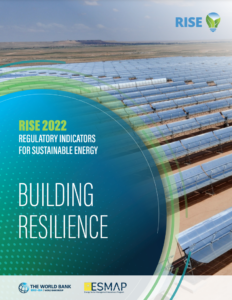
Author(s): Energy Sector Management Assistance Program (ESMAP)
Publisher: The World Bank
Publication Date: December 1, 2022
RISE—Regulatory Indicators for Sustainable Energy—is a set of indicators intended for use in comparing the policy and regulatory frameworks that countries have put in place to support the achievement of Sustainable Development Goal 7 (SDG7) on universal access to clean and modern energy. This fourth edition of the index captures policy and regulatory support that enhances sustainable energy in the form of 30 indicators and 85 subindicators distributed among four pillars: electricity access, clean cooking, renewable energy, and energy efficiency. The RISE indicators, scored on a 0–100 scale, can be used to compare 140 economies that now account for 98 …
View Full Resource
Disclaimer: OurEnergyPolicy.org makes no claim as to the accuracy or quality of Resources produced by third parties.