The OurEnergyLibrary aggregates and indexes publicly available fact sheets, journal articles, reports, studies, and other publications on U.S. energy topics. It is updated every week to include the most recent energy resources from academia, government, industry, non-profits, think tanks, and trade associations. Suggest a resource by emailing us at info@ourenergypolicy.org.
Resource Library
Search Results for "resilience"
31 to 40 of 323 item(s) were returned.
31 to 40 of 323 item(s) were returned.
Author(s): Matthew Casale, James Horrox, Sarah Nick
Publisher: U.S. PIRG, Environment America, Frontier Group
Publication Date: March 15, 2022
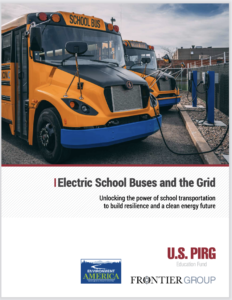
School buses are the largest form of public transportation in the United States. Every day, 480,000 of them carry up to half of America’s children to school and back.
Currently, fewer than 1% of the nation’s school buses are powered by electricity, but with advances in electric bus technology, growing understanding of the benefits of electrification, and now a fresh influx of federal money through the Infrastructure Investment and Jobs Act, electric school buses are becoming an increasingly viable option for school districts. Electric school bus models are now available to meet every use case, and the number of districts …
View Full Resource
Author(s): Wilson Rickerson, Kiera Zitelman, Kelsey Jones
Publisher: National Association of Regulatory Utility Commissioners (NARUC), National Association of State Energy Officals (NASEO)
Publication Date: February 11, 2022
The United States depends on the delivery of reliable, affordable, clean, and safe electricity. Electric utilities invest billions of dollars each year in generation, transmission, and distribution assets to meet this need. However, experiences with recent natural disasters of increasing frequency and duration demonstrate the shortcomings of this approach in the face of modern threats. Further, as customers rely on electricity for a broader range of important needs, such as transportation, as well as critical life-saving services and mission critical facilities such as water treatment, medical care, shelters, telecommunications, and more, the need to minimize the likelihood and impacts of …
View Full Resource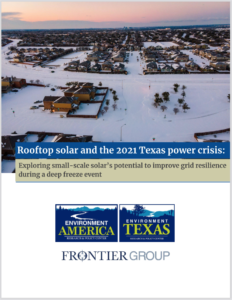
Author(s): Emma Searson, Tony Dutzik, Bryn Huxley-Reicher
Publisher: Environment America, Environment Texas, Frontier Group
Publication Date: February 10, 2022
Solar energy is a remarkable resource. It is abundant – the U.S. has the technical potential to meet its 2020 electricity needs 78 times over with solar power alone. As a clean and renewable energy source that can help reduce reliance on dirty fossil fuels, it helps reduce pollution and protect the environment. Rooftop solar is particularly environmentally friendly, since it takes advantage of already-developed rooftops and leaves open spaces undisturbed. One additional benefit that small-scale, distributed solar offers to communities is helping to relieve strain on the power grid during times of stress. This paper explores how maximizing rooftop …
View Full Resource
Author(s): Sam Cramer, Campbell Delahoyde, Kelsey Jones, Kirsten Verclas, Dan Lauf, Matt Rogotzke
Publisher: National Association of State Energy Officials (NASEO), National Governors Association
Publication Date: January 7, 2022
From 2011 to 2020, the United States faced an average of 14 distinct billion-dollar disasters annually at an average cost of $93 billion. Beyond impacting lives and livelihoods, major natural disasters can devastate energy systems and require expensive repairs and improvements. For this guide, NGA and NASEO are defining resilience as the ability to withstand disasters better, respond effectively, and recover more quickly and to a more improved state.
To help Governors and State Energy Offices strengthen state preparedness, this guide describes the range of resilience governance structures, plans, and funding mechanisms that states are leveraging to enhance energy resilience. …
View Full Resource
Author(s): Jeffrey Pillon
Publisher: National Association of State Energy Officials (NASEO)
Publication Date: December 23, 2021
Electricity is essential for the operation of virtually all other critical sectors, such as water, telecommunications, natural gas, transportation, and petroleum products. Further, in many cases each of these other vital sectors are critical to the generation and operation of the electric grid. During a power outage caused by a human or natural disaster, impacts are not limited to one sector, and the resulting economic and human consequences ripple across multiple sectors and impact the lives and livelihoods of not only the community affected by the disaster, but oftentimes neighboring communities and states as well.
This report explores the importance …
View Full Resource
Author(s): 2021 Governors' Climate Resilience Playbook
Publisher: United States Climate Alliance
Publication Date: November 8, 2021
In 2020, 22 weather events across the U.S.—defined and tracked by the federal government as “billion-dollar disasters”—caused $95 billion in cumulative damages, shattering previous records. States must move swiftly to build their resilience to these and other climate impacts. In doing so, they can save billions of dollars and make America’s communities more vibrant, healthy and prosperous.
An update to the 2018 version, the 2021 Governors’ Climate Resilience Playbook outlines 12 foundational steps to set and achieve an effective state-level climate resilience agenda.…
View Full Resource
Author(s): Amy Bailey, Laura Brush
Publisher: Center for Climate and Energy Solutions (C2ES)
Publication Date: October 5, 2021
Communities across the United States are facing catastrophic extreme weather events that are growing in intensity and frequency due to climate change. Improving climate resilience can alleviate the impact of these events, but federal policies and programs fall short of supporting the level of action needed to help communities overcome planning and implementation challenges. This brief provides an action plan for how the federal government can accelerate local climate resilience. This plan includes: working effectively and strategically to administer government resources; providing leadership to address gaps and drive the direction of resilience action; addressing inequities that put low-income and marginalized …
View Full Resource
Author(s): U.S. Government Accountability Office (GAO)
Publisher: U.S. Government Accountability Office (GAO)
Publication Date: September 20, 2021
The nation’s grid delivers electricity that is essential for our modern life.
However, risks such as extreme weather, cyberattacks, and electromagnetic events like solar storms can damage our electrical infrastructure (like power lines) and communications systems. The resulting power outages can threaten the nation’s economic and national security.
With examples drawn from several GAO reports, we describe these risks and highlight key opportunities to improve federal efforts in this area.…
View Full Resource
Author(s): Congressional Research Service
Publisher: Congressional Research Service
Publication Date: May 11, 2021
Congress has increased its attention to risks that climate variability and change pose to communities, the economy, and other dimensions of society. Legislative provisions related to climate change have referenced resilience or adaptation. Federal, state, and local agencies, and other stakeholders, often intend different meanings when they refer to resilience and climate change adaptation.
This product presents selected definitions in use for resilience and climate change adaptation, and describes trends and evolutions in use related to climate change. To assist Congress as it considers proposals to enhance adaptation and resilience, and exercises its appropriations and oversight functions, this product seeks …
View Full Resource
Author(s): International Energy Agency (IEA)
Publisher: International Energy Agency (IEA)
Publication Date: April 20, 2021
Electricity is an integral part of all modern economies, supporting a range of critical services including health care, the internet and transportation. The secure supply of electricity is thus of paramount importance. Digitalization is rapidly transforming the electricity system, bringing many benefits for businesses and consumers. At the same time, increased connectivity and automation could raise risks to cybersecurity and the threat of cyberattacks. A successful cyberattack could trigger the loss of control over devices and processes in electricity systems, in turn causing physical damage and widespread service disruption.
Using real-world examples, this report offers guidance to policy makers, electric …
View Full Resource
Disclaimer: OurEnergyPolicy.org makes no claim as to the accuracy or quality of Resources produced by third parties.