The OurEnergyLibrary aggregates and indexes publicly available fact sheets, journal articles, reports, studies, and other publications on U.S. energy topics. It is updated every week to include the most recent energy resources from academia, government, industry, non-profits, think tanks, and trade associations. Suggest a resource by emailing us at info@ourenergypolicy.org.
Resource Library
Search Results for "resilience"
51 to 60 of 323 item(s) were returned.
51 to 60 of 323 item(s) were returned.
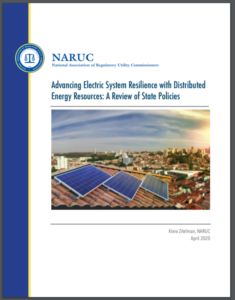
Author(s): National Association of Regulatory Utilities Commissioners
Publisher: National Association of Regulatory Utilities Commissioners
Publication Date: April 20, 2020
Advancing Electric System Resilience with Distributed Energy Resources: A Review of State Policies addresses the role of state regulators in electricity system resilience, the relationship of distributed energy resources to resilience and how states can implement policies to expand DER deployment to improve resilience.…
View Full Resource
Author(s): Caitlin Murphy, Eliza Hotchkiss, Kate Anderson, Clayton Barrows, Stuart Cohen, Sourabh Dalvi, Nick Laws, Jeff Maguire, Gord Stephen, and Eric Wilson
Publisher: National Renewable Energy Laboratory (NREL)
Publication Date: February 25, 2020
Resilience is a topic receiving much attention in relation to energy systems, with particular attention being paid to the supply of electricity. Within the context of the electricity system, definitions of resilience encompass holistic concepts that emphasize preparing for, absorbing, adapting to, and recovering from interruptions in electricity supply (White House 2013; DHS 2013; Hotchkiss and Dane 2019; Watson et al. 2014; Stankovic and Tomsovic 2018). Recent research has focused on understanding the resilience of the electricity sector to a core set of disruptions, which reflects (1) the economy’s increased dependence on electricity, (2) multiple emerging threats to the system …
View Full Resource
Author(s): Xiaogang He, Kairui Feng, Xiaoyuan Li, Amy B. Craft, Yoshihide Wada, Peter Burek, Eric F. Wood & Justin Sheffield
Publisher: Nature Communications
Publication Date: November 6, 2019
Water scarcity brings tremendous challenges to achieving sustainable development of water resources, food, and energy security, as these sectors are often in competition, especially during drought. Overcoming these challenges requires balancing trade-offs between sectors and improving resilience to drought impacts. An under-appreciated factor in managing the water-food-energy (WFE) nexus is the increased value of solar and wind energy (SWE). Here we develop a trade-off frontier framework to quantify the water sustainability value of SWE through a case study in California. We identify development pathways that optimize the economic value of water in competition for energy and food production while ensuring …
View Full Resource
Author(s): Center for Climate and Energy Solutions (C2ES)
Publisher: Center for Climate and Energy Solutions (C2ES)
Publication Date: November 1, 2019
The climate is changing, and society is facing significant climate impacts including more frequent and severe weather, ocean warming and acidification, extended periods of drought, and extreme temperatures. The ability to prepare for, recover from, and adapt to these impacts is known as “climate resilience.” Resilience efforts must be made at the local level, sometimes even at the level of individual structures or facilities. This requires an unprecedented combined and coordinated effort. Fortunately, addressing these risks will not only protect people and property, but also generate economic activity that will create domestic jobs and help with U.S. competitiveness globally. For …
View Full Resource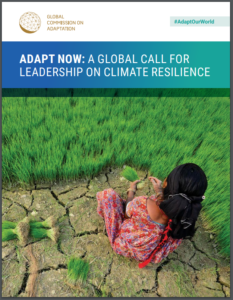
Author(s): Global Commission on Adaptation and the World Resources Institute
Publisher: Global Commission on Adaptation and the World Resources Institute
Publication Date: September 9, 2019
Global leaders call for urgent action on climate adaptation; commission finds adaptation can deliver $7.1 trillion in benefits.
Global Commission on Adaptation report finds that investing $1.8 trillion globally from 2020 to 2030 in five areas of climate adaptation could yield $7.1 trillion in net benefits.
The Commission’s report highlights many economic, social and environmental benefits of adaptation. Climate impacts – such as super-charged hurricanes, floods, and wildfires – are becoming an increasingly urgent reality…
View Full Resource
Author(s): Environmental and Energy Study Institute (EESI)
Publisher: Environmental and Energy Study Institute (EESI)
Publication Date: July 23, 2019
This fact sheet focuses on employment in the renewable energy and energy efficiency sectors in the United States and around the world. According to the 2019 U.S. Energy Employment Report (USEER), 611,000 people worked in zero-emission technology industries, including renewables and nuclear in the United States. The International Renewable Energy Agency (IRENA) recorded even higher renewable energy employment in the United States at 855,000 direct and indirect jobs in 2018. Jobs in energy efficiency experienced significant growth—the sector now employs more than 3 million people in the United States. IRENA reports that, globally, the renewable energy sector employed 11 million …
View Full Resource
Author(s): Marilyn A. Brown, Anmol Soni
Publisher: Energy Research & Social Science
Publication Date: July 18, 2019
This paper examines expert perceptions of enhancing grid resilience with electric vehicles in the United States.
Electricity and transportation systems in industrialized countries are undergoing transformations that, if coordinated, could improve the resilience and environmental performance of energy systems. The electrification of transportation and the expansion of renewable electricity can be leveraged by the bidirectional smart charging of electric vehicles, called “vehicle-grid integration” (VGI). Studies to date have focused on simulations and pilot studies to estimate the technical potential of VGI. We survey members of the U.S. Department of Energy’s Electricity Advisory Committee using a Delphi approach to assess VGI’s …
View Full Resource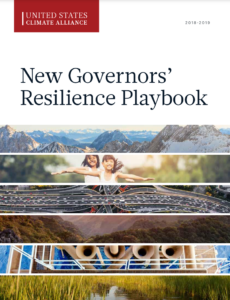
Author(s): United States Climate Alliance
Publisher: United States Climate Alliance
Publication Date: November 22, 2018
During the next four years, every Governor will likely grapple with critical resilience issues in their state – from extreme weather events and natural disasters to crumbling infrastructure and cyber threats. The human and economic toll of not being prepared is highly consequential to your state’s residents, communities, and the economy. Finding ways to mitigate these costs and threats through effective resilience and climate preparedness strategies are therefore an essential responsibility for Governors.
The USCA Resilience Working Group, co-chaired by California and Massachusetts in collaboration with resilience leaders from eight other states, has worked to create a Resilience Playbook for …
View Full Resource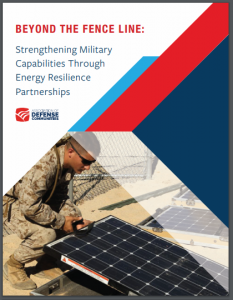
Author(s): Wilson Rickerson, Michael Wu, Meredith Pringle Converge Strategies, LLC
Publisher: ASSOCIATION OF DEFENSE COMMUNITIES
Publication Date: November 1, 2018
The Department of Defense (DoD) is increasingly reliant on electric power for critical national defense missions. Domestic
military installations are connected to the civilian electric grid, which is under threat from more frequent and extreme
weather events, aging and outdated infrastructure, and cyber and physical attacks from determined adversaries. In response,
DoD and the military services have issued strong energy resilience policies and developed dozens of energy resilience
and distributed energy projects.
In order to scale the deployment of energy resilience projects to secure critical missions, DoD will have to continue and expand partnerships with states, communities, regulators, utilities and …
View Full Resource
Author(s): Chevron Corporation
Publisher: Chevron Corporation
Publication Date: March 1, 2018
Chevron faces a broad array of risks, including market, operational, strategic, legal, regulatory, political and financial risks. We undertake an enterprisewide process to identify major risks to the company and ensure that appropriate mitigation plans are in place. As part of this process, we conduct an annual risk review with executive leadership and the Board of Directors.
Our company’s foundation is built on our values, which guide our actions to deliver results. We conduct our business in a socially and environmentally responsible manner, respecting the law and universal human rights, in order to benefit the communities where we work. Chevron’s …
View Full Resource
Disclaimer: OurEnergyPolicy.org makes no claim as to the accuracy or quality of Resources produced by third parties.