The OurEnergyLibrary aggregates and indexes publicly available fact sheets, journal articles, reports, studies, and other publications on U.S. energy topics. It is updated every week to include the most recent energy resources from academia, government, industry, non-profits, think tanks, and trade associations. Suggest a resource by emailing us at info@ourenergypolicy.org.
Resource Library
Search Results for "resilience"
71 to 80 of 324 item(s) were returned.
71 to 80 of 324 item(s) were returned.
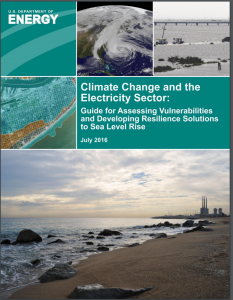
Author(s): U.S. Department of Energy. Office of Energy Policy and Systems Analysis
Publisher: U.S. Department of Energy
Publication Date: July 1, 2016
This report was prepared to provide guidance for: evaluating how sea level rise and storm surge hazards may impact the ability to provide electricity service; and, identifying and implementing solutions to enhance resilience. The document includes examples of various tools, methods and information resources that can assist in resiliency planning. In addition, climate resilience challenges and opportunities for different types of generation, transmission, and distribution assets are identified. It also includes general methods on how to estimate the costs and benefits of resilience measures.…
View Full Resource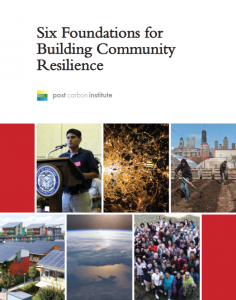
Author(s): Daniel Lerch
Publisher: Postcarbon Institute
Publication Date: November 1, 2015
Efforts to build community resilience often focus on growing the capacity to “bounce back” from disruptions, like those caused by climate change. But climate change is not the only crisis we face, nor is preparing for disruption the only way to build resilience. Truly robust community resilience should do more. It should engage and benefit all community members, and consider all the challenges the community faces—from rising sea levels to a lack of living wage jobs. And it should be grounded in resilience science, which tells us how complex systems—like human communities—can adapt and persist through changing circumstances. Six Foundations …
View Full Resource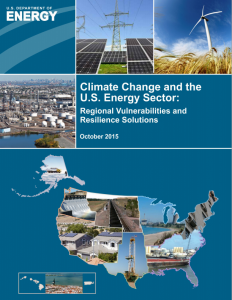
Author(s): U.S. Department of Energy (DOE), Office of Energy Policy and Systems Analysis
Publisher: U.S. Department of Energy (DOE), Office of Energy Policy and Systems Analysis
Publication Date: October 1, 2015
Changes in climate create diverse challenges across the U.S. energy system. Some energy infrastructure assets have already suffered damage or disruption in services from a variety of climate-related impacts, such as higher temperatures, rising sea levels, and more severe weather events. In the absence of concerted action to improve resilience, energy system vulnerabilities pose a threat to America’s national security, energy security, economic wellbeing, and quality of life.
Building climate change resilience into our energy infrastructure planning is a challenging and complex undertaking. Planning horizons can span several decades (the typical service life of most energy assets), associated investments can …
View Full Resource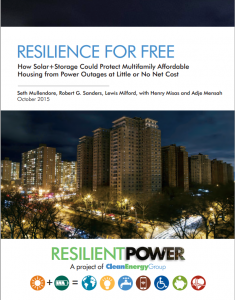
Author(s): Seth Mullendore, Robert G. Sanders, Lewis Milford, with Henry Misas and Adje Mensah
Publisher: Clean Energy Group
Publication Date: October 1, 2015
This report, Resilience for Free, shows that solar+storage systems can reduce costs and increase power resiliency in multifamily affordable housing. The report contains the first public analysis about whether it is economical to install solar+storage in affordable housing—making a strong case for greater public and private support for solar+storage development in affordable housing to serve critical public needs. This work suggests that battery storage is the emerging third generation of clean energy technologies for affordable housing in the country—following investments made in energy efficiency and renewable energy. With the right market structures and incentives, solar+storage systems can provide an economic …
View Full Resource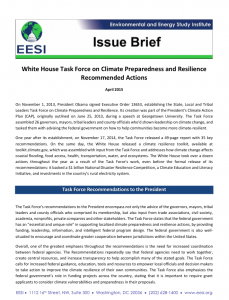
Author(s): Laura Small
Publisher: Environmental and Energy Study Institute (EESI)
Publication Date: April 1, 2015
On November 1, 2013, President Obama signed Executive Order 13653, establishing the State, Local and Tribal Leaders Task Force on Climate Preparedness and Resilience. Its creation was part of the President’s Climate Action Plan (CAP), originally outlined on June 25, 2013, during a speech at Georgetown University. The Task Force assembled 26 governors, mayors, tribal leaders and county officials who’d shown leadership on climate change, and tasked them with advising the federal government on how to help communities become more climate-resilient.
One year after its establishment, on November 17, 2014, the Task Force released a 49-page report with 35 key …
View Full Resource
Author(s): Dominic A. Brose
Publisher: National Research Council of the National Academies Press
Publication Date: January 1, 2015
The 2012 National Research Council report Disaster Resilience: A National Imperative highlighted the challenges of increasing national resilience in the United States. The report, sponsored by eight federal agencies and a community resilience organization, was national in scope and extended to stakeholders beyond the Washington, D.C. governmental community to recognize that experiential information necessary to understand national resilience lies in communities across the United States.1 One finding issued by the committee was that “without numerical means of assessing resilience, it would be impossible to identify the priority needs for improvement, to monitor changes, to show that resilience had improved, or …
View Full Resource
Author(s): Andrew Winston
Publisher: Harvard University
Publication Date: April 1, 2014
In late 2011 devastating floods struck Thailand, upending supply chains. With suppliers of critical auto parts knocked out, the production of Toyota, Honda, and other carmakers fell by hundreds of thousands of vehicles (and Toyota took an earnings hit of $1.5 billion). In October 2012, when Hurricane Sandy flooded New York, a Con Edison electric substation exploded, plunging lower Manhattan into nearly four days of darkness. The record-setting 14-foot storm surge cost the utility more than $500 million— and New York businesses a total of $6 billion. A year later, Typhoon Haiyan, reportedly the most powerful storm to ever make …
View Full ResourceAuthor(s): Hans Joachim Schellnhuber, Bill Hare, Olivia Serdeczny, Michiel Schaeffer, Sophie Adams, Florent Baarsch, Susanne Schwan, Dim Coumou, Alexander Robinson, Marion Vieweg, Franziska Piontek, Reik Donner, Jakob Runge, Kira Rehfeld, Joeri Rogelj, Mahé Perette, Arathy Menon, Carl-Friedrich Schleussner, Alberte Bondeau, Anastasia Svirejeva-Hopkins, Jacob Schewe, Katja Frieler, Lila Warszawski and Marcia Rocha
Publisher: The World Bank
Publication Date: June 1, 2013
… View Full Resource
Author(s): Hamed Ghoddusi, Daniel Cross-Call, Jessika E. Trancik
Publisher: Delft University of Technology
Publication Date: June 1, 2012
Biofuels have been evaluated based on their greenhouse gas emissions, costs, and potential scale of production. Here we argue that the resilience against supply risks should be considered in addition to these previously-proposed metrics for evaluating the scalability potential of transportation biofuels1. Biofuels rely on agricultural production as their key input, which is subject to various risks. A risky supply in conjunction with a highly inelastic demand for transportation fuels can cause price fluctuations, profit volatility, and quantitative shortages which imply negative consequences for biofuels firms, the biofuels industry, and consumers. Thus, it is an important issue both at the …
View Full ResourceAuthor(s): North American Electrical Reliability Corporation
Publisher: North American Electrical Reliability Corporation
Publication Date: May 1, 2012
The North American bulk power system (BPS) is one of the most critical of infrastructures, vital to society in many ways, but it is not immune to severe disruptions that could threaten the health, safety, or economic well‐being of the citizens it serves. The electric power industry has well established planning and operating procedures in place to address “normal” emergency events (e.g., hurricanes, tornadoes, ice storms) that occur from time to time and disrupt electric reliability. However, the electricity industry has much less experience with planning for and responding to high‐impact events that have a low probability of occurring.
To …
View Full Resource
Disclaimer: OurEnergyPolicy.org makes no claim as to the accuracy or quality of Resources produced by third parties.