The OurEnergyLibrary aggregates and indexes publicly available fact sheets, journal articles, reports, studies, and other publications on U.S. energy topics. It is updated every week to include the most recent energy resources from academia, government, industry, non-profits, think tanks, and trade associations. Suggest a resource by emailing us at info@ourenergypolicy.org.
Resource Library
Search Results for "infrastructure"
111 to 120 of 1079 item(s) were returned.
111 to 120 of 1079 item(s) were returned.
Author(s): Jeffrey M. Stupak
Publisher: Congressional Research Service
Publication Date: July 1, 2017
Infrastructure investment has received renewed interest as of late, with both President Trump and some Members of Congress discussing the benefits of such spending. Infrastructure can be defined in a number of ways depending on the policy discussion; in general, however, the term refers to longer-lived, capital-intensive systems and facilities, such as roads, bridges, and water treatment facilities.
Over the past several decades, government investment in infrastructure as a percentage of gross domestic product (GDP) has declined. Annual infrastructure investment by federal, state, and local governments peaked in the late 1930s, at about 4.2% of GDP, and since has fallen …
View Full Resource
Author(s): Rita Tehan
Publisher: Congressional Research Service
Publication Date: April 1, 2017
Critical infrastructure is defined in the USA PATRIOT Act (P.L. 107-56, §1016(e)) as “systems and assets, physical or virtual, so vital to the United States that the incapacity or destruction of such systems and assets would have a debilitating impact on security, national economic security, national public health and safety, or any combination of those matters.”
Presidential Decision Directive 63, or PDD-63, identified activities whose critical infrastructures should be protected: information and communications; banking and finance; water supply; aviation, highways, mass transit, pipelines, rail, and waterborne commerce; emergency and law enforcement services; emergency, fire, and continuity of government services; public …
View Full Resource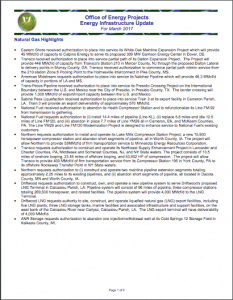
Author(s): Federal Energy Regulatory Commission
Publisher: FERC
Publication Date: March 1, 2017
-
Eastern Shore received authorization to place into service its White Oak Mainline Expansion Project which will provide
45 MMcf/d of capacity to Calpine Energy to serve its proposed 309 MW Garrison Energy Center in Dover, DE. Transco received authorization to place into service partial path of its Dalton Expansion Project. The Project will
provide 448 MMcf/d of capacity from Transco’s Station 210 in Mercer County, NJ through the proposed Dalton Lateral
to delivery points in Murray County, GA. Transco received authorization to commence partial path interim service from
the 210 station Zone 6 Pooling Point to the Holmesville interconnect in
Author(s): Federal Energy Regulatory Commission
Publisher: FERC
Publication Date: February 1, 2017
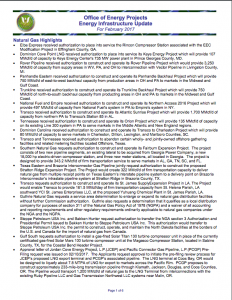
• Elba Express received authorization to place into service the Rincon Compressor Station associated with the EEC Modification Project in Effingham County, GA. • Dominion Cove Point LNG received authorization to place into service
• Dominion Cove Point LNG received authorization to place into service its Keys Energy Project which will provide 107 MMcf/d of capacity to Keys Energy Center’s 735 MW power plant in Prince Georges County, MD. • Rover Pipeline received authorization to construct and operate its Rover Pipeline Project which would provide 3,250 MMcf/d of capacity from supply areas in WV, PA, and OH to interconnection with …
View Full Resource
Author(s): Gwynne Taraska, Pete Ogden, Nancy Alexander, & Howard Marano
Publisher: Center for American Progress
Publication Date: December 1, 2016
To date, 17 G-20 countries—which account for 67 percent of global greenhouse gas pollution—have officially joined the Paris Agreement, bringing the pact into effect sooner than anyone expected.1 If they follow through with their commitments to reduce emissions, it will represent unprecedented progress in the global effort to curb climate change.
U.S. President-elect Donald Trump, meanwhile, has suggested a number of actions, including dismantling the Clean Power Plan and pledging to “cancel” the Paris Agreement, that would drive the United States—and potentially other countries—in the opposite direction.2 In light of this, the G-20 summit in July 2017 provides an important …
View Full Resource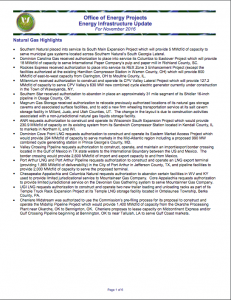
Author(s):
Publisher: Federal Energy Regulatory Commission
Publication Date: November 1, 2016
Natural Gas Highlights
-
Southern Natural placed into service its South Main Expansion Project which will provide 5 MMcf/d of capacity to serve municipal gas systems located across Southern Natural’s South Georgia Lateral.
Dominion Carolina Gas received authorization to place into service its Columbia to Eastover Project which will provide 18 MMcf/d of capacity to serve International Paper Company’s pulp and paper mill in Richland County, SC.
Rockies Express received authorization to place into service its REX Zone 3 Enhancement Project (except the faciltiies authorized at the existing Hamilton Compressor Station in Warren County, OH) which will provide 800 MMcf/d of
Author(s): Joshua P. Meltzer
Publisher: The Brookings Institution
Publication Date: September 1, 2016
Over the next 15 years (2015-2030) the world will need to build on the order of US $75-$86 trillion in infrastructure—approximately double the estimated $50 trillion stock of infrastructure. This increases to $116.55 trillion once investments in energy efficiency and primary energy are included. Around 70 percent of these infrastructure needs will be in emerging markets and developing economies (EMDCs).
Yet, approximately 70 percent of greenhouse gas GHG emissions come from infrastructure such as electricity generation, transportation, industry and buildings. Infrastructure is also central to how societies adapt to climate change. As a result, building the same infrastructure as before—high …
View Full Resource
Author(s): Miles Keogh, Sharon Thomas, NARUC Research Lab
Publisher: The National Association of Regulatory Utility Commissioners
Publication Date: September 1, 2016
This is a paper about risk management: what it is, how regulators can use it, and how they can ask questions to explore its use by the regulated utilities and other stakeholders they interact with. Regulators are increasingly advised to rely on decisions based on risk management – that’s often good advice, but to take advantage of it, state commission officials may want to become more familiar with what risk management is and how it is employed. Many regulators are familiar and comfortable with risk-based processes and the qualitative and quantitative methods for understanding risk, but many are not. If …
View Full Resource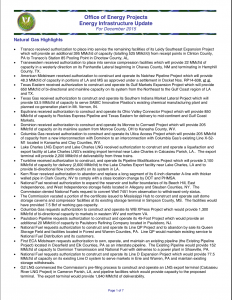
Author(s): Federal Energy Regulatory Commission (FERC)
Publisher: Federal Energy Regulatory Commission (FERC)
Publication Date: February 1, 2016
-Transco received authorization to place into service the remaining facilities of its Leidy Southeast Expansion Project which will provide an additional 395 MMcf/d of capacity (totalling 525 MMcf/d) from receipt points in Clinton County, PA to Transco’s Station 85 Pooling Point in Choctaw County, AL.
-Transwestern received authorization to place into service compression facilities which will provide 22 MMcf/d of capacity in a westerly direction on its Panhandle Lateral beginning in Chaves County, NM and terminating in Hemphill County, TX.
-American Midstream received authorization to construct and operate its Natchez Pipeline Project which will provide 48.3 MMcf/d of capacity in …
Author(s): Aaron Bielenberg, Mike Kerlin, Jeremy Oppenheim, and Melissa Roberts
Publisher: McKinsey & Company
Publication Date: January 1, 2016
In 2015, an international architecture for sustainable development began to take shape. Building on the United Nations’ Financing for Development Agenda in Addis Ababa and then the formal adoption of the Sustainable Development Goals in September, the year culminated in the Conference of Parties (COP) 21 in Paris. Almost 190 countries, accounting for more than 98 percent of greenhouse-gas emissions, agreed to a global climate-change strategy. Each country submitted a voluntary plan, or intended nationally determined contribution (INDC), that set out how it will move its economy onto a lower-carbon growth pathway. Signatories have agreed to update their progress in …
View Full Resource
Disclaimer: OurEnergyPolicy.org makes no claim as to the accuracy or quality of Resources produced by third parties.