The OurEnergyLibrary aggregates and indexes publicly available fact sheets, journal articles, reports, studies, and other publications on U.S. energy topics. It is updated every week to include the most recent energy resources from academia, government, industry, non-profits, think tanks, and trade associations. Suggest a resource by emailing us at info@ourenergypolicy.org.
Resource Library
Search Results for "hydrogen"
131 to 140 of 267 item(s) were returned.
131 to 140 of 267 item(s) were returned.
Author(s): IRENA
Publisher: IRENA
Publication Date: May 15, 2023
The need to scale up the deployment of technologies such as green hydrogen, energy storage and offshore wind has become increasingly critical to the success of the global energy transition and to meeting global climate goals. To this end, access to low-cost capital for project financing in G20 Member Countries and beyond is vital. However, this remains challenging – particularly amid the current global tightening of monetary policies – given that a substantial portion of the necessary investment in energy transition technologies has yet to be sourced.
This report, prepared by the International Renewable Energy Agency (IRENA) in close collaboration …
View Full Resource
Author(s): Institute for Energy Research
Publisher: Institute for Energy Research
Publication Date: April 18, 2023
As we look to the future, improvements in technology and increased government involvement in energy markets means we will likely see more electric vehicles (EVs), batteries for storage, solar panels, wind turbines, and increased competitiveness of hydrogen technologies. In addition to improvements in technology, many governments and some businesses around the world are trying to set targets to reach net zero carbon dioxide emissions, which means reducing carbon dioxide emissions to as close to zero as possible so that any remaining emissions are reabsorbed from the atmosphere by oceans, forests, or other plants. The Biden administration, for example, has set …
View Full Resource
Author(s): Jacqueline Ebner, Kathy Hipple, Nick Messenger, and Irina Spector
Publisher: Ohio River Valley Institute
Publication Date: April 17, 2023
For more than a century, steel has played an important role in the economy and culture of the Ohio River Valley. But the traditional method of making steel, known as BF-BOF (blast furnace-blast oxygen furnace), requires lots of energy and produces lots of climate-warming emissions. The iron and steel sector is currently responsible for about 7% of global greenhouse gas (GHG) emissions, according to the International Energy Agency.
Shifting to fossil fuel-free steelmaking could reduce greenhouse gas emissions, boost jobs, and grow the region’s economy. Fossil fuel-free DRI-EAF (direct reduced iron-electric arc furnace) steelmaking uses green hydrogen—created with wind and …
View Full Resource
Author(s): Robin Gaster
Publisher: Information Technology and Innovation Foundation
Publication Date: April 17, 2023
The $8 billion hydrogen hubs program (H2Hubs) being deployed by the Department of Energy (DOE) is the most extensive demonstration program undertaken in energy in the United States. Designed to support the creation of sustainable hydrogen-based regional ecosystems, it faces formidable challenges, and DOE will need to adjust standard management practices to meet them.
Most importantly, the program targets important markets that don’t yet exist, in many cases using technologies that have not been tested, missing critical components of the energy transportation infrastructure and facing competition from established and plentiful sources of cheap hydrogen (that emit substantial amounts of greenhouse …
View Full Resource
Author(s): Mark Mihalasky, Franco Michel-Sendis, and Luminita Grancea
Publisher: Nuclear Energy Agency and International Atomic Energy Agency
Publication Date: April 3, 2023
Uranium is the main raw material fuelling all nuclear fission reactors today. Countries around the world use it to reliably generate low-carbon electricity, process heat and hydrogen as part of their plans to reduce carbon emissions and increase energy security and supply. There is no nuclear fission power possible – of whatever kind – without uranium.
Uranium 2022: Resources, Production and Demand presents the most recent review of world uranium market fundamentals and offers a statistical profile of the uranium industry. It contains 54 country reports on uranium exploration, resources, production and reactor-related requirements, 36 of which were prepared from …
View Full Resource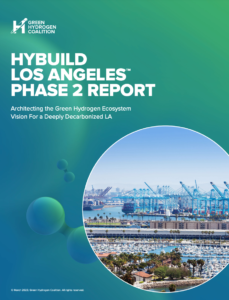
Author(s): Janice Lin, Lily Backer, Dhruv Bhatnagar, Collin Smith, Nicholas Connell, Erin Childs, Hope Fasching, Maggie Field, Shawn Carr, Jennifer Gorman, Nina Hebel, and Jordan Ahern
Publisher: Green Hydrogen Coalition
Publication Date: March 23, 2023
Green hydrogen (GH₂) is an essential resource to mitigate climate change by decarbonizing hard-to-electrify sectors, such as maritime shipping, aviation, heavy-duty trucking, firm dispatchable power, high-heat industrial processes, and agriculture. In light of the current war in Ukraine and the surging fossil fuel energy prices around the world, GH₂ can also be a resource to support energy cost stability and greater global energy security. Moreover, GH₂ can support a just and equitable clean energy transition by helping to reduce environmental burdens, while creating family-sustaining job opportunities across sectors.
The United States has reached a pivotal moment for the GH₂ market. …
View Full Resource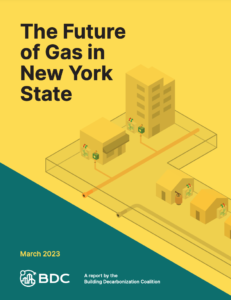
Author(s): Michael J. Walsh and Michael E. Bloomberg
Publisher: Building Decarbonization Coalition
Publication Date: March 15, 2023
This report aims to assist the Commission and other stakeholders at this critical, early moment in gas distribution system transition planning. It draws on existing research and adds new data and analysis on several key topics, such as costs of the gas distribution system, the fragility of gas utility business models to competition from new electric technologies, the hurdles to substituting fuels like renewable natural gas (RNG) or hydrogen for fossil methane gas, and the benefits and pitfalls of pathways studies. This report also offers a synthesis of these and other factors in a scenario-based discussion of potential approaches to …
View Full Resource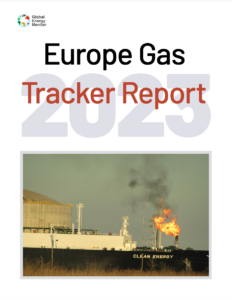
Author(s): Baird Langebrunner, Greig Aitken, Robert Rozansky, and Harvey Hassan
Publisher: Global Energy Monitor
Publication Date: March 15, 2023
In the ongoing fallout of the Russian invasion of Ukraine, the EU gas panic threatens a massive overcapacity buildout at the hands of a few member states that have harnessed and in some cases ignored EU policy recommendations. If most of it comes to fruition, this added import capacity now on the table and being rapidly developed in various countries will lead to expanded fossil gas infrastructure and carbon emissions that further distance the EU from its greenhouse gas mitigation goals.…
View Full Resource
Author(s): Thomas K. Walker III
Publisher: Clean Air Task Force
Publication Date: March 13, 2023
Clean Air Task Force conducted a first-of-its-kind analysis comparing the operational performance of hydrogen fuel cell vehicles (FCEV) and battery electric vehicles (BEV), identifying key advantages to FCEVs in efforts to decarbonize long–haul heavy-duty trucking.
The report takes a novel approach to analyzing questions of cost by comparing the operational performance of BEV and FCEV drive trains and infrastructure as alternatives to diesel trucking on a popular long-haul route in the U.S. It finds that FCEVs outperform BEVs in terms of the number of stops required (three vs. eight), total time spent refueling (1.4 hours vs. 43.8 hours), and available …
View Full Resource
Author(s): Sacha Alberici, David Gräf and Magali Aurand
Publisher: Guidehouse and European Biogas Association
Publication Date: February 13, 2023
The future energy mix will be dominated by renewable energy sources. Together with wind and solar, renewable gases such as biomethane and renewable hydrogen will play a pivotal role in delivering Europe’s long-term energy security and climate mitigation objectives.
Biomethane is the cheapest and most scalable form of renewable gas available today. It can directly substitute natural gas and is flexible as it can be readily stored and deployed across the whole energy system, using existing gas infrastructure and end-use technologies. Moreover, biomethane is a dispatchable energy carrier and as such can be deployed to balance intermittent renewable energy generation. …
View Full Resource
Disclaimer: OurEnergyPolicy.org makes no claim as to the accuracy or quality of Resources produced by third parties.