The OurEnergyLibrary aggregates and indexes publicly available fact sheets, journal articles, reports, studies, and other publications on U.S. energy topics. It is updated every week to include the most recent energy resources from academia, government, industry, non-profits, think tanks, and trade associations. Suggest a resource by emailing us at info@ourenergypolicy.org.
Resource Library
Search Results for "hydrogen"
141 to 150 of 267 item(s) were returned.
141 to 150 of 267 item(s) were returned.

Author(s): bp
Publisher: bp
Publication Date: January 30, 2023
Energy Outlook 2023 is focused on three main scenarios: Accelerated, Net Zero and New Momentum. These scenarios are not predictions of what is likely to happen or what bp would like to happen. Rather they explore the possible implications of different judgements and assumptions concerning the nature of the energy transition and the uncertainties around those judgements. The scenarios are based on existing technologies and do not consider the possible impact of entirely new or unknown technologies.
The many uncertainties surrounding the transition of the global energy system mean that the probability of any one of these scenarios materializing exactly …
View Full Resource
Author(s): Albert Cheung, Miko Tan, Mark Daly, Sarrah Raza, Antoine Vagneur-Jones, Leo Wang, Yali Jiang, Evelina Stoikou, and Youru Tan
Publisher: Bloomberg New Energy Finance (BNEF)
Publication Date: January 26, 2023
Energy Transition Investment Trends is Bloomberg NEF’s annual accounting of global investment in the low-carbon energy transition. It covers a wide scope of supply- and demand-side technologies, including renewables, energy storage, electrified vehicles and heating, hydrogen, nuclear, sustainable materials and carbon capture.
The report tracks annual spending on the deployment of these technologies, as well as investment in manufacturing facilities (new for this year). It also covers VC/PE and public markets investment in climate-tech companies.
Our data are compiled through bottom-up research on hundreds of thousands of individual deals and projects around the world, as well as aggregated estimates for …
View Full Resource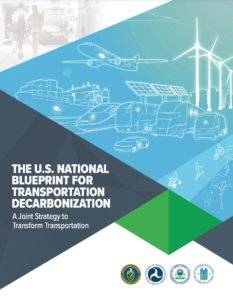
Author(s): US Department of Energy and US Department of Transportation
Publisher: US Department of Energy and US Department of Transportation
Publication Date: January 15, 2023
The transportation sector—which includes all modes of travel through land, air, and sea to move people and goods—accounts for a third of all domestic greenhouse gas emissions, negatively affecting the health and wellbeing of millions of Americans, particularly those in disadvantaged communities. Transportation costs are the second largest annual household expense in our country and for the poorest Americans, the financial burden of transportation is disproportionately and unsustainably high.
A well-planned transition to a decarbonized transportation system can address these and other inequities and provide equitable, affordable, and accessible options for moving people and goods. Further developing and deploying clean-energy …
View Full Resource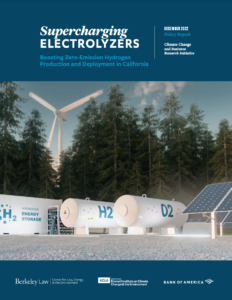
Author(s): Ethan Elkind and Ross Zelen
Publisher: Berkeley Center for Law, Energy & the Environment, UCLA Emmett Institute on Climate Change and the Environment
Publication Date: December 4, 2022
Hydrogen could play a critical role in helping California to decarbonize its electricity grid and achieve carbon neutrality. The gas can be generated from surplus renewable energy resources (like solar or wind) to create zero-emission (or “green”) hydrogen. The clean electricity powers a device called an electrolyzer, which uses the process of electrolysis to separate water into oxygen and hydrogen. The hydrogen can then be used to help decarbonize high-heat industrial activities, provide long-duration energy storage, and fuel transportation, especially heavy-duty trucks, ships, and possibly airplanes. Yet today zero-emission hydrogen is roughly triple the cost of traditional fossil-based hydrogen production. …
View Full Resource
Author(s): International Energy Agency
Publisher: International Energy Agency
Publication Date: December 1, 2022
Renewables 2022 is the IEA’s primary analysis on the sector, based on current policies and market developments. It forecasts the deployment of renewable energy technologies in electricity, transport and heat to 2027 while also exploring key challenges to the industry and identifying barriers to faster growth.
The current global energy crisis brings both new opportunities and new challenges for renewable energy. Renewables 2022 provides analysis on the new policies introduced in response to the energy crisis. This year’s report frames current policy and market dynamics while placing the recent rise in energy prices and energy security challenges in context.
In …
View Full Resource
Author(s): Jackson Ewing, Martin Ross, Amy Pickle, Robert Stout, and Brian Murray
Publisher: Nicholas Institute for Energy, Environment & Sustainability, Duke University
Publication Date: November 15, 2022
What will it take to achieve a net-zero carbon emissions footprint for the US economy by 2050? This report from Energy Pathways USA helps strengthen the evidence base on what will be required for a robust US energy transition and elucidates key barriers and opportunities for reaching net-zero goals.
The authors examine past and present emissions trends and highlight common threads across recent quantitative analyses of potential net-zero trajectories, identifying sectors and shifts that could significantly boost decarbonization. Transforming the electricity grid—with clean energy production, increased high-voltage transmission, and grid modernization for resilience and reliability—is critical to all of these …
View Full Resource
Author(s): TJ Conway, Joseph Fallurin, and Thomas Kirk
Publisher: Rocky Mountain Institute
Publication Date: October 20, 2022
If society collectively turned off the tap for gasoline and diesel today, the oil industry would continue to play a role in producing petrochemicals ranging from the fiberglass resins used in wind turbine blades to the plastic components of solar panels. Taking immediate action to cut emissions from oil refineries and petrochemical plants holds the potential for major climate wins in this decisive decade, with a 1 percent reduction equivalent to taking three million gasoline-powered cars off the road. This report outlines the full value chain approach required to decarbonize an industry operationally responsible for 3 gigatons of greenhouse gas …
View Full Resource
Author(s): Duncan Gibb, Megan Anderson, Louise Sunderland and Samuel Thomas
Publisher: Regulatory Assistance Project
Publication Date: October 18, 2022
Rapidly and consequently phasing out fossil gas demand has become a top priority in Europe. Existing European legislation is expected to achieve only moderate reductions by 2030. Proposed laws under negotiation are expected to go further, yet more ambitious targets and a unified policy approach could achieve potential reductions currently left on the table.
Our analysis finds that even with full implementation of the REPowerEU plan, by 2030 natural gas demand in Europe will remain at around 150 bcm, roughly equivalent to Russian gas imports in 2021. These reductions can be faster and deeper. A stronger energy efficiency target in …
View Full Resource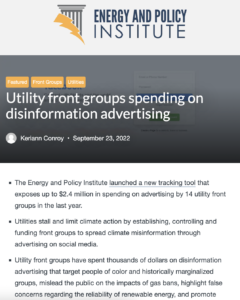
Author(s): Keriann Conroy
Publisher: Energy and Policy Institute
Publication Date: September 23, 2022
The Energy and Policy Institute launched a new tracking tool that exposes up to $2.4 million in spending on advertising by 14 utility front groups in the last year.
Utilities stall and limit climate action by establishing, controlling and funding front groups to spread climate misinformation through advertising on social media.
Utility front groups have spent thousands of dollars on disinformation advertising that target people of color and historically marginalized groups, mislead the public on the impacts of gas bans, highlight false concerns regarding the reliability of renewable energy, and promote “renewable natural gas” and hydrogen, despite multiple …
View Full Resource
Author(s): Ian Bowen, Dinesh Madan, Lavkesh Rajwani, and Shanthi Muthiah
Publisher: ICF
Publication Date: September 16, 2022
At over 700 pages, the Inflation Reduction Act (IRA) is a dense piece of legislation. At the same time, its impact on the energy sector can be summarized succinctly: clean energy economics just got a whole lot better.
We analyzed the cost impacts of the IRA by computing the levelized cost of energy (LCOE)—the average cost of electricity generation over the lifetime of a facility—for various technologies in 2030 with and without the IRA under a range of assumptions (see Figure 1). All of the technologies we analyzed see double-digit percentage declines in their LCOEs relative to their pre-IRA …
View Full Resource
Disclaimer: OurEnergyPolicy.org makes no claim as to the accuracy or quality of Resources produced by third parties.