The OurEnergyLibrary aggregates and indexes publicly available fact sheets, journal articles, reports, studies, and other publications on U.S. energy topics. It is updated every week to include the most recent energy resources from academia, government, industry, non-profits, think tanks, and trade associations. Suggest a resource by emailing us at info@ourenergypolicy.org.
Resource Library
Search Results for "infrastructure"
71 to 80 of 1078 item(s) were returned.
71 to 80 of 1078 item(s) were returned.
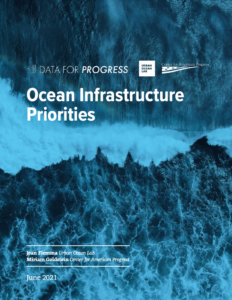
Author(s): Jean Flemma, Miriam Goldstein
Publisher: Data for Progress, Urban Ocean Lab, Center for American Progress
Publication Date: June 23, 2021
The ocean offers important solutions to mitigate the climate crisis, provide good-paying jobs, and protect coastal communities — including those that have been historically disadvantaged — from rising seas and decades of carbon emissions pollution. Offshore renewable energy development, protecting and restoring blue carbon ecosystems, and decarbonizing shipping and ports can all contribute to the U.S. goals for emissions reductions while providing other important benefits. Support for these programs should be part of any infrastructure package.…
View Full Resource
Author(s): Matt Alexander, Noel Crisostomo, Wendell Krell, Jeffrey Lu, Raja Ramesh
Publisher: California Energy Commission
Publication Date: May 28, 2021
This inaugural Assembly Bill (AB) 2127 Electric Vehicle Charging Infrastructure Assessment examines charging needs to support California’s plug-in electric vehicles (PEVs) in 2030. Under AB 2127, the California Energy Commission (CEC) is required to publish a biennial report on the charging needs of 5 million zero emission vehicles (ZEVs) by 2030. In September 2020, Governor Gavin Newsom issued Executive Order N-79-20, which directed the Commission to update this assessment to support expanded ZEV adoption targets.
In 2018, Executive Order B-48-18 set a goal of having 250,000 chargers (including 10,000 direct current fast chargers) by 2025. As of January 4, 2021, …
View Full Resource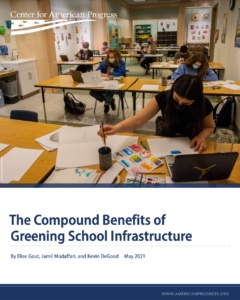
Author(s): Elise Gout, Jamil Modaffari, and Kevin DeGood
Publisher: Center for American Progress
Publication Date: May 17, 2021
Across the country, more and more students are returning to their classrooms after what has been, for some, nearly a year of online learning. The school closures brought on by COVID-19 have underscored how critical the physical environment is to student well-being and educational success. And yet, for large populations of students—particularly those in communities with fewer resources and in Black, Latino, and other communities of color—going back to school means going back to broken-down facilities with poor insulation and outdated ventilation systems.
This report will review the need for federal school infrastructure funding, the benefits of both immediate and …
View Full Resource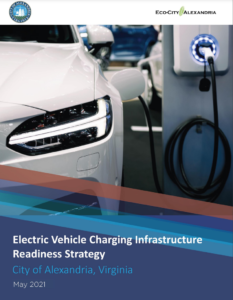
Author(s): Elise Emil, Geoff Morrison
Publisher: Cadmus, City of Alexandria Virginia
Publication Date: May 15, 2021
Cadmus worked with the City of Alexandria to develop its 2021 Electric Vehicle Charging Infrastructure Readiness Strategy (EVRS) – a plan that identifies charging needs of City residents, workforce members, and visitors between today and 2040. Cadmus conducted a geospatial analysis, implemented two public engagement surveys, and forecast vehicle population and electricity load impacts. The EVRS culminates in a set of 31 detailed, evidence-based recommendations for advancing electric vehicle charging infrastructure, placing the City of Alexandria at the forefront of municipal electric vehicle planning.
The Alexandria Electric Vehicle Charging Infrastructure Readiness Strategy (EVRS) provides a framework for advancing electric vehicle …
View Full Resource
Author(s): Julián Castro, John Delaney, Colette Honorable, Bobby Jindal, Rick Santorum, Bill Truex
Publisher: Bipartisan Policy Center (BPC)
Publication Date: May 10, 2021
These policy recommendations from the Smarter, Cleaner, Faster Infrastructure Task Force will be the first in a series building off of the principles released by the Task Force, which explained why we need to build clean infrastructure at a pace that is much quicker than we have historically built. The faster we can build, the better the outcomes for our climate, for jobs, and for economic growth. This set of recommendations focuses on two policy areas crucial to accelerating the deployment of clean infrastructure. Part 1 outlines general “good government” policy recommendations for improving agency processes for reviewing and approving …
View Full Resource
Author(s): Rennie Meyers, Alexandra Carter, Miriam Goldstein
Publisher: Center for American Progress
Publication Date: April 26, 2021
Now is the time to invest in the United States’ coastal communities and ocean. Historically, the ocean has been central to the U.S. conception of infrastructure; early cities were built in naturally sheltered bays or on the banks of tidal rivers to provide safe harbors for ships. Today, ocean-based climate solutions have the potential to provide up to one-fifth of the reductions in greenhouse gas (GHG) emissions needed globally to limit the world’s temperature rise to 1.5 degrees Celsius, which scientists say is necessary in order to lower the risks associated with climate change.
This report proposes agency-by-agency infrastructure and …
View Full Resource
Author(s): Doug Vine
Publisher: Center for Climate and Energy Solutions (C2ES)
Publication Date: April 21, 2021
The power sector must play a central role in the decarbonization of the U.S. economy. Other sectors such as buildings, industry, and transportation will be electrifying to reduce their emissions, which means the power sector over the next few decades not only has to be 100 percent non-emitting, but also much larger. It will need to accommodate massive deployments of variable renewable energy resources such as solar and wind, as well as burgeoning numbers of electric vehicles, distributed energy resources, and energy storage technologies. This will require a significant buildout of power system infrastructure, including additional generation, distribution, and transmission …
View Full Resource
Author(s): Sanya Carley
Publisher: Niskanen Center
Publication Date: April 13, 2021
Supporting and expanding the nation’s infrastructure is of the utmost importance. Investments in roads and bridges, water systems, broadband, and transmission and distribution lines help improve well-being and personal lifestyles. Such investments also generate new jobs and economic growth, and can lead to long-term reductions in climate emissions if designed well. These objectives are the impetus for current infrastructure planning in Congress and the several trillion-dollar American Jobs Plan released by the Biden administration.
The American Recovery and Reinvestment Act of 2009 (the “Recovery Act”), adopted a month into President Obama’s first term and during the worst economic recession in …
View Full Resource
Author(s): Devyn Powell, Becca Ellison, Sam Ricketts, Bracken Hendricks
Publisher: Evergreen Collaborative, Data for Progress
Publication Date: March 19, 2021
President Biden and Vice President Harris campaigned and won on a bold Build Back Better plan that called for a $2 trillion investment in “modern, sustainable infrastructure and an equitable clean energy economy.” Clean Jumpstart 2021 is a manual for how Congress can realize President Biden’s vision.
The report details $2.3 trillion in investments—in 39 different action steps— that will deliver on climate, jobs, and justice. Federal lawmakers should seize this opportunity.
In order to build a just and sustainable clean energy economy, the investments in Clean Jumpstart 2021 must be made equitably, in line with President Biden’s commitment to …
View Full Resource
Author(s): Matthew Goetz, Ryan Levandowski, James Bradbury, Grace Van Horn
Publisher: M.J. Bradley & Associates, Georgetown Climate Center
Publication Date: March 18, 2021
This report provides a summary of the EV charging investments included in recent congressional bills on climate, clean energy, and transportation, and outlines ways federal investments could be designed to be more equitable and transformative. Georgetown Climate Center and M.J. Bradley & Associates provide lessons and examples from previous federal programs, and describe examples of state and local transportation, clean energy, and climate policies that federal policymakers can learn from and build upon.…
View Full Resource
Disclaimer: OurEnergyPolicy.org makes no claim as to the accuracy or quality of Resources produced by third parties.