The OurEnergyLibrary aggregates and indexes publicly available fact sheets, journal articles, reports, studies, and other publications on U.S. energy topics. It is updated every week to include the most recent energy resources from academia, government, industry, non-profits, think tanks, and trade associations. Suggest a resource by emailing us at info@ourenergypolicy.org.
Resource Library
Search Results for "infrastructure"
81 to 90 of 1078 item(s) were returned.
81 to 90 of 1078 item(s) were returned.
Author(s): United Nations Environment Programme (UNEP)
Publisher: United Nations Environment Programme (UNEP)
Publication Date: February 24, 2021
The International Good Practice Principles for Sustainable Infrastructure set out ten guiding principles that policymakers can follow to help integrate sustainability into infrastructure planning and delivery. They are focused on integrated approaches and systems-level interventions that governments can make to create an enabling environment for sustainable infrastructure.
The principles are complemented by a second publication, Integrated Approaches in Action: A Companion to the International Good Practice Principles for Sustainable Infrastructure.
Together, the publications aim to inform the forthcoming wave of global infrastructure investment. Collectively, they specify and demonstrate how environmental, social and economic sustainability must be integrated right across …
View Full Resource
Author(s): Steven R. Miles
Publisher: Rice University's Baker Institute for Public Policy
Publication Date: February 10, 2021
The world is demanding cleaner fuels. The U.S. is uniquely positioned to take the lead in providing them. Author Steven R. Miles explains.
As the incoming U.S. administration leads the United States back into the Paris Climate Accord, there can be little doubt that countries and their citizens around the world are demanding cleaner fuels, both for electric power generation and transportation. But the share of electric energy being produced by wind and solar is a small fraction of power consumption, and an even smaller percentage of energy used for transportation. Both the U.S. Energy Information Administration and the International …
View Full Resource
Author(s): Lesley Jantarasami, Lindsey Walter, Conrad Schneider
Publisher: Third Way, Bipartisan Policy Center, Clean Air Task Force
Publication Date: February 4, 2021
To develop these results, Decarb America commissioned Evolved Energy Research and Industrial Economics, Inc. to undertake a rigorous, multi-part modeling analysis (more information is available at About the Initiative). The analysis explores five main research topics: 1) Pathways to Net-Zero Emissions; 2) Energy Infrastructure Needs for a Net-Zero Economy; 3) Power Sector Deep Dive; 4) Clean Energy Innovation Breakthroughs; and 5) Impacts on Jobs and the Economy.
This report presents key takeaways on topics (1) and (2) from our modeling results to date, with a focus on infrastructure needs for a net-zero economy. These modeling results address four critical questions:…
View Full Resource
Author(s): Rob Gramlich, Jay Caspary
Publisher: Americans for a Clean Energy Grid
Publication Date: January 27, 2021
Over the last 25 years, four major FERC orders, No. 888, 2000, 890 and 1000, each made incremental progress building regional transmission infrastructure, moving the industry away from its past balkanized structure with relatively weak connections between utility systems towards a more reliable and efficient system allowing for more regional exchange of power. As we look to the future, much more regional and inter-regional power exchange will be needed for national energy security, reliability, resilience, cost-effectiveness, and economic competitiveness. A decade after FERC Order No. 1000’s issuance, the nation faces new challenges and it is clear that neither the current …
View Full Resource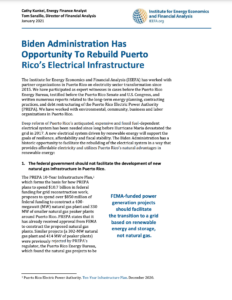
Author(s): Cathy Kunkel, Tom Sanzillo
Publisher: Institute for Energy Economics and Financial Analysis (IEEFA)
Publication Date: January 19, 2021
The Institute for Energy Economics and Financial Analysis (IEEFA) has worked with partner organizations in Puerto Rico on electricity sector transformation since 2015. We have participated as expert witnesses in cases before the Puerto Rico Energy Bureau, testified before the Puerto Rico Senate and U.S. Congress, and written numerous reports related to the long-term energy planning, contracting practices, and debt restructuring of the Puerto Rico Electric Power Authority (PREPA). We have worked with environmental, community, business and labor organizations in Puerto Rico.
Deep reform of Puerto Rico’s antiquated, expensive and fossil fuel-dependent electrical system has been needed since long before …
View Full Resource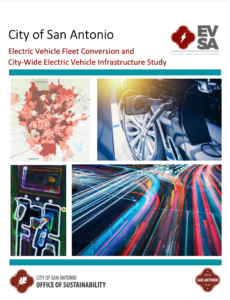
Author(s): Angel Gonzalez, Geoff Morrison, Miyoung Squire, Brian Fariello, Kelly Blynn, Elise Emil, Cian Fields, Damon Fordham, Toral Patel, Carson Peacock, Philip Quebe, James Schroll
Publisher: Cadmus, City of San Antonio, GKW Engineering, MSE Group
Publication Date: January 12, 2021
Cadmus supported the City of San Antonio in a major new study on electric vehicle fleet conversion and city-wide electric vehicle infrastructure. The study The Electric Vehicle Fleet Conversion and City-Wide Electric Vehicle Infrastructure Study assesses the barriers and opportunities to greater electric vehicle (EV) adoption in San Antonio. The objectives of this study are to promote a common understanding of EVs in San Antonio, provide near-term strategies for accelerating EV adoption, describe a plan for the electrification of the municipal fleet, and ensure that the benefits and costs of EVs are shared equally across residents of San Antonio.
Project …
View Full Resource
Author(s): Eric Larson, Chris Greig, Jesse Jenkins, Erin Mayfield, Andrew Pascale, Chuan Zhang, Joshua Drossman, Robert Williams, Steve Pacala, Robert Socolow, Ejeong Baik, Rich Birdsey, Rick Duke, Ryan Jones, Ben Haley, Emily Leslie, Keith Paustian, Amy Swan
Publisher: Princeton University, Andlinger Center For Energy and Environment, High Meadows Environmental Institute, Carbon Mitigation Initiative
Publication Date: December 15, 2020
The new “Net-Zero America” research outlines five distinct technological pathways for the United States to decarbonize its entire economy. The research is the first study to quantify and map with this degree of specificity, the infrastructure that needs to be built and the investment required to run the country without emitting more greenhouse gases into the atmosphere than are removed from it each year. It’s also the first to pinpoint how jobs and health will be affected in each state at a highly granular level, sometimes down to the county.
The study’s five scenarios describe at a highly detailed, state-by-state …
View Full Resource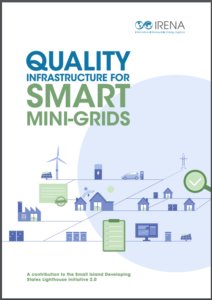
Author(s): International Renewable Energy Agency (IRENA)
Publisher: International Renewable Energy Agency (IRENA)
Publication Date: December 9, 2020
This report from the International Renewable Energy Agency (IRENA) highlights the crucial role of smart renewable mini-grids infrastructure. Grid-connected mini-grids can increase power system resilience and reliability, while facilitating the integration of solar and wind power. Renewable mini-grids far off the main grid, meanwhile, can provide reliable electricity access for remote areas and islands.…
View Full Resource
Author(s): Smart Electric Power Alliance (SEPA)
Publisher: Smart Electric Power Alliance (SEPA)
Publication Date: June 30, 2020
With electric vehicle (EV) charging projected to increase U.S. electricity consumption 11% by 2040, according to Bloomberg New Energy Finance, there is no ignoring the importance of EV infrastructure to electric utilities. As of April 2020, almost $3 billion in transportation electrification investments have been approved or are pending approval by state utility commissions nationally.
Having the right strategic plan, building a strong team, and providing a good customer experience, will lead to successful EV charging programs. Download this report for recommendations for developing a comprehensive utility EV infrastructure program. Whether EV novice or expert, the best practices are useful …
View Full Resource
Author(s): Elizabeth Abramson, Dane McFarlane, Jeff Brown
Publisher: Great Plains Institute, Regional Carbon Capture Deployment Initiative
Publication Date: June 8, 2020
As seen in the maps included in this white paper, many of the industrial and power facilities in the United States are located in regions without significant deep saline or hydrocarbon geologic formations. Long distance transport infrastructure can unlock the economic potential for these facilities to sell captured CO2 and earn tax credits for storage under Section 45Q. CO2 transport infrastructure achieves beneficial economies of scale with higher volumes of CO2 delivered. Large trunk lines designed to carry CO2 from many facilities toward many storage sites can achieve a lower transport cost over long distances than lines with capacity designed …
View Full Resource
Disclaimer: OurEnergyPolicy.org makes no claim as to the accuracy or quality of Resources produced by third parties.