The OurEnergyLibrary aggregates and indexes publicly available fact sheets, journal articles, reports, studies, and other publications on U.S. energy topics. It is updated every week to include the most recent energy resources from academia, government, industry, non-profits, think tanks, and trade associations. Suggest a resource by emailing us at info@ourenergypolicy.org.
Resource Library
Search Results for "hydrogen"
121 to 130 of 267 item(s) were returned.
121 to 130 of 267 item(s) were returned.

Author(s): EFI Foundation
Publisher: EFI Foundation
Publication Date: October 20, 2023
This report focuses on the infrastructure needs of the U.S. Environmental Protection Agency’s (EPA’s) proposed rules for fossil-fueled power plant emissions reductions. This modeling-driven study analyzes the potential outcomes of EPA’s proposal on the energy system by region, including the costs of the potential electricity, hydrogen, and carbon dioxide (CO2) infrastructure requirements.
The report is the first in a new report series called the U.S. Hydrogen Infrastructure Action Plan, which analyzes the opportunities of hydrogen infrastructure for enabling market formation. This series is a follow-up to the February 2023 Energy Futures Initiative (EFI) report, The U.S. Hydrogen Demand Action Plan, …
View Full Resource
Author(s): International Energy Agency
Publisher: International Energy Agency
Publication Date: September 30, 2023
The Breakthrough Agenda Report 2023 is an annual collaboration between the International Energy Agency (IEA), the International Renewable Energy Agency (IRENA) and the United Nations Climate Change High-Level Champions, focused on supporting stronger international collaboration to drive faster reductions in global greenhouse gas emissions. This year’s report shows that current efforts on clean energy and sustainable solutions, while improving, are not yet delivering the levels of investment and deployment required to meet international climate goals. In response, it calls on governments to strengthen collaboration in key areas – such as standards and regulation, financial and technical assistance and market creation …
View Full Resource
Author(s): DNV
Publisher: DNV
Publication Date: September 23, 2023
The passage of the Inflation Reduction Act and the refocused Canadian Federal Budget are a major boost for clean energy in North America. They are accelerating the buildout of renewable energy and the growth of whole new demand sectors for that clean energy, from EVs through to electrolyzers producing green hydrogen.
By more than doubling electrification in the region and transitioning to an almost fully decarbonized electricity mix, vast amounts of energy waste will be eliminated in North America. Combined with the plunging costs of renewables and battery storage, the positive impacts of reduced energy intensity on economic activity are …
View Full Resource
Author(s): Renewable Thermal Collaborative
Publisher: Renewable Thermal Collaborative
Publication Date: September 12, 2023
The Inflation Reduction Act (IRA) and the Infrastructure Investment and Jobs Act (IIJA) made some significant investments in industrial decarbonization, particularly for clean hydrogen and carbon capture, storage, and utilization. However, analyses show that the IRA does not adequately incentivize the full range of renewable thermal solutions. To accelerate the decarbonization of thermal energy for industry and buildings, the RTC has developed a set of recommendations for our advocacy efforts that build on the IRA and IIJA while addressing some critical policy gaps.…
View Full Resource
Author(s): Elizabeth Press, Thijs Van de Graaf, Martina Lyons, Isaac Elizondo Garcia, Ellipse Rath, and Benjamin Gibson
Publisher: International Renewable Energy Agency (IRENA)
Publication Date: July 29, 2023
IRENA’s analytical work on geopolitics began in 2018 with the formation of the Global Commission on the Geopolitics of Energy Transformation, which culminated in a sweeping overview of the geopolitical implications of a global shift to renewables in the 2019 report, A New World: The Geopolitics of the Energy Transformation. In 2020, IRENA created the Collaborative Framework on the Geopolitics of Energy Transformation as a forum for dialogue on the geopolitical implications of this shift. In response to priorities voiced by IRENA’s members during those discussions, IRENA undertook a detailed study on the future of hydrogen in the 2022 report, …
View Full Resource
Author(s): Diane Cameron, Emma Wong, Lucas Mir, Brent Wilhelm, Takuya Funahashi, Shahnaz Hoque, Antonio Vaya Soler, and Yereen Kim
Publisher: Nuclear Energy Agency
Publication Date: July 20, 2023
All low-carbon solutions will be required to achieve the world’s net zero targets. Nuclear energy has a role to play in meeting this need. A wave of innovation in small modular reactors (SMRs) is advancing quickly with the potential to help decarbonise hard-to-abate sectors. Progress is real and is positioned to accelerate pathways to net zero. SMRs could replace coal on-grid, fossil fuel cogeneration of heat and power for heavy industry, diesel at off-grid mines, as well as producing hydrogen and synthetic fuels.
Looking beyond technical feasibility, The NEA Small Modular Reactor Dashboard defines new criteria for assessing real progress …
View Full Resource
Author(s): Kingsmill Bond, Sam Butler-Sloss, Amory Lovins, Laurens Speelman, and Nigel Topping
Publisher: RMI
Publication Date: July 1, 2023
In partnership with the Bezos Earth Fund, Global Optimism, and Systems Change Lab, RMI is pleased to present the first in a series of reports analyzing the exponential growth of renewable energy technologies globally. The series demonstrates why and how major areas of the energy system, from electricity and electric vehicles to hydrogen and heat pumps, are achieving further market penetration and getting us closer to global climate goals, faster than many realize.
In X-Change: Electricity, RMI’s Kingsmill Bond, Sam Butler-Sloss, Amory Lovins, Laurens Speelman, and guest author Nigel Topping, former High Level Climate Champion, make the case that solar …
View Full Resource
Author(s): Pavitra Srinivasan, Andrew Hoffmeister, and Kristin Campbell
Publisher: American Council for an Energy-Efficient Economy
Publication Date: June 29, 2023
Utilities can play three key roles in industrial decarbonization. (1) They can offer programs to industrial customers related to energy efficiency, electrification, hydrogen, renewable energy, waste reduction/pollution prevention, and the circular economy. (2) They can decarbonize their operations, energy sources, and the grid. (3) They can help state and other policymakers to understand barriers to decarbonization and the savings opportunities it offers while offering technical support to industrial end-users pursuing decarbonization.
This handbook offers examples of existing programs at utilities, along with their goals, targets, and policy options in relation to financial incentives and regulatory requirements. It also outlines resources …
View Full Resource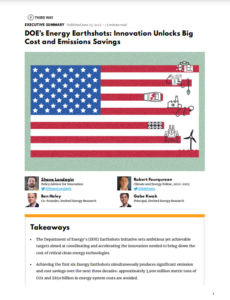
Author(s): Shane Londagin, Robert Fourqurean, Ben Haley, and Gabe Kwok
Publisher: Third Way
Publication Date: June 23, 2023
In 2021, the US Department of Energy (DOE) launched its Energy Earthshots Initiative, a novel and innovative approach to catalyze decarbonization across some of the hardest to abate sectors of our economy. These ‘Earthshots’ are meant to tackle the toughest remaining scientific and technical barriers to deploying the technologies we need to rapidly reduce emissions. Modeled after the wildly successful 2011 SunShot Initiative, the current Earthshots set aggressive cost targets for seven critical areas: hydrogen, carbon removal, long duration energy storage, enhanced geothermal, floating offshore wind, low-carbon industrial heat, and clean fuels and products. These goals are ambitious, well-thought-out, and …
View Full Resource
Author(s): International Energy Agency
Publisher: International Energy Agency
Publication Date: May 15, 2023
Today, oil and gas operations account for around 15% of total energy-related emissions globally, the equivalent of 5.1 billion tonnes of greenhouse gas emissions. In the International Energy Agency’s Net Zero Emissions by 2050 Scenario, the emissions intensity of these activities falls by 50% by the end of the decade. Combined with the reductions in oil and gas consumption in this scenario, this results in a 60% reduction in emissions from oil and gas operations to 2030.
Fortunately, oil and gas producers have a clear opportunity to address the problem of emissions from their activities through a series of ready-to-implement …
View Full Resource
Disclaimer: OurEnergyPolicy.org makes no claim as to the accuracy or quality of Resources produced by third parties.