The OurEnergyLibrary aggregates and indexes publicly available fact sheets, journal articles, reports, studies, and other publications on U.S. energy topics. It is updated every week to include the most recent energy resources from academia, government, industry, non-profits, think tanks, and trade associations. Suggest a resource by emailing us at info@ourenergypolicy.org.
Resource Library
Search Results for "infrastructure"
11 to 20 of 1079 item(s) were returned.
11 to 20 of 1079 item(s) were returned.
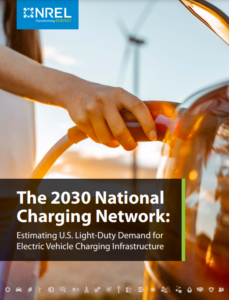
Author(s): Eric Wood, Brennan Borlaug, Matt Moniot, Dong-Yeon (D-Y) Lee, Yanbo Ge, Fan Yang, and Zhaocai Liu,
Publisher: National Renewable Energy Laboratory (NREL)
Publication Date: July 22, 2023
Both energy and the environment are inputs into production, influencing the economy and the overall welfare of the population. While the economy itself has been a central focus of economic history from its inception, energy and the environment have received more limited attention. On the energy side, the relative lack of attention reflects economic historians’ focus on labor, capital, and technology. Two areas that have received attention are the effects of energy on the spatial location of economic activity and the importance of coal for the Industrial Revolution. On the environmental side, the relative lack of attention likely reflects the …
View Full Resource
Author(s): Ameresco
Publisher: Ameresco
Publication Date: July 15, 2023
Explore ways in which municipalities, federal agencies, healthcare facilities, and private sector companies can leverage their energy infrastructure to improve energy resilience and minimize the adverse impacts of major events.
To date, much of the interest in energy resilience has been limited to a few key sectors; however, as addressed throughout this white paper, a wide range of organizations, public and private, are beginning to understand that they can use their energy infrastructure to become more resilient in budget-sensitive ways.
A smart approach to resilience integrates innovative technological solutions, contracting structures, and participation in broader energy markets. Organizations can become …
View Full Resource
Author(s): Eric Wood, Brennan Borlaug, Matt Moniot, Dong-Yeon (D-Y) Lee, Yanbo Ge, Fan Yang, and Zhaocai Liu
Publisher: National Renewable Energy Laboratory
Publication Date: June 27, 2023
Estimating infrastructure needs at the national level is a challenging analytic problem that requires quantifying the needs of future PEV drivers in various use cases, under region-specific environmental conditions, and with consideration for the built environment. This analysis leverages the National Renewable Energy Laboratory’s suite of electric vehicle infrastructure analysis tools (EVI-X) and the best available real-world data describing PEV adoption patterns, vehicle technology, residential access, travel profiles, and charging behavior to estimate future charging needs. Multiple PEV charging use cases are considered, including typical needs to accommodate daily driving for those with and without residential access, corridor-based charging supporting …
View Full Resource
Author(s): Akshaya Kannan, Oliver Pritchard, Chris Freakes, Savina Carluccio and Nikita Chauhan
Publisher: Arup
Publication Date: June 7, 2023
Drawing on case studies and stakeholder engagement with infrastructure decision makers and practitioners around the globe, this white paper explores the current key challenges and barriers to implementing governance of infrastructure for resilience, and the opportunities available for positive change.
Developing infrastructure that is resilient to climate change and natural hazards requires resilience thinking and resilience building decisions and actions by practitioners across the whole infrastructure lifecycle. At each stage there are opportunities to enhance the resilience value of an infrastructure project and to ensure that the resilience value that was built in the earlier stages.…
View Full ResourceAuthor(s): Federation of American Scientists
Publisher: Federation of American Scientists
Publication Date: June 6, 2023
The U.S. Department of Transportation’s (USDOT) Office of the Assistant Secretary for Research and Technology has engaged the FAS to support expert outreach to scope research and technology topics suitable for their advanced research portfolio, given recent authorizations and appropriations for new programs like the Advanced Research Projects
Agency-Infrastructure (ARPA-I). This scoping has been done through workshops aimed at
surfacing advanced research program concepts. This report is a result of many of the insights
gathered by the FAS from these workshops and outreach within the transportation infrastructure innovation ecosystem.…
Author(s): Department of Transportation
Publisher: Department of Transportation
Publication Date: May 24, 2023
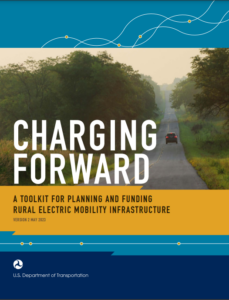
While there is significant information available on how to plan and develop EV charging stations, these resources are spread across Federal agencies and do not specifically address the unique needs of rural communities. Similarly, funding programs for EV infrastructure are distributed across numerous Federal and State agencies, making it difficult for rural stakeholders to determine which programs they are eligible for.
This toolkit is meant to be a one-stop resource to help rural communities scope, plan, and identify ways to fund EV charging infrastructure. A rural organization or individual—such as a property owner, business, town, Tribe, or planning or transit …
View Full Resource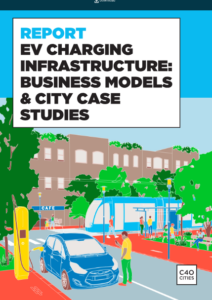
Author(s): Ana Terra, Claire Markgraf, Mariola Panzuela, Zoe Allen, Gustavo Jiménez, Jorge Suárez, Miriram Monterrubio, Josemaría Jiménez, and Fabrício Pietrobelli
Publisher: C40
Publication Date: April 30, 2023
This report examines the combination of funding and financial resources required to invest in electric vehicle charging infrastructure (EVCI) and the stakeholders involved and how they interact to provide public charging solutions in cities. The study investigates the successes and failures of EVCI deployment in seven exemplary cities, offering an overview of their funding, financing mechanisms, and business models.…
View Full Resource
Author(s): Joshua Linn, Virginia McConnell, Sophie Pesek, and Daniel Raimi
Publisher: Resources for the Future
Publication Date: April 13, 2023
In this working paper, the authors use an economic model of the US household vehicle market to estimate the effects of three alternative revenue policies for funding transportation infrastructure construction and maintenance.
Federal and state tax policies designed to fund the construction and maintenance of transportation infrastructure rely almost exclusively on excise taxes levied on petroleum products. But as the United States and the world seek to reduce greenhouse gas emissions, boosting fuel economy and electric vehicle (EV) sales will reduce the demand for petroleum and associated public revenues. In this analysis, we use an economic model of the US …
View Full Resource
Author(s): Brian Seal, Arindam Maitra, Wenzong Wang, Celso Rocha, and Xavier Francia
Publisher: U.S. Department of Energy Office of Scientific and Technical Information
Publication Date: April 1, 2023
This document is a technical report based on a large-scale DOE-funded project conducted between 2019 and 2022. The project, called SOLAr Critical infrastructure Energization (SOLACE), is aimed at leveraging distributed energy resources (DERs) to provide local power to communities, feeders, or other regions. The project included a particular focus on high-value critical loads such as municipal water supply, telecommunication hubs, and disaster shelters. The key developments of the project were: (1) A comprehensive pre-event power system analysis methodology that identifies and characterizes the viable local power options. (2) A DMS-based example control system for activating and operating the local power …
View Full Resource
Author(s): Daniel C. Steinberg, Maxwell Brown, Ryan Wiser, Paul Donohoo-Vallett, Pieter Gagnon, Anne Hamilton, Matthew Mowers, Caitlin Murphy, and Ashreeta Prasana
Publisher: National Renewable Energy Laboratory
Publication Date: March 20, 2023
In this report, we detail the methods and results of a study estimating the potential impacts of key provisions of IRA and BIL on the contiguous U.S. power sector from present day through 2030. The analysis employs an advanced power system planning model, the Regional Energy Deployment System (ReEDS), to evaluate how major provisions from both laws impact investment in and operation of utility-scale generation, storage, and transmission, and, in turn, how those changes impact power system costs, emissions, and climate and health damages. While not exhaustive in capturing every provision, the analysis estimates the possible scale of power sector …
View Full Resource
Disclaimer: OurEnergyPolicy.org makes no claim as to the accuracy or quality of Resources produced by third parties.